


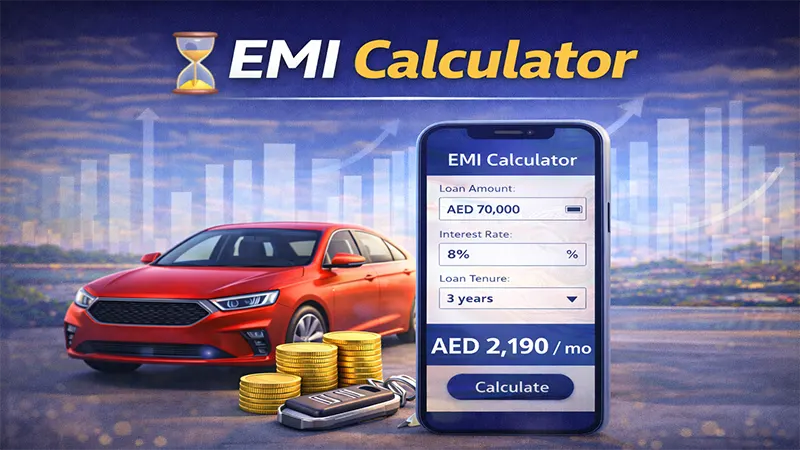
EMI Calculator UAE – Calculate Your Loan Installments 2026
Calculate your Equated Monthly Installment (EMI) for any loan in the UAE instantly. Whether you’re planning a car loan, personal loan, or home mortgage, our free EMI calculator helps you understand your monthly payment obligations in AED before you commit. Make informed borrowing decisions with accurate calculations tailored for UAE residents.
Table of Contents
ToggleWhat is an EMI Calculator?
An EMI (Equated Monthly Installment) calculator is a financial tool that helps you determine the exact monthly payment amount you’ll need to make when repaying a loan. For UAE residents taking loans from banks like Emirates NBD, ADCB, Mashreq, or FAB, understanding your EMI is crucial for financial planning.
Our EMI calculator provides instant results based on three key factors: loan amount, interest rate, and loan tenure. Here’s what makes it essential:
- Instant calculations: Get your monthly EMI amount in seconds without complex formulas
- Complete breakdown: See total interest payable and total payment amount
- UAE-specific: Designed for AED currency and local banking practices
- Multiple loan types: Works for personal loans, car loans, home loans, and mortgages
- Free and unlimited: Use it as many times as needed to compare different loan scenarios
Whether you’re buying a property in Dubai Marina, financing a car in Abu Dhabi, or considering a personal loan in Sharjah, this calculator helps you plan your finances accurately. It’s trusted by thousands of UAE residents for making smart borrowing decisions.
Calculate Your EMI Now
🧮 Advanced EMI Calculator
Calculate your monthly loan installments with detailed breakdown
Payment Breakdown
How Does the EMI Calculator Work?
The EMI calculation uses a standardized mathematical formula recognized by all banks and financial institutions in the UAE. Understanding this formula helps you see exactly how your monthly payment is determined.
The EMI Formula
EMI = [P × R × (1+R)^N] / [(1+R)^N-1]
Where:
- P = Principal loan amount (the amount you borrow in AED)
- R = Monthly interest rate (Annual rate ÷ 12 ÷ 100)
- N = Loan tenure in months (Years × 12)
Step-by-Step Calculation Process
Step 1: Enter Your Loan Details
Input the principal amount you want to borrow (e.g., AED 100,000), the annual interest rate offered by your bank (e.g., 8.5%), and the loan tenure in years (e.g., 5 years).
Step 2: Automatic Conversion
The calculator converts the annual interest rate to a monthly rate by dividing by 12 months and 100. It also converts years to months by multiplying by 12.
Step 3: Formula Application
The calculator applies the standard EMI formula to compute your exact monthly payment amount. This calculation accounts for both principal repayment and interest charges.
Step 4: Results Display
You receive three critical numbers: your monthly EMI amount, total interest payable over the loan period, and total amount payable (principal + interest).
Important Considerations
The calculator assumes a fixed interest rate throughout the loan tenure. If you opt for a variable rate loan, your EMI may change when interest rates fluctuate. Additionally, some banks charge processing fees (typically 1-2% of loan amount) which aren’t included in the EMI calculation but add to your overall cost.
For home loans specifically, remember that banks in the UAE typically finance 75-80% of property value for expats and up to 85% for UAE nationals, meaning you’ll need a down payment for the remaining amount.
EMI Calculation Examples for UAE
Let’s look at three realistic scenarios that UAE residents commonly face when taking loans. These examples show exact calculations to help you understand how EMI works in practice.
Example 1: Car Loan in Dubai
Scenario: Ahmed, a marketing manager in Dubai Media City, wants to buy a Toyota Camry priced at AED 110,000. He plans to make a 20% down payment and finance the rest.
Loan Details:
- Car price: AED 110,000
- Down payment (20%): AED 22,000
- Loan amount needed: AED 88,000
- Interest rate: 6.5% per annum
- Loan tenure: 4 years (48 months)
Calculation:
Using the EMI formula with P = 88,000, R = 0.00542 (6.5/12/100), and N = 48:
Monthly EMI = AED 2,093
Total Breakdown:
- Total amount payable: AED 100,464
- Total interest paid: AED 12,464
- Effective monthly cost: AED 2,093
Ahmed can comfortably afford this EMI as it represents about 20% of his AED 11,000 monthly salary, staying within the recommended debt-to-income ratio banks prefer.
Example 2: Personal Loan for Home Renovation
Scenario: Sarah, an architect living in Sharjah, needs AED 75,000 to renovate her apartment. She has a good credit history and receives a competitive interest rate from her bank.
Loan Details:
- Loan amount: AED 75,000
- Interest rate: 9.9% per annum
- Loan tenure: 3 years (36 months)
Calculation:
With P = 75,000, R = 0.00825 (9.9/12/100), and N = 36:
Monthly EMI = AED 2,411
Total Breakdown:
- Total amount payable: AED 86,796
- Total interest paid: AED 11,796
- Cost of borrowing: 15.7%
By choosing a shorter tenure, Sarah pays less total interest compared to a 5-year loan, which would cost her approximately AED 17,500 in interest. This demonstrates how loan duration significantly impacts your total cost. Check our loan calculator to compare different tenures.
Example 3: Home Loan for First-Time Buyer
Scenario: Mohammed and Fatima, a young couple working in Abu Dhabi, are buying their first apartment in Al Reem Island for AED 1,200,000. As UAE nationals, they qualify for an 85% loan from ADIB.
Loan Details:
- Property price: AED 1,200,000
- Down payment (15%): AED 180,000
- Loan amount: AED 1,020,000
- Interest rate: 3.99% per annum (special rate for nationals)
- Loan tenure: 25 years (300 months)
Calculation:
With P = 1,020,000, R = 0.003325 (3.99/12/100), and N = 300:
Monthly EMI = AED 5,384
Total Breakdown:
- Total amount payable: AED 1,615,200
- Total interest paid: AED 595,200
- Combined monthly income needed: Approximately AED 17,950 (using 30% DTI ratio)
The couple’s combined salary of AED 22,000 makes this mortgage comfortable, leaving them sufficient funds for other expenses. They could also consider making extra payments to reduce the total interest burden. For investment planning, explore our investment calculator to balance loan repayment with savings goals.
Important Information About EMI in UAE
Debt Burden Ratio (DBR) Regulations
The Central Bank of UAE mandates that your total monthly debt obligations cannot exceed 50% of your gross monthly income. This includes all EMIs, credit card payments, and other financial commitments. If your salary is AED 15,000, your maximum monthly debt repayment should not exceed AED 7,500. Banks strictly enforce this rule when approving loans.
Interest Rate Types in UAE
UAE banks offer two types of interest rates. Fixed rates remain constant throughout the loan tenure, giving you payment certainty. Variable rates are linked to EIBOR (Emirates Interbank Offered Rate) and fluctuate with market conditions. Most personal and car loans have fixed rates, while home loans often start with fixed rates for 1-3 years before switching to variable rates.
Common Mistakes to Avoid
Ignoring processing fees: Banks charge 1-2% processing fees on the loan amount. For a AED 100,000 loan, this means AED 1,000-2,000 upfront that many borrowers forget to budget for.
Maximum tenure selection: Choosing the longest tenure reduces monthly EMI but dramatically increases total interest. A AED 200,000 loan at 8% for 7 years costs AED 77,000 in interest, while the same loan for 3 years costs only AED 26,000.
Not comparing offers: Interest rates can vary by 2-3% between banks for the same borrower profile. A 1% difference on a AED 500,000 loan over 10 years means paying AED 27,000 more in interest.
Overlooking prepayment options: Some banks charge prepayment penalties (typically 1-2% of outstanding amount), while others allow free prepayment. This matters if you plan to close the loan early.
Expert Tips for Smart Borrowing
Negotiate your rate: If you have a good credit history or salary above AED 15,000, you can often negotiate 0.5-1% lower interest rate. This saves thousands over the loan period.
Consider insurance: EMI protection insurance covers your payments if you lose your job or become disabled. While it costs 0.5-1% of loan amount annually, it provides crucial security in uncertain times.
Use balance transfer: If interest rates drop or you find better offers, many banks offer balance transfer facilities with lower rates. This can reduce your EMI or loan tenure significantly. Compare options using our ROI calculator.
For salary-based calculations and employment benefits, visit our gratuity calculator to understand your end-of-service benefits alongside loan planning.
Frequently Asked Questions About EMI Calculator
How accurate is this EMI calculator for UAE banks?
Our calculator uses the standard EMI formula employed by all banks and financial institutions in the UAE, including Emirates NBD, ADCB, Mashreq, FAB, and DIB. The results are 100% accurate for the inputs you provide. However, your actual EMI might slightly vary if banks add insurance premiums or other charges to the monthly payment. Always confirm the final EMI with your bank before signing loan documents.
Can I use this calculator for all types of loans?
Yes, this calculator works for personal loans, car loans, home loans, mortgages, and any other fixed-rate EMI-based loan products in the UAE. The mathematical formula remains the same regardless of loan type. The only difference is the interest rates, which vary by loan type—personal loans typically range from 8-15%, car loans from 5-9%, and home loans from 3.5-6% in the current UAE market.
What is a good EMI to salary ratio in UAE?
Financial experts recommend keeping your total EMI obligations below 40% of your net monthly salary for comfortable repayment. Banks in UAE typically approve loans where total debt servicing doesn’t exceed 50% of gross income (DBR limit). For example, if you earn AED 12,000 monthly, your total EMIs should ideally stay below AED 4,800, though banks may approve up to AED 6,000 in debt obligations.
How can I reduce my monthly EMI amount?
You have four primary options to reduce EMI: increase your loan tenure (spreads payments over more months), negotiate a lower interest rate (even 0.5% reduction helps significantly), make a larger down payment to reduce principal amount, or wait to apply when interest rates drop. Remember that extending tenure reduces monthly EMI but increases total interest paid. Use our calculator to compare different scenarios before deciding.
Does the calculator include insurance and processing fees?
No, the calculator shows only the principal and interest components of your EMI. Banks typically charge separate processing fees (1-2% upfront) and may require loan protection insurance that adds AED 50-200 to your monthly payment. For a complete picture, ask your bank for the “all-inclusive EMI” which includes these additional charges. The basic EMI calculated here remains accurate for comparing loan offers.
Can my EMI change during the loan period?
For fixed-rate loans, your EMI remains constant throughout the tenure. For variable or floating rate loans, your EMI will change whenever the bank adjusts interest rates based on EIBOR movements. Many UAE home loans have hybrid structures with fixed rates for the first 1-3 years, then switch to variable rates. If rates increase by 1%, your EMI could rise by 8-10%. Always check your loan agreement for rate revision terms.
Is it better to prepay my loan or invest the money?
This depends on comparing your loan interest rate with potential investment returns. If your loan charges 9% interest and you can earn 7% from fixed deposits, prepayment saves more. However, if you can achieve 12% returns through mutual funds or other investments, investing might be better. Also consider tax benefits—UAE has no income tax, so there’s no deduction benefit for interest paid. Most financial advisors suggest prepaying high-interest personal loans (above 10%) while focusing on investments for low-interest home loans (below 5%).
What documents do I need to apply for a loan in UAE?
Standard requirements include a valid Emirates ID, passport with residence visa, salary certificate from employer, last 6 months’ bank statements, and salary transfer letter. For home loans, you’ll additionally need property documents and valuation reports. Some banks require a minimum salary of AED 5,000 for personal loans and AED 10,000 for home loans. Salaried employees typically get better rates than self-employed individuals. Having these documents ready speeds up the approval process significantly.
Start Calculating Your EMI Today
Use our free EMI calculator above to plan your loan repayment effectively. Input different loan amounts, interest rates, and tenures to find the perfect balance between affordable monthly payments and minimal total interest cost. The calculator is completely free, requires no registration, and provides instant results.
For official information about loan regulations and consumer protection in the UAE, visit the Central Bank of UAE website. They provide comprehensive guidelines on responsible borrowing and your rights as a consumer.
Remember, taking a loan is a significant financial decision that impacts your budget for years. Use this calculator to explore all options, compare offers from multiple banks, and choose a loan structure that fits your financial goals and comfort level. Smart borrowing today leads to financial freedom tomorrow.
Related Financial Calculators
Explore our other calculators to make comprehensive financial decisions:
- Loan Calculator – Compare different loan amounts and calculate total costs for various borrowing scenarios
- Mortgage Calculator – Specialized calculator for home loans with down payment and property tax considerations
- Compound Interest Calculator – See how your savings grow over time and plan for loan prepayment strategies
- SIP Calculator – Plan systematic investments to build wealth while managing loan repayments
- Savings Calculator – Calculate how much to save monthly for future down payments or loan prepayments
- ROI Calculator – Evaluate if prepaying your loan or investing offers better returns
Visit Shaz Vlog Blog for more financial tips, calculator guides, and UAE-specific money management advice. Access all our calculators at All Calculators.