


Table of Contents
ToggleFactor Calculator – Find All Factors of Any Number Instantly
Need to break down a number into its factors quickly and accurately? Our free factor calculator identifies every factor, prime factorization, and factor pair for any positive integer. Whether you’re a student tackling math homework, a teacher preparing lessons, or a professional working with number theory — this tool delivers precise results in seconds.
What Is a Factor Calculator?
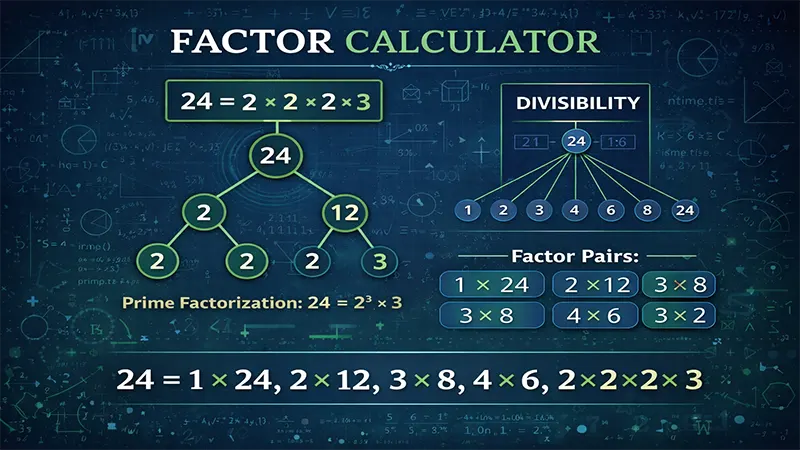
A factor calculator is a math tool that takes any positive integer and returns a complete list of its factors — the numbers that divide evenly into it with zero remainder. Beyond a simple factor list, our calculator also provides prime factorization, factor pairs, and the total factor count.
Here’s what makes this tool valuable:
- Complete factor list — Every positive divisor of your number, sorted in ascending order
- Prime factorization — The number expressed as a product of prime numbers
- Factor pairs — All pairs of numbers that multiply to give your original number
- Instant results — No manual long division; get answers immediately
The calculator uses a mathematically verified algorithm. It checks divisibility from 1 up to the square root of the input number, ensuring both speed and complete accuracy. Students preparing for exams, engineers running quick checks, or anyone brushing up on number theory can rely on the results.
If you’re studying in the UAE and preparing for university entrance exams, you might also find our uni grade calculator helpful alongside this tool.
Factor Calculator
Find all factors, prime factorization & factor pairs instantly
| # | Factor Pair | Product |
|---|
How the Factor Calculator Works
The Core Method
Finding factors relies on a straightforward mathematical principle: if a number n is divisible by another number d (meaning n ÷ d has no remainder), then both d and n ÷ d are factors of n.
Our calculator follows this step-by-step process:
Step 1: Input Validation
Enter any positive integer. The calculator accepts numbers from 1 up to very large values. Decimals, negatives, and zero are flagged with a helpful error message.
Step 2: Factor Discovery
The algorithm tests every integer from 1 to the square root of your number. For each divisor found, it automatically records the paired factor. For example, when checking 36: since 4 × 9 = 36, finding that 4 is a divisor also tells us 9 is a factor.
Step 3: Prime Factorization
The calculator then breaks your number down into its prime factors — the building blocks that are only divisible by 1 and themselves. It repeatedly divides by the smallest prime (starting with 2) until the quotient equals 1.
Formula notation: For any composite number n, the prime factorization is expressed as:
n = p₁a₁ × p₂a₂ × p₃a₃ × …
Where p₁, p₂, p₃ are distinct primes and a₁, a₂, a₃ are their respective exponents.
Step 4: Results Display
Results are organized into three clear sections: the full factor list, factor pairs, and prime factorization. The total number of factors is also displayed.
Important note: Every positive integer has at least two factors — 1 and itself. A number with exactly two factors is a prime number. The calculator clearly identifies primes when detected.
Factor Calculator Examples
Example 1: Finding Factors of 60
Scenario: Amina is a Grade 10 student in Dubai preparing for her math exam. She needs to find all factors of 60 and express it as a product of primes.
Input: 60
Step-by-step:
- Check integers from 1 to √60 ≈ 7.74, so test 1 through 7
- 60 ÷ 1 = 60 → factors: 1, 60
- 60 ÷ 2 = 30 → factors: 2, 30
- 60 ÷ 3 = 20 → factors: 3, 20
- 60 ÷ 4 = 15 → factors: 4, 15
- 60 ÷ 5 = 12 → factors: 5, 12
- 60 ÷ 6 = 10 → factors: 6, 10
- 60 ÷ 7 = 8.57… → not a factor
All factors of 60: 1, 2, 3, 4, 5, 6, 10, 12, 15, 20, 30, 60 (12 factors total)
Prime factorization: 60 = 2² × 3 × 5
Example 2: Finding Factors of 97 (A Prime Number)
Scenario: Omar is a university student in Abu Dhabi checking whether 97 is prime for a discrete mathematics assignment.
Input: 97
Step-by-step:
- Check integers from 1 to √97 ≈ 9.85, so test 1 through 9
- 97 ÷ 2 = 48.5 → not a factor
- 97 ÷ 3 = 32.33… → not a factor
- 97 ÷ 4 through 97 ÷ 9 → none divide evenly
All factors of 97: 1, 97 (2 factors — confirming 97 is prime)
Prime factorization: 97 = 97 (it is itself a prime)
Example 3: Finding Factors of 360 (Large Composite Number)
Scenario: Sara is an architect in Sharjah dividing a circular layout into equal sections and needs to know all the ways 360 can be evenly divided.
Input: 360
Step-by-step:
- Check integers from 1 to √360 ≈ 18.97, so test 1 through 18
- Divisors found: 1, 2, 3, 4, 5, 6, 8, 9, 10, 12, 15, 18 — each paired with 360, 180, 120, 90, 72, 60, 45, 40, 36, 30, 24, 20
All factors of 360: 1, 2, 3, 4, 5, 6, 8, 9, 10, 12, 15, 18, 20, 24, 30, 36, 40, 45, 60, 72, 90, 120, 180, 360 (24 factors)
Prime factorization: 360 = 2³ × 3² × 5
This tells Sara she has 24 different ways to divide 360 degrees into equal parts — very useful for architectural design.
Important Information About Factors
Key Mathematical Rules
Understanding a few core rules helps you use factor results effectively:
- 1 is a factor of every number. Every positive integer is divisible by 1.
- Every number is a factor of itself. So n always appears in its own factor list.
- Perfect squares have an odd number of factors. For example, 36 has 9 factors because the square root (6) pairs with itself rather than a different number.
- The number of factors can be calculated from prime factorization: if n = p₁a × p₂b, total factors = (a+1)(b+1).
Common Mistakes to Avoid
Students and professionals often trip up on these points:
- Forgetting 1 and the number itself — These are always factors. Don’t skip them.
- Confusing factors with multiples — Factors divide into a number; multiples are produced by multiplying a number.
- Mixing up prime factors and all factors — Prime factorization only includes prime numbers. The complete factor list includes composites too.
Expert Tips
To quickly estimate how many factors a number has, first find its prime factorization, then add 1 to each exponent and multiply those results together. For financial calculations like finding common denominators in compound interest or EMI calculations, understanding factors can simplify the math significantly.
Frequently Asked Questions
What exactly is a factor of a number?
A factor (or divisor) is any integer that divides into another integer with zero remainder. For instance, the factors of 12 are 1, 2, 3, 4, 6, and 12 because each divides into 12 evenly.
How accurate is this factor calculator?
The calculator uses a deterministic algorithm that checks every possible divisor up to the square root of your input. Results are mathematically exact — there’s no estimation or rounding involved.
Can this calculator handle very large numbers?
Yes. The calculator handles numbers well into the millions efficiently. For extremely large numbers (billions and beyond), computation may take slightly longer, but results remain accurate.
What is the difference between factors and prime factors?
Factors include every number that divides evenly into the target number (including composites like 4, 6, 8, etc.). Prime factors are the subset of factors that are prime numbers. Prime factorization expresses the number as a product of only primes.
How do I find the Greatest Common Factor (GCF) of two numbers?
Find the factors of both numbers using the calculator, then identify the largest number that appears in both factor lists. For example, factors of 24 include 1, 2, 3, 4, 6, 8, 12, 24 and factors of 36 include 1, 2, 3, 4, 6, 9, 12, 18, 36 — the GCF is 12.
Can I use this for finding LCM (Least Common Multiple)?
Yes. Use the prime factorizations from this calculator. Take the highest power of each prime that appears in either number’s factorization and multiply them together. That product is the LCM.
Is this tool useful for students in UAE schools?
Absolutely. Factor finding is part of the math curriculum from Grade 5 onwards across UAE schools following both the MOE and international curricula (IB, IGCSE, American). Students can use this to check homework answers and understand factoring methods.
Does the calculator show factor pairs?
Yes. Factor pairs are displayed alongside the complete factor list. Each pair consists of two numbers that multiply together to produce the original number, such as (4, 15) for 60.
Start Finding Factors Now
Enter any positive integer into the calculator above and get a complete breakdown — all factors, factor pairs, and prime factorization — within seconds. Bookmark this page for quick access whenever you need it.
For additional math resources, the Khan Academy factors and multiples course provides excellent video lessons on the topic.
Related Calculators
- Compound Interest Calculator — Calculate how your investments grow over time
- Uni Grade Calculator — Estimate your university GPA quickly
- ROI Calculator — Measure returns on your investments
- CAGR Calculator — Find compound annual growth rates
- Tax Calculator — Estimate your tax obligations accurately