


Need to figure out how much concrete, gravel, mulch, or soil your project requires? Our free cubic yard calculator gives you accurate volume estimates in seconds. Whether you’re a homeowner planning a garden bed or a contractor quoting a commercial job, simply enter your measurements and get the exact cubic yardage you need to order — no manual math required.
Table of Contents
ToggleWhat Is the Cubic Yard Calculator?
A cubic yard calculator converts length, width, and depth measurements into cubic yards — the standard unit used by suppliers worldwide to price and deliver bulk materials like concrete, gravel, sand, topsoil, and mulch. Instead of wrestling with unit conversions and formulas on paper, this tool handles everything automatically.
Here’s why thousands of users rely on it every month:
- Accurate estimates — reduces costly over-ordering or frustrating shortfalls on the job site.
- Flexible inputs — enter measurements in feet, inches, centimeters, or meters and the calculator converts for you.
- Multiple shape modes — calculate volume for rectangular areas, circular areas (like tree rings or round patios), and triangular sections.
- Built-in cost estimator — input a price per cubic yard to see projected material costs instantly.
The formulas are based on standard geometric volume equations verified against engineering references. Whether you’re ordering ready-mix concrete in Dubai Marina or topsoil for a backyard project in Texas, the math is the same — and this calculator does it flawlessly.
📐 Cubic Yard Calculator
Calculate volume for concrete, gravel, mulch, soil & more
Calculation Breakdown
How the Cubic Yard Calculator Works
The Core Formula
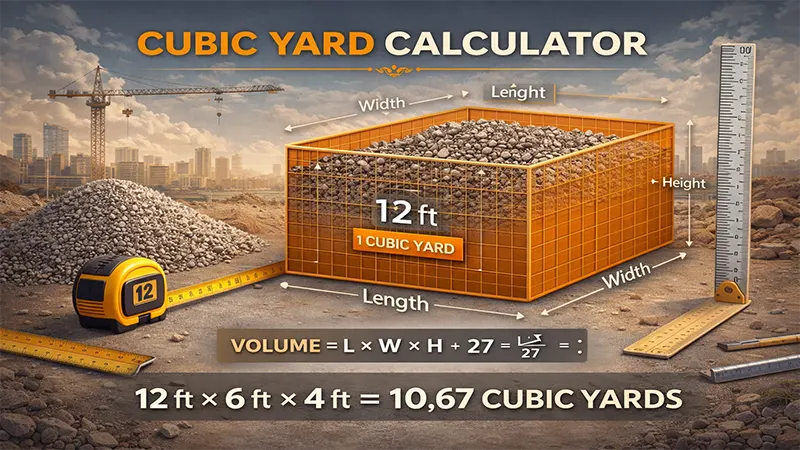
A cubic yard equals a cube measuring 3 feet × 3 feet × 3 feet — that’s 27 cubic feet. The calculator uses this fundamental relationship to convert any set of dimensions into cubic yards:
Cubic Yards = (Length × Width × Depth) ÷ 27
All three measurements must be in feet before dividing by 27. If you enter values in inches, the tool divides each by 12 first. If you enter values in meters, it multiplies each by 3.281 to convert to feet.
Step-by-Step Breakdown
Step 1: Select your shape — rectangle, circle, or triangle.
Step 2: Enter your dimensions. For a rectangle, that’s length, width, and depth. For a circle, it’s diameter and depth. For a triangle, it’s base, height, and depth.
Step 3: Choose your measurement unit (feet, inches, centimeters, or meters).
Step 4: Click “Calculate.” The tool converts your inputs to feet, computes volume in cubic feet, then divides by 27 to display the result in cubic yards.
Shape-Specific Formulas
For rectangular areas: Volume = Length × Width × Depth
For circular areas: Volume = π × (Diameter ÷ 2)² × Depth
For triangular areas: Volume = 0.5 × Base × Height × Depth
Important note: Always add a 5–10% buffer to your calculated volume when ordering materials. Compaction, spillage, and uneven ground can increase the amount you actually need. Most experienced contractors order 10% extra to stay safe.
Practical Cubic Yard Examples
Example 1: Concrete Driveway in a Villa Compound
Ahmed is pouring a new concrete driveway at his villa. The driveway measures 30 feet long × 12 feet wide × 0.5 feet deep (6 inches thick).
Calculation:
Volume in cubic feet = 30 × 12 × 0.5 = 180 cubic feet
Cubic yards = 180 ÷ 27 = 6.67 cubic yards
With a 10% buffer: 6.67 × 1.10 = 7.33 cubic yards
Ahmed should order approximately 7.5 cubic yards of ready-mix concrete. At a typical rate of AED 350–450 per cubic yard in the UAE, his material cost would be roughly AED 2,625–3,375.
Example 2: Mulch for a Landscaped Garden Bed
Sarah is refreshing the mulch in her rectangular garden bed, which measures 20 feet long × 8 feet wide. She wants a 3-inch layer (0.25 feet).
Calculation:
Volume in cubic feet = 20 × 8 × 0.25 = 40 cubic feet
Cubic yards = 40 ÷ 27 = 1.48 cubic yards
Sarah should order 1.5 cubic yards of mulch. Since mulch compresses after watering, ordering a touch extra is smart. Bulk mulch typically costs $25–$50 per cubic yard in the US, so her total would be around $37–$75.
Example 3: Circular Patio Base with Gravel
Raj is building a circular patio with a diameter of 14 feet and needs a 4-inch gravel base (0.333 feet).
Calculation:
Radius = 14 ÷ 2 = 7 feet
Area = π × 7² = 3.1416 × 49 = 153.94 sq ft
Volume in cubic feet = 153.94 × 0.333 = 51.26 cubic feet
Cubic yards = 51.26 ÷ 27 = 1.90 cubic yards
Raj should order 2 cubic yards of gravel. This is a good example of a non-rectangular shape where the circle formula matters — using a simple length × width estimate would have resulted in significantly more waste.
Important Things to Know
Common Mistakes to Avoid
Mixing up units is the most frequent error. If your depth is in inches but you enter it as feet, your result will be off by a factor of 12. Always double-check which unit you’ve selected before calculating.
Ignoring depth variations is another pitfall. If you’re filling an area where the ground isn’t level, measure the depth at multiple points and use the average. A driveway that’s 4 inches deep on one end and 8 inches on the other averages 6 inches — using just one measurement will lead to shortages or excess.
Expert Tips
When ordering concrete, round up to the nearest half yard. Suppliers typically deliver in half-yard increments, and returning unused dry materials like gravel or mulch is far easier than scheduling a second delivery of wet concrete.
If you’re working on a larger project — say a commercial foundation on Yas Island or a warehouse floor in Jebel Ali — break the area into simpler shapes, calculate each one separately, then add the results. You can also use our ROI calculator to evaluate whether a project’s material costs justify the expected returns.
For UAE-based projects, always confirm material pricing with at least two local suppliers. Prices for ready-mix concrete, aggregate, and landscaping materials can vary significantly between Emirates and even between suppliers within Dubai.
Frequently Asked Questions
How many cubic feet are in one cubic yard?
One cubic yard equals 27 cubic feet (3 ft × 3 ft × 3 ft). This is the conversion factor the calculator uses to translate your measurements into the unit most suppliers quote.
Can I use this calculator for concrete orders?
Yes. Enter the dimensions of your pour area — length, width, and slab thickness — and the calculator will return the volume in cubic yards. Add 5–10% extra when placing your order to account for spillage and slight variations in slab thickness.
What if my measurements are in meters?
The calculator supports meters, feet, inches, and centimeters. Select “Meters” from the unit dropdown and enter your values normally. The tool handles all conversions internally before displaying results in cubic yards.
How accurate is this cubic yard calculator?
The calculator is mathematically precise based on the inputs you provide. Accuracy depends on how carefully you measure your project area. For best results, measure twice and use the average of multiple depth readings on uneven terrain.
How much does a cubic yard of concrete weigh?
A cubic yard of standard ready-mix concrete weighs approximately 4,050 pounds (1,837 kg). This is useful for structural calculations and for ensuring your delivery vehicle can handle the load. Other materials weigh differently — topsoil is about 2,200 lbs/yd³ and gravel around 2,700 lbs/yd³.
Should I add extra to my calculated amount?
Always. Industry practice is to add 5–10% for small projects and 10–15% for irregular shapes or uneven ground. Running short mid-pour is far more expensive than ordering slightly more than you need.
Can I calculate cubic yards for a triangular area?
Yes. Switch the calculator to “Triangle” mode, enter the base length, height, and depth, and the tool applies the formula (0.5 × Base × Height × Depth) ÷ 27 to give you the correct cubic yardage.
How do I convert cubic yards to cubic meters?
Multiply your cubic yard value by 0.7646. For example, 5 cubic yards × 0.7646 = 3.82 cubic meters. This conversion is useful if your supplier quotes in metric units, which is common in the UAE and much of Europe.
Start Calculating Now
Scroll up to the calculator, enter your project dimensions, and get your cubic yardage in seconds. Whether you’re pricing materials for a small home project or a large commercial build, accurate volume calculations prevent waste and save money. For budgeting the financial side of your project, check out our loan calculator or savings calculator to plan your spending effectively.
If you’re working with a contractor, share your calculated results to ensure you’re both aligned on material quantities before ordering.
Related Calculators
- VAT Calculator — Estimate VAT on your material purchases.
- ROI Calculator — Evaluate the return on your construction investment.
- Loan Calculator — Plan financing for larger projects.
- EMI Calculator — Calculate monthly installments on project loans.
- Savings Calculator — See how saving before your project reduces borrowing.
- Investment Calculator — Project long-term returns on property investments.