


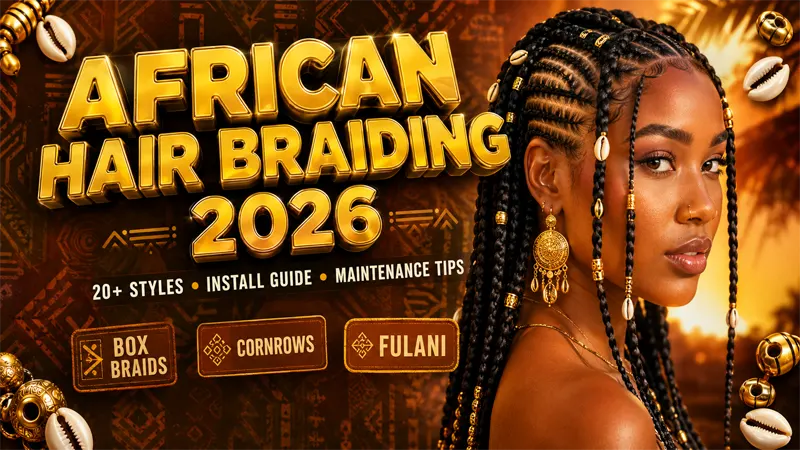

Quick answer: African hair braiding is a centuries-old protective styling tradition that includes box braids, cornrows, Fulani braids, Ghana braids, knotless braids, goddess braids, passion twists, and faux locs. Most styles take 4–10 hours to install, last 4–8 weeks with proper care, and cost $50–$400+ depending on style and salon. Box braids and cornrows are the most beginner-friendly. Knotless braids cause less scalp tension than traditional braids. Proper prep, moisture, and gentle takedown prevent breakage and protect your edges.
What Is African Hair Braiding?
African hair braiding refers to the dozens of traditional and modern braiding techniques that originated across the African continent — from the cornrows depicted in Saharan rock paintings over 5,000 years ago, to the intricate Himba clay-coated braids of Namibia, to the elaborate Yoruba ceremonial designs of Nigeria. These styles weren't just aesthetic; throughout history, braid patterns signaled family lineage, marital status, age, social rank, and tribal affiliation.
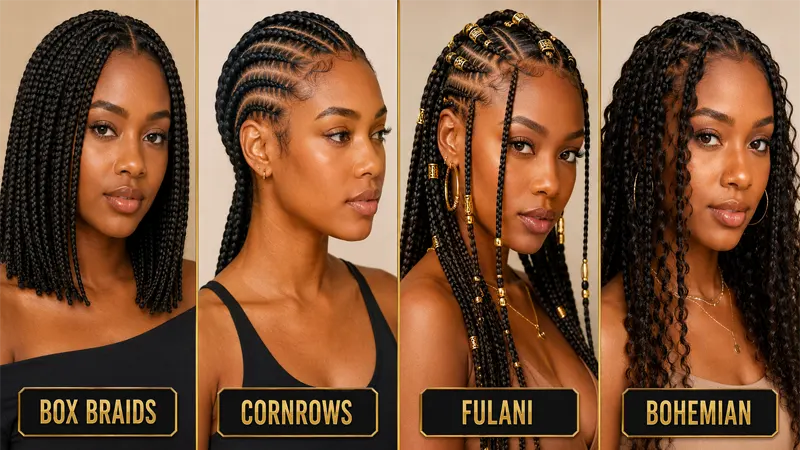
Today, African hair braiding has evolved into one of the most versatile protective styling traditions worldwide. It does three important things at once: it preserves natural hair from daily manipulation damage, allows length retention by minimizing breakage, and offers limitless creative expression. The styles range from sleek and minimal (back-to-front cornrows) to extravagant and dramatic (waist-length box braids with beads).
In 2026, demand for skilled braiders is at an all-time high. The natural hair movement has driven millions away from chemical relaxers and toward protective styles. Knotless braids, Fulani braids, and bohemian-style box braids dominate Instagram and TikTok. Whether you're getting your first install or your hundredth, this guide covers every style, prep step, and care routine you need to know.
Cultural Significance & Brief History
Understanding the roots of African hair braiding makes the practice more meaningful — and helps avoid common cultural misconceptions. A few essential historical notes:
- Cornrows date back to at least 3,500 BC. Some of the earliest artistic depictions of cornrows appear in Saharan rock paintings, making them one of the oldest documented hairstyles in human history.
- Yoruba braiding in Nigeria has been used for centuries to honor ceremonial and spiritual occasions, with patterns representing family heritage.
- Fulani braids originate from the Fulani (Fula) people across West Africa. Traditional Fulani braids are paired with cowrie shells, beads, and gold cuffs that carry their own cultural significance.
- Himba people of Namibia use intricate clay-coated braids as both cultural identity markers and practical protection in their harsh desert climate.
- During the Transatlantic Slave Trade, braiding survived as an act of resistance. Enslaved people braided escape route maps and seeds for crops into their hair — preserving cultural knowledge and aiding survival.
- The 1960s–70s Black Power movement brought cornrows, afros, and other natural hairstyles back into prominence as symbols of pride and resistance.
The 20+ Most Popular African Braiding Styles
There are dozens of styles within the African braiding tradition. These are the most commonly requested in 2026:
Cornrow-Based Styles
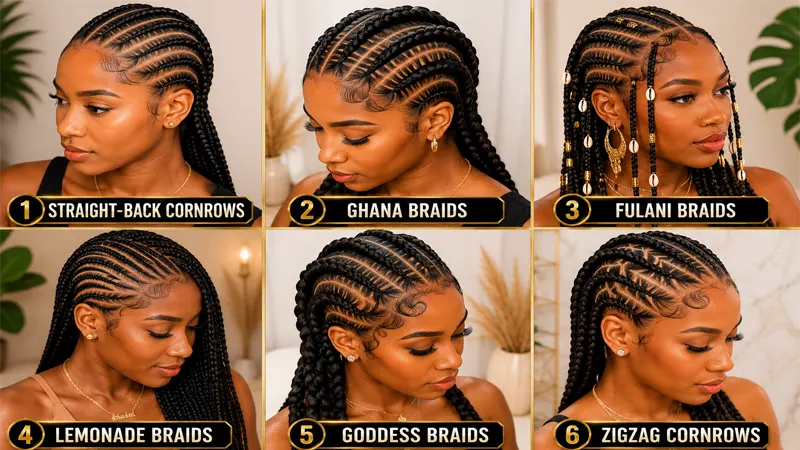
1. Classic Cornrows
Three-strand braids plaited flat against the scalp in straight or curved patterns. The foundation of nearly every other African braid style.
2. Straight-Back Cornrows
Simple straight cornrows running from forehead to nape. Common school style, sports-friendly, low maintenance.
3. Ghana Braids (Banana Braids)
Thick cornrows that gradually increase in size from forehead to nape. Often styled with creative geometric patterns.
4. Fulani Braids
Hybrid style — cornrows in the middle, free-hanging braids on the sides. Traditionally accessorized with beads, cuffs, or cowrie shells.
5. Lemonade Braids
Variation of Fulani braids where all cornrows fall to one side, popularized by Beyoncé's "Lemonade." Side-swept and dramatic.
6. Goddess Braids
Chunky, statement cornrows often combined with thinner braids in elaborate patterns. Stunning for special occasions.
7. Halo Braid
Single chunky braid that circles the head like a crown or halo. Elegant, traditional, suits formal events.
8. Zigzag / Geometric Cornrows
Cornrows formed in zigzag, swirl, or geometric patterns rather than straight lines. Maximum artistic expression.
Box Braid & Individual Braid Styles
9. Classic Box Braids
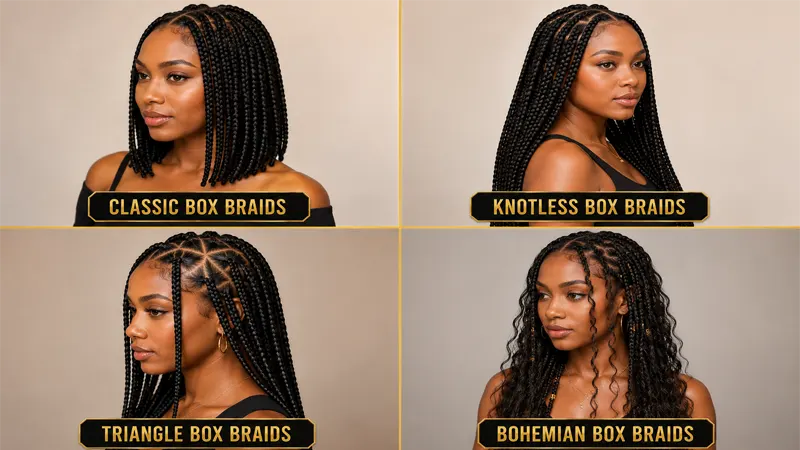
Individual braids in square sections, usually extended with synthetic hair. The most popular African braid style worldwide.
10. Knotless Box Braids
Box braids without the small knot at the root. Reduces scalp tension significantly, gentler on edges. Worth the extra cost.
11. Triangle Box Braids
Box braids with triangular partings instead of square. Creates sharp, graphic visual interest from the scalp.
12. Bohemian Box Braids
Box braids with loose curly tendrils added throughout. Soft, romantic, currently trending hard in 2026.
13. Micro Braids
Very thin individual braids. Most time-consuming style but lasts longest and offers the most styling versatility.
14. Jumbo Box Braids
Extra-large box braids. Faster install, less tension on the scalp, statement-making look.
Twist & Loc Styles
15. Senegalese Twists
Two-strand twists instead of three-strand braids. Faster to install than box braids, looks similar.
16. Passion Twists
Two-strand twists with curly/wavy synthetic hair for a more textured, bohemian finish.
17. Marley Twists
Thicker, fuller two-strand twists using Marley hair (with afro-textured finish).
18. Faux Locs
Temporary dreadlock-style installation using extensions. Gives the loc look without the long-term commitment.
19. Goddess Locs
Faux locs with curly ends and loose tendrils mixed throughout. Soft, romantic version of standard faux locs.
20. Spiraled / Curly End Braids
Standard box braids with undone, curly, or coily ends instead of sealed tips. Modern texture-mixing trend.
21. Crochet Braids
Pre-braided hair looped through cornrows underneath. Fastest method to achieve a braided look. Easier to change.
Best Braids by Occasion
Different styles suit different settings. Here's how to pick the right braid for your context:
| Occasion | Best Styles | Avoid |
|---|---|---|
| Conservative office | Straight-back cornrows, classic knotless box braids in medium length, halo braid | Bright colors, extreme lengths, heavily accessorized Fulani braids |
| Wedding / formal | Goddess braids, halo braid, Fulani braids with gold accessories, updo styles | Casual messy styles, very long crochet braids |
| Athletic / gym | Straight-back cornrows, single thick French braid, tight box braids | Loose hanging styles, fragile micro braids |
| Vacation / pool | Box braids, faux locs, passion twists (all water-friendly when properly sealed) | Newly-installed knotless braids (give them a week first) |
| Everyday casual | Knotless box braids, Senegalese twists, bohemian braids | Heavy ceremonial styles unless that's your vibe |
| Maximum protection | Knotless box braids, micro braids, faux locs | Very tight cornrows (can cause traction damage) |
| Bold statement | Lemonade braids, geometric Ghana braids, jumbo box braids with color | Anything subtle if you want to stand out |
Pre-Install Prep Checklist
Proper preparation makes the difference between braids that last 8 weeks and braids that look frizzy by week 3. Do these things 24–48 hours before your appointment:
✅ Your Prep Checklist (Do This Before Your Appointment)
- Wash your hair thoroughly with a clarifying shampoo to remove all product buildup and oil. Braids hold better on clean hair.
- Deep condition for 30+ minutes. Use a moisturizing deep conditioner — your hair won't be conditioned again for weeks.
- Detangle completely with a wide-tooth comb, section by section, working from ends to roots. Never rush this — tangles cause breakage during install.
- Stretch your hair using the banding method (small hair ties along each section) or low-heat blow-drying. Stretched hair braids cleaner and faster.
- Apply leave-in conditioner to the ends, where hair dries fastest under braids.
- Trim split ends 1–2 weeks before braiding so your braids look fresh, not frayed at the tips.
- Eat a real meal before your appointment — installs take hours and low blood sugar makes it miserable.
- Bring a phone charger, snacks, water, and headphones. You'll be sitting for 4–10 hours.
- Wear a button-down or zip-up shirt so you don't have to pull anything over your head when you leave.
- Bring your own braiding hair if your braider doesn't supply it. Xpression and FreeTress are the most-requested brands. Estimate 6–8 packs for box braids.
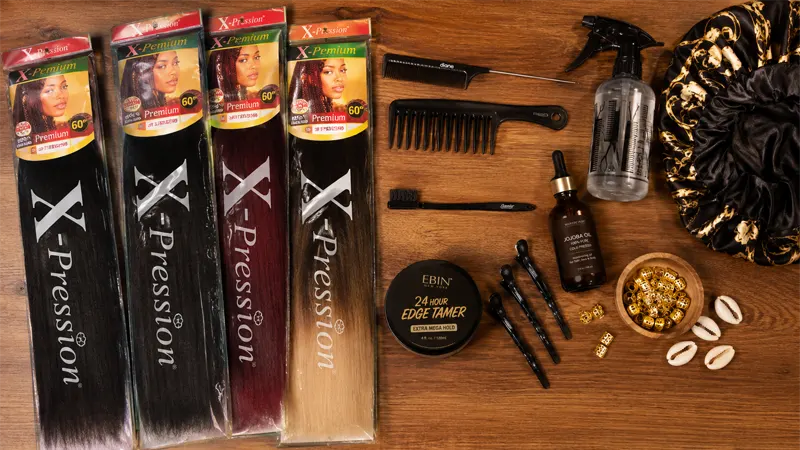
The Install Process (What to Expect)
- Consultation (10–15 min). Your braider will assess your hair density, length, and condition. They'll confirm the style, size, and length you want. Bring 2–3 reference photos to remove ambiguity.
- Sectioning (20–40 min). Hair is parted with a rat-tail comb into precise sections matching your chosen style — squares for box braids, triangles for triangle braids, rows for cornrows.
- Application (3–9 hours depending on style). Each section is braided one at a time. Extensions are added if using. Knotless installs add 1–3 hours but reduce scalp tension significantly.
- Sealing the ends. Synthetic hair is sealed by dipping ends in hot water or burning lightly with a lighter. Natural ends are secured with small clear elastics.
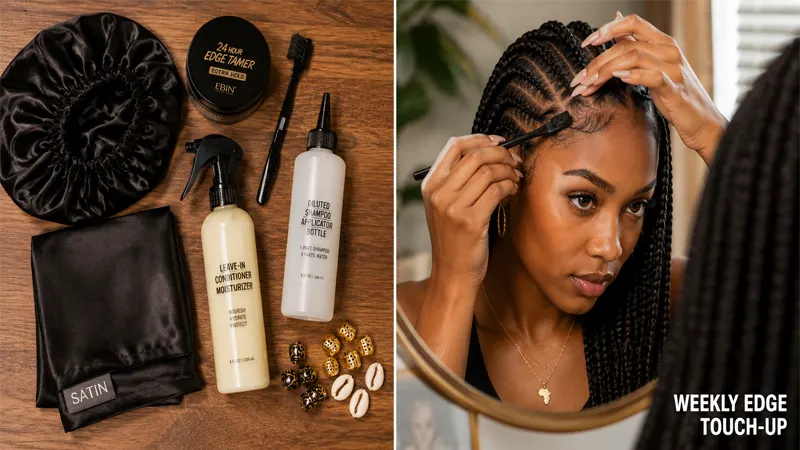
- Edge styling (10–15 min). Edges are smoothed with edge control gel and a small brush. Baby hairs are laid carefully if you want them.
- Final inspection. Walk around the chair, look at every angle in the mirror. Speak up about any issues NOW — fixes are easier before you leave.
6-Week Maintenance Schedule
Braids last as long as the care behind them. Follow this week-by-week routine for maximum lifespan:
Scalp Safety — Warning Signs to Watch
African hair braiding is generally safe, but tight braids can cause real damage. Traction alopecia — permanent hair loss from prolonged tension — is the most serious risk. Here's what to watch for:
- You feel sharp, painful pulling at the scalp (different from mild tightness)
- Your eyes water involuntarily from the pain
- Small white bumps appear where braids were just installed
- You see "knots" forming at the roots that look like beads
- Your scalp turns red beyond normal post-braid pinkness
- Thinning hairline that doesn't recover after takedown
- Bald patches near the temples or crown
- Persistent scalp pain weeks after braid removal
- Hair that doesn't grow back in areas where braids were tight
Salon vs DIY — Should You Try It Yourself?
| Factor | Salon Install | DIY Install |
|---|---|---|
| Quality | Professional finish, even sections | Variable — improves with practice |
| Time | 4–10 hours | 8–20+ hours (sometimes split across days) |
| Cost | $80–500+ all-in | $30–80 for braiding hair only |
| Pain control | Trained braiders manage tension | You feel every pull — easier to over-tighten |
| Best for | Box braids, knotless, Fulani, all extensions | Simple cornrows, single French braid, halo braid |
If you've never installed braids before, start with simple cornrows on a friend, then progress through styles over months. Never DIY box braids or knotless braids on your first attempt — the labor is intense and uneven sections show immediately.
Takedown & Hair Recovery
How you remove braids matters as much as how they're installed. Wrong takedown = breakage and shedding.
- Spray with diluted conditioner. Mix conditioner with water 1:4 in a spray bottle. Soak each braid before unraveling.
- Cut off the extensions first (for styles with synthetic hair). Trim above where your natural hair ends in the braid.
- Unravel section by section with your fingers. Never rip or comb through. Detangle each section gently as you go.
- Pre-shampoo with a moisturizing oil mask for 30 minutes before washing. Hair will be tangled and dry after weeks under braids.
- Wash with a clarifying shampoo once, then a moisturizing shampoo a second time. Follow with deep conditioner for 30+ minutes.
- Let your hair rest 2–4 weeks before installing new braids. Use this time for protein treatments, scalp massages, and trimming.
Cost Breakdown — What You'll Actually Pay
| Style | Salon Cost | Braiding Hair Cost | Total |
|---|---|---|---|
| Cornrows (no extensions) | $50–150 | $0 | $50–150 |
| Cornrows with extensions | $80–180 | $15–30 | $95–210 |
| Classic box braids | $150–350 | $25–50 | $175–400 |
| Knotless box braids | $250–500 | $40–80 | $290–580 |
| Fulani braids | $150–300 | $25–50 | $175–350 |
| Senegalese twists | $150–300 | $30–60 | $180–360 |
| Faux locs | $200–500 | $50–100 | $250–600 |
| Micro braids | $300–500+ | $50–100 | $350–600+ |
Tip percentage: 15–20% of the salon cost is standard for braiders. For long appointments (8+ hours), tip higher — your braider has been on their feet that whole time.
Pro Tips for Long-Lasting Braids
- Braids for Boys Guide 2026 — child- and teen-focused braid styles
- Slavic Braids Guide — different cultural braid tradition
- Best Braiding Gel Reviews — products that hold braids without flaking
- Blowout Taper Haircut Guide — alternative protective option for short natural hair
- Dark Brown Hair with Highlights — adding color to your braids
- Cowlick Management — handling natural hair patterns
African Hair Braiding — Frequently Asked Questions
How long do African braids typically last?
Most African braids last 4–8 weeks depending on the style and how well you care for them. Box braids and knotless braids tend to last the longest (6–8 weeks), while cornrows and goddess braids typically last 2–5 weeks. Beyond 8 weeks, matting and breakage risk increases significantly — plan your takedown before that point.
Are knotless braids really better than traditional box braids?
For most people, yes. Knotless braids start with your natural hair rather than a knot of synthetic hair at the root, which dramatically reduces scalp tension and protects your edges from traction damage. The trade-offs: knotless braids cost more (often $100+ extra), take longer to install (1–3 additional hours), and are harder to DIY. If you can afford it, the gentler tension is worth it.
How much does African hair braiding cost?
Costs vary widely based on style, length, location, and braider experience. Cornrows typically run $50–150. Classic box braids cost $150–350. Knotless box braids cost $250–500. Faux locs cost $200–500. Micro braids can reach $500+. Add $15–80 for braiding hair extensions. Urban salons in major US cities charge at the higher end; smaller markets are typically 30–40% less.
Can I wash my hair while wearing braids?
Yes, and you should — about every 2–3 weeks. Mix sulfate-free shampoo 1:3 with water in an applicator bottle, apply directly to the scalp, massage gently with fingertips (not nails), and rinse thoroughly. Let braids air-dry fully or use a hooded dryer on low. Wet braids that stay damp too long can develop mildew, so always dry completely.
What's traction alopecia and how do I avoid it?
Traction alopecia is hair loss caused by prolonged tension on the hair follicles — common with chronically tight braids. It often starts as a receding hairline at the temples and can become permanent if ignored. Avoid it by: choosing knotless braids over knot braids, insisting on medium tension (not painful tight), taking 2–4 week breaks between braid styles, and stopping immediately if you feel sharp pulling pain during install.
How do I make my braids last longer?
Six things: (1) Sleep on satin or silk every night with a bonnet, (2) Avoid over-washing — twice in 6 weeks is plenty, (3) Moisturize the scalp daily with a light leave-in spray, (4) Re-lay edges weekly with edge control gel, (5) Vary how you wear them — don't put them in a tight bun every day, (6) Plan takedown by Week 6–8, not later.
Can African braiding work on non-textured hair?
Yes, but with adjustments. Most African braiding techniques work on straight or wavy hair, especially when synthetic extensions are added for grip. The braids may not last as long (2–4 weeks vs 6–8), and the tension feels different. Many salons will braid any hair type, but expect different pricing and shorter wear time compared to natural textured hair.
What braiding hair brand should I buy?
Xpression Pre-Stretched and FreeTress are the two most-requested brands in 2026. Xpression has the smoothest finish and the most consistent quality. FreeTress is slightly more affordable and offers wider color variety. For curly box braids and bohemian styles, FreeTress Water Wave is the go-to. Avoid the cheapest no-name brands — they shed, knot, and look synthetic from a distance.
How many packs of hair do I need for box braids?
For shoulder-length box braids: 5–6 packs. For mid-back length: 6–7 packs. For waist-length: 7–8 packs. For jumbo box braids: 4–5 packs. Always buy 1 extra pack — running out mid-install is the worst situation, and unused hair can be saved for touch-ups later.
Can men get African braids?
Absolutely — African braiding has always been worn by men and boys in African cultures. Common men's styles include cornrows, single back-to-front cornrows, two-strand twists, individual braids, and faux locs. Men's braids are typically shorter (chin-length or shoulder-length) and the styles emphasize sharp clean lines. See our braids for boys guide for child- and teen-specific styles.
How do I sleep with new braids comfortably?
Wear a satin or silk bonnet, sleep on a satin pillowcase, and keep braids loose (not pulled into a tight ponytail). For the first 2–3 nights when scalp tightness is worst, sleep slightly elevated on an extra pillow to reduce pressure. A few drops of light oil on the parts can ease tightness pain. If pain prevents sleep, the braids were installed too tight — go back to your braider to loosen the affected sections.
African hair braiding is a living cultural tradition with thousands of years of history. This guide provides general information; for your specific hair type and needs, consult a licensed cosmetologist or experienced braider. If you experience persistent scalp pain, hair loss, or skin irritation, consult a dermatologist.
