


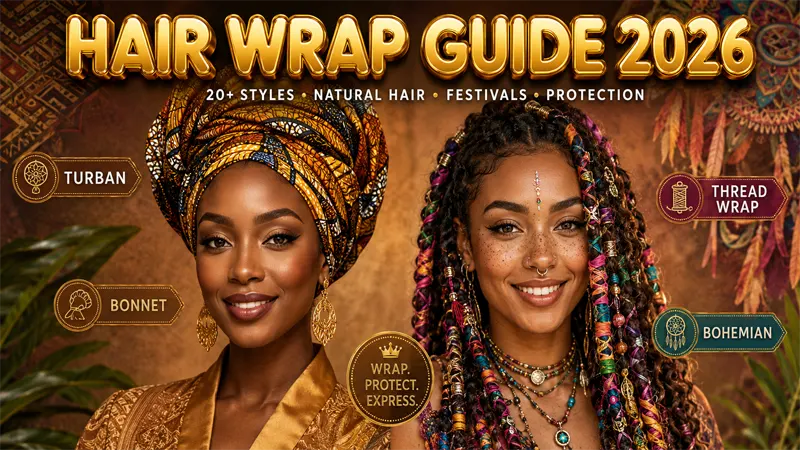

Quick answer: A hair wrap refers to two distinct things: (1) a headscarf, turban, or satin/silk bonnet worn over the hair for protection or style, and (2) a thread or yarn wrap braided into a section of hair as a festival/bohemian accent. Both are trending in 2026 — headscarves for protective natural hair styling and "quiet luxury" aesthetics; thread wraps for music festivals and Y2K nostalgia. Headscarves last as long as you wear them; thread wraps stay in 1–3 weeks. This guide covers 20+ styles, step-by-step tying tutorials, fabric choices, and care for both types.
What Is a Hair Wrap?
The term "hair wrap" covers two different but related styles. Understanding which one you're after is the first step:
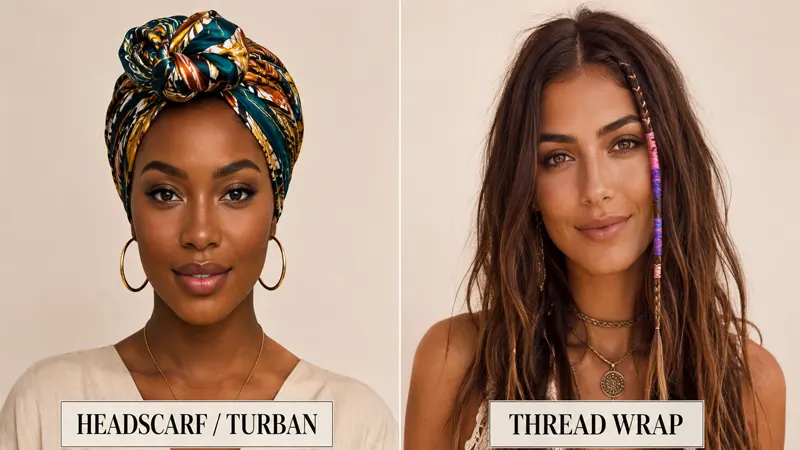
1. Headscarves, turbans, and satin bonnets — fabric wrapped around the head to cover, protect, or style the hair. This is the dominant meaning of "hair wrap" in 2026, especially within the natural hair community. Headscarves protect curls and braids overnight, hide bad hair days, finish off polished outfits, and carry deep cultural significance across African, Caribbean, South Asian, and Middle Eastern traditions.
2. Thread or yarn wraps — colorful embroidery floss or yarn wound tightly around a small section of braided hair, creating a decorative bohemian accent. Popularized in the 1970s and again at music festivals throughout the 2010s and 2020s. The Y2K aesthetic revival has brought these back into mainstream popularity for 2026.
This guide covers both. Skip to the section you need:
- Headscarves, Turbans & Bonnets — Section 1
- Thread & Yarn Hair Wraps — Section 2
PART 1 — Headscarves, Turbans & Bonnets
Why Wear a Headscarf?
Beyond aesthetics, headscarves serve several practical purposes:
- Protect natural hair overnight. A satin or silk wrap prevents cotton-pillowcase friction that causes breakage, frizz, and curl-pattern damage. Essential for preserving wash-day curls or freshly installed braids.
- Preserve protective styles. If you wear box braids, cornrows, or other protective styles, a satin headwrap extends their lifespan by 2+ weeks.
- Cover transitional or "bad" hair days. Mid-grow-out, post-take-down, or between salon appointments, headscarves are the elegant solution.
- Make a fashion statement. Bold prints and rich fabrics transform a simple outfit. African Ankara prints, silk Italian scarves, and modern minimalist solids all work.
- Cultural and religious significance. For many wearers, headscarves connect them to heritage — African heritage, Caribbean traditions, hijab practice, or other cultural identities.
- Sun and weather protection. A wrap shields the scalp from UV exposure, dust, and cold temperatures.
Choosing the Right Fabric
Fabric determines comfort, longevity, and aesthetic. Here's what each option does best:
| Fabric | Best For | Pros | Cons |
|---|---|---|---|
| Silk | Sleeping, protecting curls | Maximum hair protection, luxurious feel, no friction | Slips easily, more expensive ($25–50+) |
| Satin | Daily wear, sleeping | Slip-free hold, similar protection to silk, affordable | Less luxurious feel than silk |
| Stretchy jersey knit | Long-style wraps, high turbans | Forgiving stretch, easy to tie, comfortable | Less polished finish for formal occasions |
| Ankara / African wax print | Statement fashion looks | Bold patterns, cultural authenticity, structured form | Stiffer to tie, requires practice |
| Cotton | Casual everyday wear | Affordable, breathable, easy to find | Damages hair (friction), worst for protection |
| Bamboo silk blend | Sustainable, sensitive scalps | Eco-friendly, hypoallergenic, soft | Limited color and pattern selection |
| Chiffon | Formal events, weddings | Elegant drape, lightweight, glamorous | Slips easily, not for daily wear |

10+ Headscarf & Turban Styles for 2026
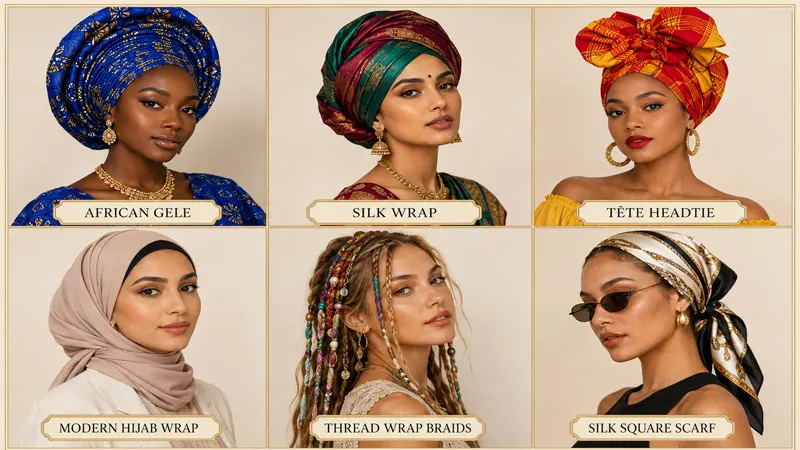
1. Classic Turban
Twisted fabric wrapped around the head with the knot positioned at the top center. The most versatile and elegant headwrap style. Works for any occasion.
2. African Gele (Headtie)
Structured, sculpted headwrap originating from West Africa. Tied in elaborate fan, peacock, or bow shapes. Statement piece for cultural events, weddings, or special occasions.
3. Top-Knot Turban
Hair gathered into a high bun first, then wrapped with fabric and tied at the front. Effortless yet polished.
4. Side-Tied Wrap
Fabric brought around the head and tied off to one side, leaving the ends to drape or hang loose. Boho-chic.
5. Satin Bonnet (Sleep)
Pre-shaped satin or silk bonnet with elastic edge. Slips on quickly for overnight hair protection. Non-negotiable for natural hair sleepers.
6. Bandana Wrap
Triangle bandana folded and tied at the back of the head. Casual, vintage, Y2K-inspired.
7. Pillbox Wrap
Vintage-inspired flat-topped wrap that looks like a small hat. Sophisticated retro vibe.
8. Long-Tail Turban
Turban with long fabric tails left to flow down the back or shoulder. Elegant and dramatic.
9. Sleek Silk Wrap (Y2K Revival)
Smooth silk scarf wrapped flat around a sleek bun or ponytail. Quiet luxury aesthetic. Carolyn Bessette-Kennedy-inspired.
10. Hijab-Style Wrap
Modest religious headcovering with multiple layers and pinning. Various regional traditions and styles within Muslim communities.
11. Festival Bohemian Wrap
Loose, draped fabric with deliberate messy ends. Often paired with braids and flower accessories. Music festival staple.
12. Caribbean Tete (Headtie)
Brightly colored headtie often associated with Caribbean traditional dress. Tied with elaborate folds and points.
How to Tie a Classic Turban — Step-by-Step
The classic turban is the easiest starting point. Once you master this, every other style becomes easier:
- Choose your scarf. A rectangular scarf about 60×30 inches (or stretchy jersey 67×25 inches) works best for beginners.
- Position your hair. Gather your hair into a low bun or ponytail at the nape of your neck. This gives the wrap structure.
- Place the center of the scarf at the back of your neck. The two ends should hang evenly on either side.
- Bring both ends forward. Cross them over your forehead, ensuring the fabric is smooth and flat against your head.
- Twist the ends together once. Take both ends and twist them around each other one time, just above the center of your forehead.
- Bring the ends back over the top of your head. Cross them at the top center of your skull.
- Tie a knot at the back or top. For a top-knot finish, tie at the crown. For a clean look, tie at the back of your head.
- Tuck in any loose ends. Use the tail-tucking technique — slide the ends under the wrapped fabric for a clean finish.
How to Wrap for Overnight Hair Protection
- Detangle hair gently. Use a wide-tooth comb to remove tangles before wrapping.
- Apply leave-in conditioner. A light spray-on conditioner adds moisture that the wrap will trap overnight.
- Section or gather hair. For natural hair: gather into 2–4 large twists or a loose bun. For braids: leave as-is or gather into a loose pineapple at the top.
- Smooth a satin bonnet over the hair. The elastic edge should sit at your hairline. Adjust until comfortable but not tight.
- For extra security: Wrap a silk scarf over the bonnet and tie at the back. Double protection prevents the bonnet from slipping off.
- Sleep peacefully. The satin or silk surface allows your hair to slide without friction damage.

PART 2 — Thread & Yarn Hair Wraps
The Festival Thread Wrap
Thread wraps are the colorful bohemian alternative — a small section of hair braided and then tightly wrapped with embroidery floss or yarn to create a decorative accent piece. Popularized at music festivals like Coachella, EDC, and Tomorrowland, and revived strongly in 2026 with the Y2K aesthetic comeback.
The benefits: minimal commitment (lasts 1–3 weeks), virtually no damage to the hair, customizable with any colors, and works on every hair type from straight to coily. The downsides: requires a friend or salon to install (very difficult to DIY on yourself), and looks dated if done in unflattering color combinations.
Thread Hair Wrap Styles
13. Single Color Wrap
One solid color wrapped along the length. Minimalist, monochromatic, works for everyday wear.
14. Striped Wrap
2–4 colors alternating in bands along the length. The classic festival look.
15. Spiral / Twist Wrap
Two contrasting colors spiraled together for a candy-cane effect.
16. Beaded Wrap
Wrap finished with beads threaded onto the ends. Adds movement and visual interest.
17. Hidden Underlayer Wrap
Wrap installed underneath the top layers of hair, revealed only when hair moves. Subtle and surprising.
18. Multiple Thin Wraps
Several small thread wraps scattered through the hair instead of one statement piece. Bohemian and layered.
19. Front Strand Wrap
Single thread wrap on a face-framing strand near the front. Visible accent that frames the face.
20. Crochet-Style Wrap
Yarn wrap incorporating small crochet stitches or knots for added texture.
How to Install a Thread Hair Wrap
Best done by a friend or salon professional. Here's the standard technique:

- Gather materials. Embroidery floss or yarn (2–4 colors, each at least 3 yards long for long hair), small hair tie, scissors, optional beads.
- Pick the wrap location. Choose a small section of hair (about 30–50 strands thick). Common spots: behind the ear, face-framing strand, hidden under top layers.
- Braid the section halfway. Create a small standard 3-strand braid halfway down the section. This gives the wrap a sturdy base.
- Tie the threads to the braid. Combine all your color threads. Tie them onto the braid with a small knot about 1/2 inch from the hairline. Leave a tail.
- Start wrapping with one color. Pull out one long thread and wrap it tightly around all the other threads + the hair below the braid. Wrap firmly so the layers stack neatly.
- Change colors as desired. To switch, tuck the working thread alongside the others and pull out a new color. Wrap with that one for as long as you want before switching again.
- Wrap to your desired length. Continue 1–1.5 inches past the end of your hair if you want a tail beyond the wrap.
- Finish with a knot. Tie all threads in a strong double-knot. Trim to desired length, leaving a 1-inch tail.
- Add beads if desired. Thread beads onto the tail and tie knots below each bead to hold them in place.
Thread Wrap Care & Removal
- Lifespan: 1–3 weeks depending on installation tightness and care.
- Washing: You can wash your hair normally, but avoid scrubbing the wrap directly. Pat dry instead of rubbing.
- Spray bottle trick: Spray with light hair oil between washes to keep the wrap looking fresh and prevent stiffness.
- To remove: Carefully cut the knot at the bottom of the wrap with small sharp scissors, then unwrap the thread from the hair. NEVER cut the hair itself.
- Save the threads: Used threads can be cleaned and reused for future wraps.
Cultural Significance of Hair Wraps
Headwraps and hair wraps carry centuries of cultural meaning that's important to understand and honor:
- African headwraps (gele, dukure, tichel). Have been worn for centuries across West, East, and North African cultures. They've signified marital status, age, ethnicity, religion, and social rank. The Ankara fabric most associated with modern African headwraps originated in West African trade with Dutch settlers in the 19th century.
- Caribbean tete. Brightly colored headties were part of African diaspora culture in the Caribbean, with specific tie patterns conveying different meanings — including the famous "head ties" of Madame Tinubu and other Yoruba women.
- Middle Eastern and South Asian wraps. Hijabs, niqabs, and various religious head coverings have long traditions in Muslim, Sikh (turbans), Jewish (tichel), and Christian (chapel veils) communities.
- African American history. During slavery in the American South, Black women were often forced to wear headwraps as marks of inferiority. Reclaimed in the 20th century, headwraps became symbols of cultural pride, Black power, and natural hair appreciation.
- Bohemian thread wraps. Festival thread wraps emerged from the 1970s hippie movement, with influences from Native American, Bohemian, and South American textile traditions. The modern festival revival borrows heavily from these origins.
Common Hair Wrap Mistakes
❌ Using cotton fabric for overnight wraps
Fix: Cotton creates friction that damages hair while you sleep — the opposite of what you want. Always use silk, satin, or jersey knit for sleeping wraps.
❌ Tying headwraps too tight
Fix: Wraps shouldn't give you a headache. If you feel pressure or pulling, loosen the wrap. The "two-finger test" applies — you should be able to slide two fingers between the wrap and your head.
❌ Skipping the leave-in conditioner
Fix: Applying moisture before wrapping helps your hair absorb conditioner overnight. Skipping this misses the biggest benefit.
❌ Wearing the same wrap too long without washing
Fix: Wash your headscarves every 5–7 wears. Oils and product buildup transfer back to your hair otherwise.
❌ Choosing complicated styles for first attempts
Fix: Start with the classic turban or basic bandana. Master these before attempting elaborate gele or pillbox styles.
❌ Cutting your hair to remove a thread wrap
Fix: Always cut the knot of the WRAP, never the hair. With careful unwinding, the thread comes off without losing any hair.
❌ Choosing unflattering color combinations for thread wraps
Fix: Match thread colors to either your hair color (subtle), your outfit palette (cohesive), or your skin undertone (warm/cool harmony). Avoid clashing rainbow combinations unless that's the vibe.
❌ Borrowing styles without cultural awareness
Fix: Research the cultural origins of the style you're wearing. Some wraps are appropriate for anyone; others (like religious hijabs) should be respected as practice, not fashion.
Where to Buy Quality Hair Wraps
For Headscarves & Bonnets
- Black-owned brands (recommended): Melanin Haircare, Cee Cee's Closet NYC, Loza Tam, Grace Eleyae, Olori, Niquidy Naturals
- Specialty natural hair retailers: Curlmix, Mielle Organics, Honey's Child Boutique
- Cultural specialty shops: West African import stores for authentic Ankara prints, Caribbean specialty shops for tete fabric
- General retailers: Etsy (for handmade), Amazon (basic options), local fashion boutiques
- Vintage and secondhand: Silk scarves from estate sales and vintage shops are often higher quality than new options
For Thread Wrap Supplies
- Embroidery floss: DMC and Anchor brands are highest quality. Available at Michaels, Joann, or online craft retailers
- Cotton yarn: Works for chunkier wraps. Various weights available
- Beads: Pony beads, wood beads, or specialty beads from craft stores
- Festival installation: Many music festivals have hair wrap booths offering professional installation for $20–50
Care Tips for All Hair Wraps
- African Hair Braiding Guide 2026 — protective styles that pair with headwraps
- Braids for Boys Guide — wraps for young braided hair
- Best Braiding Gel 2026 — products to protect natural hair
- Slavic Braids Guide — different cultural braid tradition
- Cowlick Hair Management — wraps can train cowlick patterns overnight
- Dark Brown Hair with Highlights — wraps protect color-treated hair
Hair Wrap — Frequently Asked Questions
What's the difference between a hair wrap and a headscarf?
The terms are often used interchangeably. "Hair wrap" can refer to either fabric headwraps (like turbans, headscarves, and bonnets) OR thread/yarn wraps installed in a section of braided hair. "Headscarf" specifically means the fabric covering. Context determines which one is being discussed — this guide covers both.
Do hair wraps damage your hair?
The opposite is true when worn correctly. Silk and satin headwraps actually PROTECT hair from friction damage caused by cotton pillowcases and dry air. Cotton wraps worn overnight can cause friction damage. Thread wraps cause minimal damage since they don't pull on the hair. Always use silk, satin, or jersey for protection.
How long do thread hair wraps last?
Thread wraps typically last 1–3 weeks depending on installation quality and care. Loosely-installed wraps last a few days. Tightly-installed wraps with secure knots can last 3+ weeks. You can wash your hair normally during this period without significantly affecting the wrap.
Can I sleep with a headscarf on?
Yes, and it's recommended for natural hair. A satin or silk bonnet or wrapped scarf prevents friction damage while you sleep, helps preserve curl patterns, extends the life of styled hair, and traps moisture from leave-in conditioners. It's one of the most beneficial hair care practices you can adopt.
What's the best fabric for a hair wrap?
For sleeping and hair protection: silk is the gold standard, but satin is a more affordable alternative with similar benefits. For daily fashion wraps: jersey knit (stretchy) is easiest for beginners. For formal occasions: chiffon or structured silk. For cultural authenticity: African wax print (Ankara) for headwraps. Avoid cotton for overnight use — it causes friction damage.
How do I keep my headscarf from slipping?
Several techniques: (1) Apply a thin headband under the scarf to add grip, (2) Use a satin-lined scarf since the satin grips better than smooth silk, (3) Pin discreetly with bobby pins or U-pins, (4) Choose jersey knit for the most natural slip-resistance, (5) Apply a tiny amount of mousse to your hairline so the scarf catches the texture.
Can I make my own thread hair wrap?
Yes, but it's very difficult to install on yourself due to angle and reach. Most people need a friend or salon professional. Materials cost $5–15 from any craft store. Allow 30–60 minutes for installation. If you're going to a music festival, look for hair wrap booths — most install on-site for $20–50.
What's the cultural significance of headwraps?
Headwraps have deep cultural meaning across many traditions. In African cultures, they signal everything from marital status to ethnic identity to social rank. In Caribbean cultures, tete designs convey specific meanings. In African American communities, headwraps are symbols of natural hair pride reclaiming a history of oppression. Religious traditions (hijab, tichel, turbans) carry distinct spiritual meaning. Always approach styles outside your own culture with respect and education.
How do I tie a basic turban for beginners?
The classic turban method: Place the center of a rectangular scarf at the back of your neck. Bring both ends forward and cross them at the forehead. Twist once and bring back over the top of your head. Tie a knot at the crown or back. Tuck loose ends. Practice 2–3 times to master the technique — it gets easier each time.
Can hair wraps help with hair growth?
Indirectly, yes. Hair wraps don't directly stimulate growth, but they prevent breakage, friction damage, and moisture loss that all contribute to hair NOT growing as long as it could. By protecting your hair overnight with silk or satin, your strands retain length instead of breaking at the ends. Combined with healthy hair practices, this can result in noticeable length retention over months.
How much do hair wraps cost?
Wide range. Basic satin bonnets: $10–20. Quality silk scarves: $25–50. Premium silk or designer scarves: $50–150+. African Ankara wax print scarves: $15–40. Bandanas: $5–10. Thread wrap supplies: $5–15 in materials. Festival thread wrap installation: $20–50. Start with one quality satin bonnet for sleeping and one silk square scarf for styling — you'll get 80% of the benefits.
Hair wraps carry cultural significance across many traditions. This guide aims to inform and inspire while respecting the cultural roots of various styles. Individual results vary by hair type, fabric choice, and styling technique. For specialized care of natural, color-treated, or chemically processed hair, consult a licensed hairstylist.
