


Find out exactly where you stand on the Army Combat Fitness Test. This free ACFT calculator scores all six events based on your age group and gender, giving you a clear picture of your readiness. Whether you’re preparing for your first test, training toward a higher MOS standard, or tracking progress over time, this tool delivers accurate results in seconds.
Table of Contents
ToggleWhat Is the ACFT Calculator and Why Use It?
The ACFT calculator takes your raw performance data from each of the six Army Combat Fitness Test events and converts it into official point scores. Instead of flipping through dense scoring charts and cross-referencing age brackets manually, you enter your numbers and get your total score immediately.
Here’s what makes this tool valuable:
- Accurate event-by-event scoring — Based on official U.S. Army ACFT scoring tables (March 2022 standards)
- Age and gender adjusted — Scores reflect your specific demographic bracket across 10 age groups
- MOS pass/fail classification — Instantly see whether you meet the Heavy (Black), Significant (Gray), or Moderate (Gold) standard
- Training gap identification — Pinpoint weak events dragging your total down so you can train smarter
The scoring data aligns with the standards published by the U.S. Army’s official fitness page. Note that as of June 2025, the Army has transitioned the ACFT to the Army Fitness Test (AFT), removing the Standing Power Throw and adjusting standards. This calculator supports both the legacy 6-event ACFT and the updated 5-event AFT format.
ACFT / AFT Score Calculator
Army Combat Fitness Test & Army Fitness Test Scoring Tool
How the ACFT Scoring System Works
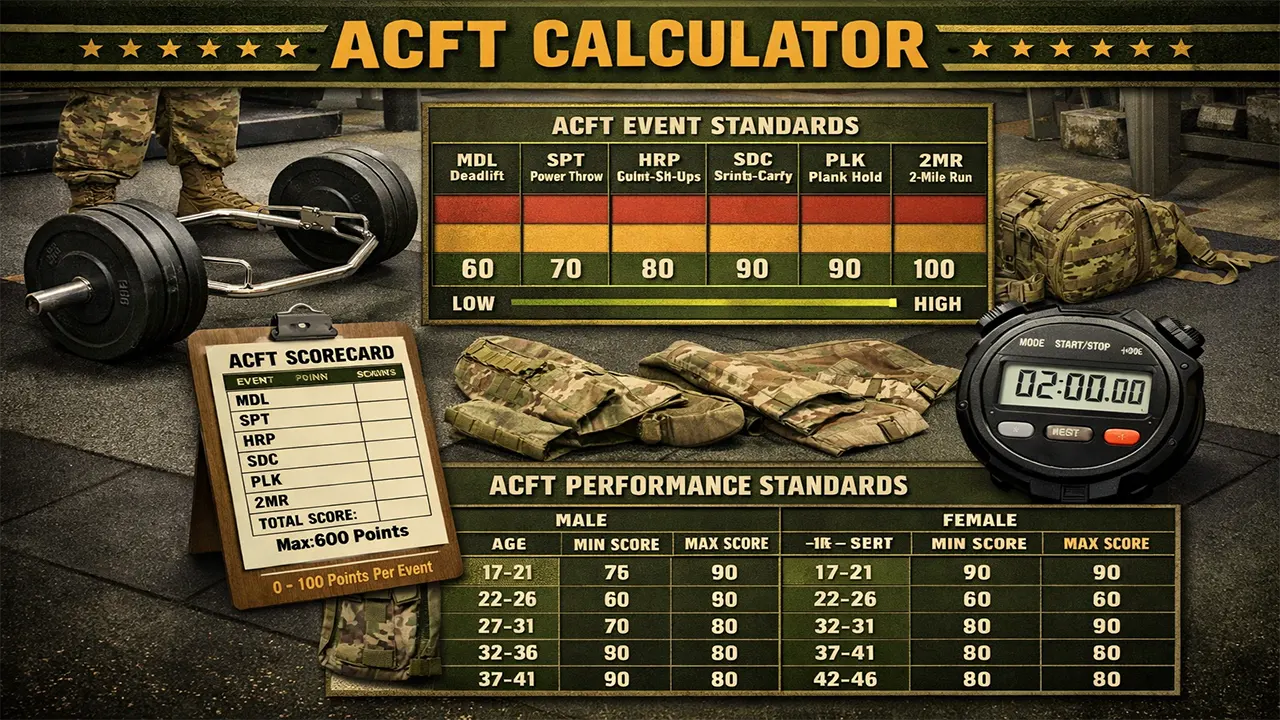
The Army Combat Fitness Test assigns a point value between 0 and 100 for each of its six events. Your total ACFT score is the sum of all event scores, with a maximum possible score of 600 points (or 500 under the new 5-event AFT format).
The Six ACFT Events
Each event targets a different physical capability critical to combat readiness:
- 3-Repetition Maximum Deadlift (MDL) — Measures lower-body and grip strength using a hex bar. Score based on maximum weight lifted for 3 reps (range: 140–340 lbs).
- Standing Power Throw (SPT) — Tests explosive power through a backward overhead 10-lb medicine ball throw. Score based on distance in meters. (Removed in the AFT as of June 2025.)
- Hand-Release Push-Up (HRP) — Evaluates upper body muscular endurance. Score based on maximum reps completed in 2 minutes.
- Sprint-Drag-Carry (SDC) — A composite event covering 5 × 50-meter shuttles involving sprinting, sled dragging, lateral movement, kettlebell carrying, and sprinting. Score based on completion time.
- Plank (PLK) — Assesses core strength and endurance. Score based on maximum hold time.
- Two-Mile Run (2MR) — Tests aerobic endurance. Score based on completion time.
Scoring Methodology
The Army uses age-normed and gender-specific scoring tables. A 200-lb deadlift earns different points for a 19-year-old male than for a 55-year-old female. The calculator cross-references your input against the correct scoring bracket and returns the exact point value.
Pass/fail thresholds depend on your Military Occupational Specialty (MOS):
- Heavy (Black): Minimum 70 points per event, 440 total
- Significant (Gray): Minimum 65 points per event, 440 total
- Moderate (Gold): Minimum 60 points per event, 360 total
Under the new AFT combat standard, soldiers in 21 combat MOSs must score at least 60 per event with a 350 total on a sex-neutral, age-normed scale. General standard soldiers need 60 per event and 300 total.
Important: Scores below 60 on any single event result in a test failure regardless of your total. There is no compensation between events for the minimum threshold.
ACFT Score Examples: Three Realistic Scenarios
Example 1: Active Duty Infantry Soldier (Male, Age 24)
SGT Rodriguez, stationed at Fort Liberty, trains regularly and wants to verify he meets the Heavy (Black) standard for his 11B Infantry MOS.
His performance:
- MDL: 280 lbs → 80 points
- SPT: 10.5 meters → 78 points
- HRP: 48 reps → 80 points
- SDC: 1:45 → 88 points
- PLK: 3:20 → 80 points
- 2MR: 14:30 → 80 points
Total Score: 486 out of 600
SGT Rodriguez passes the Heavy (Black) standard comfortably, exceeding both the 70 minimum per event and 440 total. His strongest event is the Sprint-Drag-Carry, while his power throw has the most room for improvement.
Example 2: Female Supply Sergeant (Age 31)
SSG Kim works in logistics (92Y MOS — Moderate/Gold standard) and is preparing for a promotion board. She needs consistent passing scores.
Her performance:
- MDL: 180 lbs → 72 points
- SPT: 7.0 meters → 68 points
- HRP: 22 reps → 70 points
- SDC: 2:20 → 72 points
- PLK: 2:45 → 72 points
- 2MR: 18:30 → 74 points
Total Score: 428 out of 600
SSG Kim passes the Moderate (Gold) standard with a strong margin above the 360 total and well above 60 per event. For promotion competitiveness, she could target the 80+ range on her deadlift and run.
Example 3: National Guard Soldier Returning After Profile (Male, Age 44)
SFC Martinez is returning to full fitness after a knee profile. He needs to pass the Moderate standard and is concerned about his run time.
His performance:
- MDL: 200 lbs → 68 points
- SPT: 8.0 meters → 64 points
- HRP: 18 reps → 62 points
- SDC: 2:35 → 62 points
- PLK: 2:10 → 64 points
- 2MR: 19:45 → 62 points
Total Score: 382 out of 600
SFC Martinez passes, but just barely above the minimum thresholds. His push-ups, SDC, and run are all close to the 60-point cutoff. A focused 8-week training plan targeting upper body endurance and running should create a larger buffer. If you’re tracking return on investment in your training time, improving these three weak events offers the highest score gains per hour of training.
Key Rules, Tips, and Common Mistakes
Critical Rules to Know
The ACFT must be completed in the prescribed order: MDL → SPT → HRP → SDC → PLK → 2MR. You cannot skip events or rearrange the sequence. The entire test is designed to be completed within 70 minutes, not including the preparation and warmup period.
Soldiers are allowed two attempts at the deadlift. If your first attempt fails at a given weight, you can either retry that weight or drop down. You cannot increase weight after a failed attempt.
Transition to the AFT
The Army officially replaced the ACFT with the Army Fitness Test (AFT) on June 1, 2025. The Standing Power Throw has been removed, leaving five scored events. ACFT scores recorded before May 31, 2025 remain valid for promotions until September 30, 2025. No administrative action is taken for AFT failures until January 1, 2026.
Common Mistakes to Avoid
- Neglecting the plank — Many soldiers under-train core endurance and score poorly on what should be an easy event.
- Going too fast on the SDC sled drag — Burning out on the first shuttle can destroy your overall SDC time.
- Incorrect push-up form — Reps don’t count if your arms don’t fully extend to the sides during the hand release.
- Running the 2MR too fast at the start — Negative splits (starting slower, finishing faster) consistently produce better times.
Expert Training Tips
Focus on your weakest event first. A soldier scoring 62 on push-ups has far more room for improvement than one scoring 90 on the deadlift. Use this calculator regularly — ideally every 2 weeks — to track whether your targeted training is actually moving the needle.
Frequently Asked Questions About the ACFT Calculator
How accurate is this ACFT calculator?
The calculator uses the official scoring tables published by the U.S. Army (March 2022 standards). Scores match what you’d receive on an official score card. The tool also supports the updated AFT 5-event format.
Does the ACFT calculator account for age and gender?
Yes. You select your age range (from 17–21 up to 62+) and gender before entering event scores. The calculator applies the correct scoring bracket automatically, since the same raw performance produces different point values across demographics.
What is the minimum passing score for the ACFT?
Under the original ACFT, minimums varied by MOS: 360 total for Moderate (Gold), 440 for Significant (Gray) and Heavy (Black). Under the new AFT, the general standard is 300 total with 60 per event, and the combat standard is 350 total with 60 per event.
Can I use this calculator for the new Army Fitness Test (AFT)?
Yes. Simply skip the Standing Power Throw field when calculating your AFT score. The remaining five events — MDL, HRP, SDC, PLK, and 2MR — use the same scoring logic. The calculator sums only the events you complete.
What happens if I fail one event but pass overall?
You fail the entire test. The Army requires a minimum score on each individual event. Even a 580 total fails if any single event scores below the minimum threshold for your MOS category.
How often should I retake the ACFT?
The Army typically administers the test twice per year. However, for training purposes, you should simulate the test and use this calculator monthly to track improvement. Allow at least 72 hours of rest before a full practice test.
Is the Standing Power Throw still part of the test?
No. As of April 2025, the Army removed the Standing Power Throw. The test now consists of five events under the rebranded Army Fitness Test (AFT). However, this calculator retains the SPT option for soldiers referencing older scores or training records.
Can soldiers outside the U.S. use this calculator?
Absolutely. The ACFT scoring standards are universal across all U.S. Army components worldwide — active duty, Reserve, and National Guard. Whether you’re training at Camp Arifjan in Kuwait, stationed in Germany, or preparing at a gym in Dubai, the scoring tables are identical.
Calculate Your ACFT Score Now
Scroll up to the calculator, enter your performance data, and get your score in seconds. Bookmark this page and return after each training cycle to measure progress. For official scoring documentation, visit the U.S. Army AFT page or download the official ACFT scoring scales PDF.
This calculator is a training tool and does not replace official Army scoring. Always confirm your results with your unit’s certified ACFT grader.
Related Calculators You Might Find Useful
- Savings Calculator — Plan your financial goals alongside your fitness targets
- Investment Calculator — Project long-term growth on military TSP contributions
- Retirement Calculator — Estimate your military or post-service retirement readiness
- ROI Calculator — Measure returns on equipment, education, or training investments
- University Grade Calculator — Useful for soldiers pursuing degrees through tuition assistance
- Tax Calculator — Estimate your tax obligations during and after military service