



Quick answer: The best braids for boys in 2026 include classic cornrows, stitch braids, pop smoke braids, box braids, and twists. Choose based on your son's age, hair length, school dress code, and activity level. Install time ranges from 30 minutes (simple cornrows on a toddler) to 4+ hours (full pop smoke braids on a teen). Most styles last 2–4 weeks with proper care. Bring snacks, headphones, and a tablet to the appointment — kids do better when distracted. Always insist on medium tension — children's scalps are more sensitive than adults'.
Why Braids Work So Well for Boys
Braids aren't just stylish — they solve real problems for boys with textured, curly, or coily hair. They're protective, low-maintenance after installation, easier than daily styling, and they look great in school photos. They also carry deep cultural significance for many Black, Hispanic, and mixed-race families, connecting kids to heritage they can wear proudly.
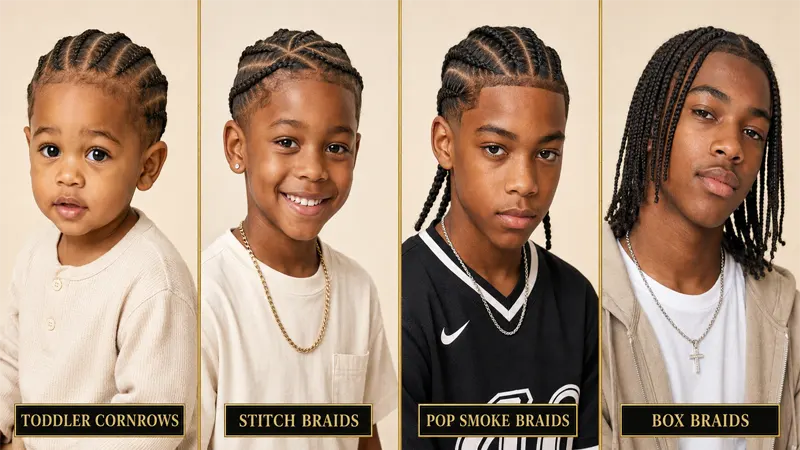
For parents new to braiding their sons' hair, the world of styles can feel overwhelming. There are cornrows, stitch braids, pop smoke braids, box braids, twists, French braids, and dozens of decorative variations. This guide breaks it all down by age, school-appropriateness, activity level, and time commitment — so you can pick the right style and walk into the braiding appointment ready.
One important note before we dive in: this article covers braids for boys of all hair textures and backgrounds. Many of the styles originated in African and African American culture, and we honor that heritage throughout. For deeper cultural context, see our African hair braiding guide.
Braids for Boys by Age Group
Different ages have different needs. A 2-year-old can't sit still for 4 hours. A 14-year-old has opinions about specific styles. Here's the realistic breakdown by age:
👶 Toddlers (Ages 1–3)
Goal: Quick, comfortable styles that don't pull on tender scalps.
Best styles: Simple back-to-front cornrows (3–6 rows), basic twists, two-strand twists with the natural hair only (no extensions). Keep braids loose and chunky — small tight braids hurt toddler scalps.
Install time: 20–45 minutes. Plan for breaks — toddlers can't sit longer than 15 minutes at a stretch.
Lasts: 1–2 weeks. Toddlers fidget, sleep wildly, and pull at their hair — even great braids loosen fast.
Pro tip: Schedule first appointments at off-peak hours (mornings, not weekends). Bring their favorite toy, tablet, and snacks.
🧒 Preschool/Kindergarten (Ages 4–6)
Goal: Styles that survive recess and sleep but still look polished for school.
Best styles: Straight-back cornrows (4–8 rows), simple stitch braids, two-strand twists, basic box braids (no extensions). Designs and patterns can start now — zigzag parts, star shapes, simple geometric designs.
Install time: 45 minutes to 1.5 hours. They can sit longer than toddlers but still need movement breaks.
Lasts: 2 weeks with bedtime bonnet routine.
Pro tip: Get them invested. Show photos before the appointment and let them pick the pattern. Sense of ownership = better cooperation in the chair.
🎒 Elementary School (Ages 7–10)
Goal: Trendy styles that match their friends', appropriate for school dress codes.
Best styles: Pop smoke braids (a top trend for this age), stitch braids with designs, freestyle cornrows, French cornrows, box braids with or without extensions, single braids with beads.
Install time: 1.5–3 hours. They can manage this with phone/tablet entertainment.
Lasts: 2–4 weeks.
Pro tip: Check the school dress code BEFORE the appointment. Some schools restrict colored extensions, beads, or styles considered "extreme." A quick email to the teacher saves drama later.
🏀 Tweens (Ages 11–14)
Goal: Trend-forward styles that express identity, often inspired by athletes, rappers, and TikTok creators.
Best styles: Pop smoke braids, layered pop smokes (2–3 layered), fade with stitch braids on top, Allen Iverson cornrows, tribal-inspired patterns, single back braid (Viking style).
Install time: 2–4 hours.
Lasts: 3–4 weeks.
Pro tip: Let them lead. At this age they should pick the style — but verify with the braider that it's age-appropriate. Some adult styles don't translate well to younger faces.
🎓 Teens (Ages 15–17)
Goal: Adult-level style options with school/work considerations.
Best styles: Any adult braid style works — full box braids with extensions, knotless braids, faux locs, Fulani braids, samurai bun braids, long pop smokes.
Install time: 3–6 hours.
Lasts: 4–8 weeks.
Pro tip: Teens often want longer-lasting styles to reduce appointment frequency. Knotless braids are the gentlest option for teens still in scalp-development years.
25+ Popular Braid Styles for Boys (Detailed)
Here are the styles parents and barbers see most in 2026, organized by category:
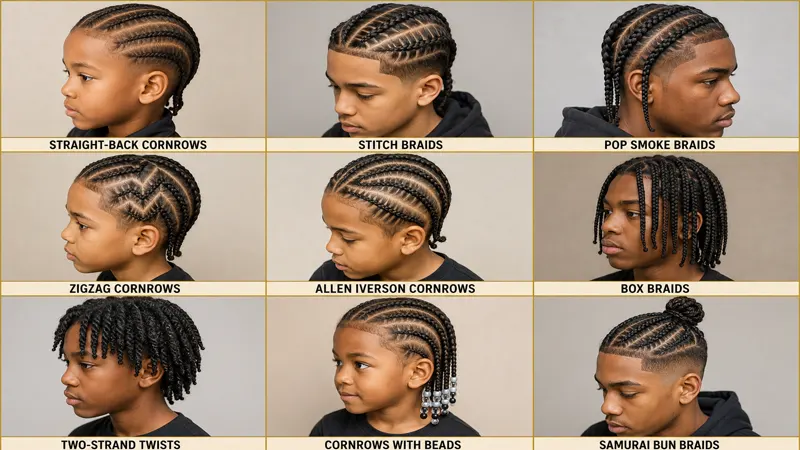
Cornrow-Based Styles
1. Straight-Back Cornrows
The classic. 4–8 rows running from forehead to nape. Low-maintenance, school-friendly, suits all ages.
2. Stitch Braids
Cornrows with raised lines created by alternating pickup direction. Sharp, modern, signature 2026 look.
3. Pop Smoke Braids
4–6 thick cornrows going straight back. Named after the rapper. Currently the most-requested style for boys 8+.
4. Zigzag Cornrows
Cornrows in zigzag patterns instead of straight lines. Eye-catching for school photos and special events.
5. Allen Iverson Cornrows
Classic basketball-inspired pattern. 8–10 medium-sized cornrows with sharp parts. Timeless and tough.
6. Freestyle Cornrows
Cornrows in creative, asymmetric patterns. No two installations are the same. Best with an experienced braider.
7. Layered Pop Smokes (2–3 Layers)
Pop smokes that split into multiple layers along the head. Bold statement style for tweens and teens.
8. Cornrows with Fade
Cornrows on top, faded sides. Combines braids with a fresh modern taper. Best for older kids.
Box Braids & Individual Braids
9. Classic Box Braids
Individual braids in square sections. Can be done with natural hair only or with extensions for length.
10. Knotless Box Braids
Gentlest option — no tension knot at the root. Best for kids with sensitive scalps or fragile hair.
11. Mini Box Braids
Small, neat box braids that can be styled in many ways. Great for older kids who want versatility.
12. Individual Plaits (Natural Hair Only)
Simple 3-strand braids without extensions. Best for everyday wear and active kids.
Twist Styles
13. Two-Strand Twists
Easier and faster than braids. Two strands twisted together. Great for first-time clients and toddlers.
14. Twisted Cornrows
Cornrows made with two-strand twists instead of three-strand braids. Faster install, similar look.
15. Senegalese Twist Braids
Two-strand twists with extensions for length. Lighter feel than full box braids.
Special & Decorative Styles
16. Cornrows with Beads
Add beads to the ends of single braids or at intersections. Beautiful for special events and family photos.
17. Single Back Braid (Viking)
One thick cornrow down the center with shaved or short sides. Bold warrior style for confident boys.
18. Braid Bun / Man Bun
Cornrows or twists gathered into a bun at the crown or back of the head. Stylish and out-of-the-way.
19. Tribal-Inspired Cornrows
Geometric or symbolic patterns connecting to African cultural designs. Beautiful cultural connection.
20. Cornrows with Curly Ends
Cornrows that transition into free-flowing curls or twists at the back. Adds visual interest.
21. Spider Braids
Intricate web-like patterns starting from the middle and radiating outward. Specialty design.
22. Star/Heart Pattern Cornrows
Cornrows with star or heart-shaped parts. Loved by younger kids for the design element.
23. Crossover Cornrows
Cornrows that cross or weave over each other in patterns. More elaborate than straight-back.
24. Mohawk Braids
Cornrows in the middle, shaved or very short sides. Edgy style for older kids who want to stand out.
25. Side-Swept Cornrows
All cornrows flowing to one side instead of straight back. Modern asymmetric look.
School-Friendly Braid Choices
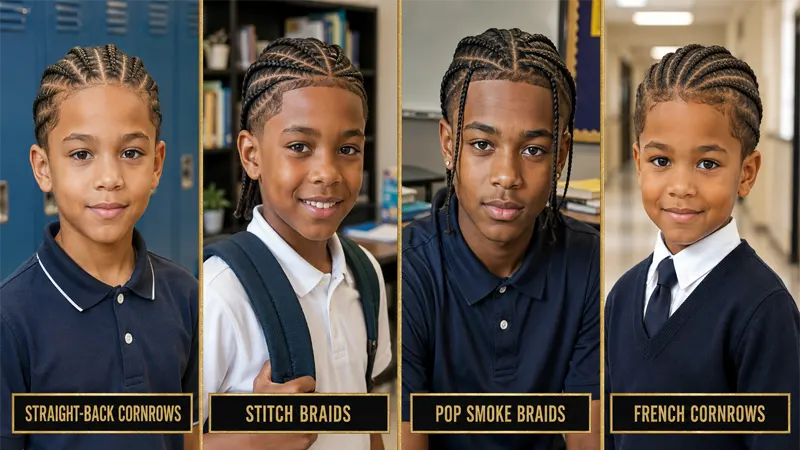
School dress codes vary widely. Some schools welcome all braided styles; others restrict colored extensions, beads, or "extreme" patterns. To avoid getting your kid sent home or in trouble:
| School Type | Safest Choices | Often Restricted |
|---|---|---|
| Strict private school | Straight-back cornrows, simple stitch braids, no extensions | Colored extensions, beads, mohawk-style, layered pop smokes |
| Religious school | Simple cornrows, classic styles | Long box braids, "extreme" patterns, anything trend-driven |
| Charter school | Most braids OK — check handbook | Varies — always verify |
| Public school | Most braid styles welcome (protected by CROWN Act in many states) | Rarely restricted — but check first |
Parent's Pre-Appointment Checklist
A successful braiding appointment with a child requires preparation. Here's everything to do before the big day:
✅ Parent's Pre-Appointment Checklist
- Schedule wisely: Book the appointment for your child's best time of day (morning for early risers, after nap for younger kids). Avoid hungry or tired hours.
- Wash hair 24 hours before: Use clarifying shampoo. Skip leave-in conditioner on the day. Hair should be clean and product-free.
- Detangle thoroughly: Comb out all knots and tangles the night before. Tangled hair causes pain and breakage during braiding.
- Trim split ends 1–2 weeks prior: Braids look neater on healthy ends.
- Feed them a real meal first: Snacks during the appointment work, but a hungry kid is a fidgety kid.
- Bring entertainment: Tablet with downloaded shows, headphones, favorite toys, coloring books.
- Pack snacks and water: Hands-free finger foods work best (crackers, grapes, granola bars).
- Dress for the chair: Comfortable button-up shirt or zip-up (nothing to pull over the head later).
- Bring reference photos: 2–3 photos of the exact style you want.
- Bring extensions if needed: Ask if the braider supplies or if you should bring your own. Xpression and FreeTress are standard brands.
- Set realistic expectations with your child: Explain how long they'll need to sit and what to expect. Praise them for cooperating.
- Have a "tap out" signal: If your kid feels pain, they should know they can tell the braider — without you advocating for them.
What to Say to the Braider — Parent Scripts
Clear communication prevents bad experiences. Use these scripts when you meet the braider:
Opening the Appointment
"Hi, this is [child's name]. He's [age] and this is his [first/second/regular] time getting braids. He can sit for about [X] minutes before needing a break. We'd like [style name] today and I brought reference photos. Please use MEDIUM tension — he has a sensitive scalp."
If the Tension Seems Too Tight
"Excuse me, can we check the tension on those braids? He's saying it hurts and I want to make sure we're not pulling too hard. Let's loosen the front rows."
For the Final Check
"Can he walk around and check how it feels? Also, can you tell me the best way to wash these and how often? When should we come back for the takedown or refresh?"
Tension & Comfort — Critical for Kids
This is the single most important section. Children's scalps are more sensitive than adults', their hair follicles are still developing, and they're more susceptible to traction alopecia (hair loss from tension). Get tension wrong and your child can develop bald spots that may not grow back.
- Your child cries, complains of sharp pain, or eyes water from pulling
- You see red dots or "white bumps" forming where braids were just installed
- The scalp is visibly red beyond normal pinkness
- Your child can't move their eyebrows or feels facial tightness
- The braider is using force or visible effort to tighten
Always insist on MEDIUM tension — firm enough that braids last, loose enough that your child is comfortable. If a braider gets defensive when you ask them to loosen, leave. There are many skilled braiders who understand kids' needs.
Maintenance for Active Kids
Boys are usually rougher on their hair than girls — sports, swimming, sleepovers, rough-and-tumble play. Here's how to keep their braids fresh despite the activity:
Sports & Athletic Activities
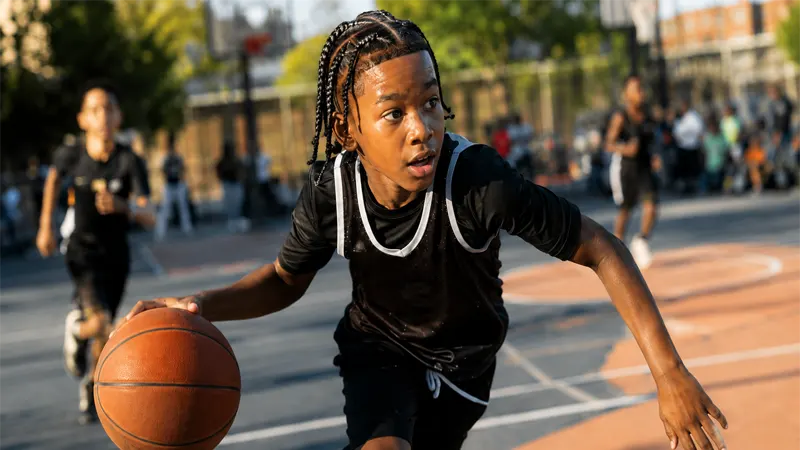
- Football, basketball, soccer: Most braids are sports-friendly. Pop smoke braids and cornrows specifically excel for athletes.
- Wrestling/martial arts: Tight individual braids or box braids work best. Avoid long flowing styles that opponents can grab.
- Swimming: Always wear a swim cap. Chlorine and saltwater accelerate frizz and dryness. After swimming, rinse with fresh water within an hour.
- Helmet sports (football, baseball): Stick to flat cornrows. Box braids and bulkier styles don't fit comfortably under helmets.
Sleep & Bedtime
- Satin or silk bonnet/scarf: Non-negotiable for kids who want braids to last. Cotton pillowcases destroy braids overnight.
- For toddlers who pull off bonnets: Use a satin pillowcase instead. Same protection without the resistance.
- Bedtime moisture spray: Light leave-in conditioner spray helps prevent dryness. Apply to the scalp, not the braids.
Daily Care
- Light scalp moisturizing 2–3 times per week: A few drops of jojoba or castor oil on the scalp.
- Edge touch-ups: Use a small amount of braiding gel or edge control and a soft baby brush. See our braiding gel guide for kid-safe options.
- Wash every 2–3 weeks: Diluted shampoo applied with an applicator bottle directly to the scalp.
- Always dry completely after washing: Damp braids develop mildew. Use a hooded dryer on low or air-dry fully.
10 Common Mistakes Parents Make
❌ Skipping the prep wash before appointment
Fix: Always wash 24 hours before. Dirty hair grips poorly and braids look frizzy on day 2.
❌ Letting the braider go too tight to "make them last longer"
Fix: Tension shouldn't be a trade-off for longevity. Skilled braiders achieve both at proper tension. Tight braids cause traction alopecia.
❌ Choosing styles based on appearance, not your child's daily life
Fix: A football player needs different braids than a kid who studies all day. Match the style to the lifestyle.
❌ Forgetting to verify school dress code first
Fix: Check the handbook or email the teacher BEFORE the appointment. Save yourself the conflict.
❌ Booking with a braider who only does adult styles
Fix: Find a braider experienced with children specifically. Their patience and tension awareness is different.
❌ Leaving braids in too long (past 4 weeks for kids)
Fix: Kids' hair is more fragile. Take down at 3–4 weeks max, even if braids still look OK.
❌ Not protecting hair at night
Fix: Satin bonnet or pillowcase every night, no exceptions.
❌ Ripping braids out instead of unraveling carefully
Fix: Spray with diluted conditioner, unravel section by section. Rushing causes major breakage.
❌ Using heavy adult products on kids' hair
Fix: Lighter formulas. Adult-strength gels and oils overwhelm children's fine hair.
❌ Re-braiding immediately after takedown
Fix: Let hair rest 1–2 weeks between styles. This gives the scalp time to recover and grow.
Cost Breakdown
| Style | Time | Cost (Salon) | Cost (Mobile/Home) |
|---|---|---|---|
| Basic cornrows (toddler) | 30–45 min | $25–50 | $20–40 |
| Straight-back cornrows | 1–2 hr | $40–80 | $30–60 |
| Stitch braids | 1.5–2.5 hr | $60–100 | $50–80 |
| Pop smoke braids | 1.5–2.5 hr | $60–120 | $50–90 |
| Layered pop smokes | 2–3.5 hr | $80–150 | $70–120 |
| Box braids (no extensions) | 2–3 hr | $80–130 | $60–100 |
| Box braids (with extensions) | 3–5 hr | $120–250 | $100–200 |
| Knotless box braids | 3–6 hr | $150–300 | $120–250 |
| Designs with beads/extras | +30–60 min | +$20–40 | +$15–30 |
Tip: Tip your braider 15–20% if you're happy with the work. Children's braiding requires extra patience — a generous tip builds a long relationship with someone you'll likely use repeatedly.

Can Parents Do Braids at Home?
Yes — and it's a beautiful bonding experience. But manage expectations: at-home braiding requires practice, and your first attempts won't look like salon work. Here's where to start:
Best Styles for At-Home Beginners
- Simple two-strand twists — easiest to learn, no actual braiding technique needed
- Basic 3-strand plaits on natural hair only — practice on doll hair first
- 3–4 simple cornrows — once you've mastered plaiting, try flat-against-the-scalp cornrowing
- Single back braid — easiest cornrow variation
What NOT to DIY (Yet)
- Box braids with extensions — too technical for beginners
- Knotless braids — require specific feeding-in technique
- Pop smoke braids — sizing and parting matter; pros do this best
- Decorative patterns — start simple, build complexity over months
Honoring the Cultural Heritage
Boy braids carry generations of cultural significance, especially in African and African American communities. Cornrows have been worn by men and boys across Africa for thousands of years, signaling everything from tribal affiliation to spiritual status. Modern styles like pop smoke braids, Allen Iverson cornrows, and stitch braids continue this tradition in contemporary contexts.
If you're a parent from outside these communities braiding your son's hair, do so with respect and education. Read about the history, support Black-owned braiding businesses, and teach your child the significance of what they're wearing. For deeper context, see our comprehensive African hair braiding guide.
- African Hair Braiding Guide 2026 — full guide on styles, install, and cultural context
- Best Braiding Gel 2026 — kid-safe products and reviews
- Blowout Taper Haircut — pair fades with cornrows for teen styles
- Line Up Haircut Guide — sharp edges for the cleanest braid look
- Cowlick Management — handle stubborn hair patterns before braiding
- Slavic Braids Guide — different cultural braid tradition for comparison
Braids for Boys — Frequently Asked Questions
At what age can boys start getting braids?
Boys can start getting simple braids as young as 1–2 years old, but install times and styles need to match their attention span. Toddlers (1–3) can handle 20–30 minute appointments for basic cornrows or twists. By age 4–5, most boys can sit for 1–1.5 hours. By age 7+, almost any style is possible with breaks. Avoid extensions on very young children (under 5–6) to protect their developing follicles.
How long do braids last on boys?
Most braids on boys last 2–4 weeks, shorter than adult styles because boys are more active and rougher on their hair. Cornrows typically last 2–3 weeks. Box braids and pop smoke braids can last 3–4 weeks with good care. Beyond 4 weeks, kids' braids start to look frizzy and matting risk increases. Plan for takedown at 3–4 weeks for best hair health.
How much do boys' braids cost?
Costs vary by style, location, and braider experience. Basic cornrows for toddlers: $25–50. Straight-back cornrows: $40–80. Stitch braids or pop smoke braids: $60–120. Box braids: $80–250 depending on extensions. Mobile braiders in your home typically cost 20–30% less than salon prices. Always tip 15–20% for great work.
Are braids bad for boys' hair?
Properly installed braids are actually protective for boys' hair, reducing daily manipulation damage. Problems only arise from: braids installed too tightly (traction alopecia), leaving styles in too long (over 4 weeks for kids), failing to moisturize the scalp, or sleeping without satin protection. With proper care, braids support hair growth and length retention.
What's the most popular boy braid style in 2026?
Pop smoke braids are the single most-requested style for boys age 6+ in 2026. Named after the late rapper Pop Smoke, the style features 4–6 thick cornrows going straight back. Layered pop smokes (2–3 layered cornrow rows) are growing rapidly. For younger boys, stitch braids and freestyle cornrows dominate.
Can boys with short hair get braids?
Yes — but the minimum length is about 2 inches. Below that, hair can't grip into a braid pattern. For very short hair, two-strand twists or mini braids work better than cornrows. As hair grows longer, more styles become possible. Most braiders won't braid hair shorter than 1.5–2 inches because the result won't hold.
How do I make my son's braids last longer?
Six things: (1) Satin or silk bonnet/pillowcase every night, (2) Wash only every 2–3 weeks with diluted shampoo, (3) Light scalp moisturizer 2–3 times weekly, (4) Edge touch-ups with kid-safe gel weekly, (5) Wear swim cap in pools, (6) Plan takedown by Week 3–4, not later. Active kids may need slightly more refreshes — that's normal.
Can I braid my son's hair myself?
Yes, with practice. Start with simple two-strand twists (no actual braiding technique needed). Move to basic 3-strand plaits on the natural hair. Then attempt 3–4 simple straight-back cornrows. Watch beginner tutorials on YouTube, practice on a doll head first, and accept that your first 5–10 attempts will look amateur. Avoid trying box braids with extensions, knotless braids, or pop smokes until you've mastered basic cornrowing.
Will my son's school accept braids?
The CROWN Act prohibits hair discrimination in schools and workplaces in many U.S. states. However, individual school dress codes still vary. Public schools rarely restrict natural braided styles. Strict private and religious schools may restrict colored extensions, beads, mohawks, or "extreme" styles. Always check the handbook or email the teacher BEFORE the appointment to avoid conflict.
How do I take down my son's braids without breakage?
Spray each braid with diluted conditioner (1:4 with water). Cut off extensions first if applicable. Unravel each section gently with fingers — never rip or comb through tight knots. Detangle each freed section as you go. After all braids are removed, do a pre-shampoo oil mask for 30 minutes before washing with a clarifying shampoo. Deep condition for 30+ minutes. Let hair rest 1–2 weeks before re-braiding.
What products should I use on my son's braids?
Look for kid-safe, gentle formulas: light leave-in conditioner sprays for moisture, alcohol-free braiding gels for edges, jojoba or castor oil for scalp nourishment. Brands like Aunt Jackie's Baby Girl line, Mielle Organics, and SheaMoisture's kids range work well. Avoid heavy adult-formula products, anything with sulfates or parabens, and strong fragrances that may irritate sensitive scalps.
This guide reflects current best practices for braiding children's hair in 2026. Every child's hair and scalp is different — adjust techniques and styles based on your son's individual needs. If you notice unusual hair loss, scalp irritation, or pain that persists after takedown, consult a pediatric dermatologist.
