



Quick answer: A line up haircut (also called shape up, edge up, or outline) is the barbering technique that creates crisp, sharp lines along the forehead, temples, sideburns, and neckline. Using clippers or a straight razor, the barber sharpens your natural hairline into clean 90-degree angles for a polished finish. Line ups work with any haircut — fades, buzz cuts, afros, curly tops, and more. Touch-ups are needed every 1–2 weeks as hair grows back. A good line up costs $10–30 as an add-on, or comes included with most full haircuts. Critical warning: A bad line up can permanently damage your natural hairline — always choose an experienced barber.
What Is a Line Up Haircut?
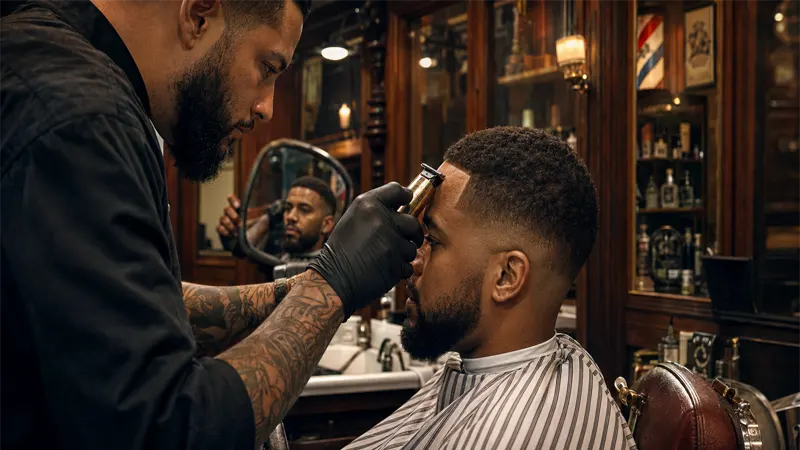
A line up haircut isn't a haircut on its own — it's the finishing detail that defines the edges of any haircut you wear. Using clippers with a very short guard (or no guard) or a straight razor, the barber sharpens your natural hairline along four key areas: the forehead (the top of your hairline), the temples (the sides above your ears), the sideburns (in front of your ears), and the neckline (the back of your head where hair meets neck).
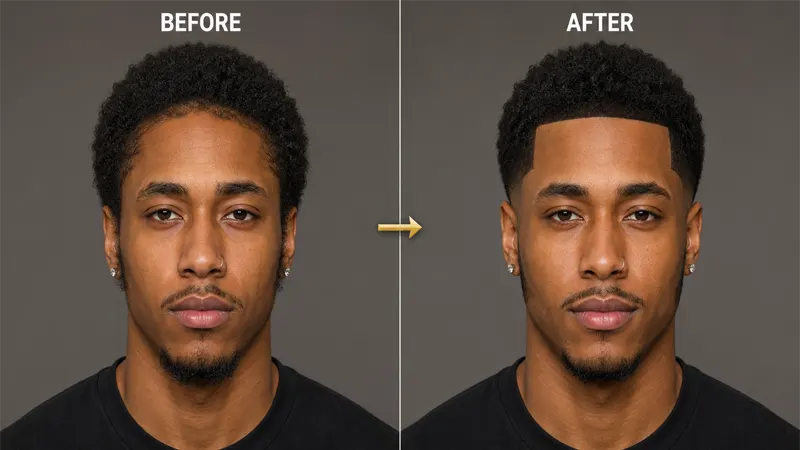
The result is a tidy, almost geometric appearance with crisp 90-degree angles where the hair meets the skin. The visual effect is dramatic: a haircut that would otherwise look "fine" becomes "fresh." A line up is the single biggest difference between a good haircut and a great one. It's why men leaving a barbershop look so much sharper than they did walking in.
Line ups are sometimes called shape ups, edge ups, or outlines. These terms are used interchangeably depending on region — in NYC barbershops it's usually "line up," in LA "edge up," in Chicago "shape up." All refer to the same technique.
Line Up vs Natural Hairline
Your natural hairline is where your hair actually grows. A line up artificially defines that hairline by removing the irregular peach-fuzz hairs at the edges and creating sharp, straight or slightly curved lines instead. The barber doesn't follow your natural hairline exactly — they straighten it, sharpen the corners, and create geometric precision.
Why Get a Line Up?
- Instant style upgrade. A line up makes any haircut look freshly done — even an older cut looks new with sharp edges.
- Polished appearance. Critical for professional settings, photo days, special events, and dating.
- Works with every haircut. Buzz cuts, fades, afros, curly tops, dreads — line ups enhance them all.
- Affordable upgrade. Often free as part of a full haircut, or $10–30 as a touch-up service between cuts.
- Cultural significance. Line ups have deep roots in Black, Latino, and urban barbershop traditions. Getting one shows you understand grooming detail.
- Photographs incredibly well. Sharp lines look amazing in selfies, professional headshots, and social media content.
20+ Line Up Haircut Styles for 2026
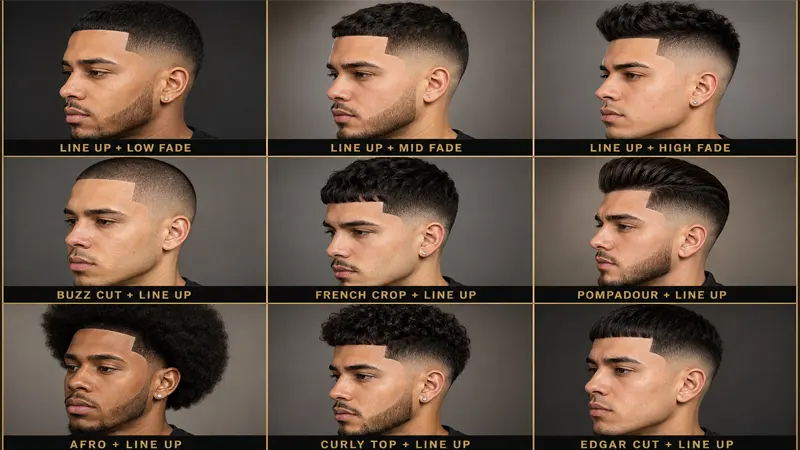
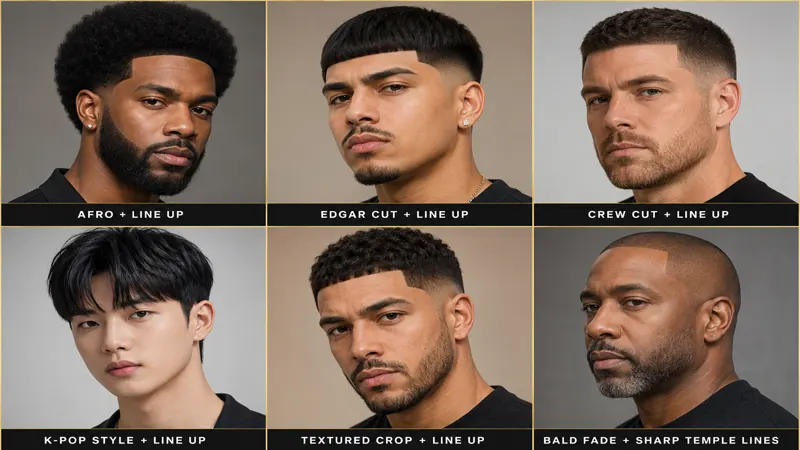
The "line up" itself is consistent — sharp edges — but it pairs with countless haircuts. Here are the most popular combinations:
Line Up + Fade Combinations
1. Line Up + Low Taper Fade
The most universal combination. Subtle low fade with crisp lines. Office-friendly and versatile. Works for nearly every man.
2. Line Up + Mid Fade
Fade starts at temple-height. Creates more contrast. Slightly bolder look while still everyday-appropriate.
3. Line Up + High Fade
Fade starts above the temples. Maximum contrast between top and sides. Sharp, modern, statement-making.
4. Line Up + Skin Fade
Fade goes all the way to skin at the bottom. Maximum precision and impact. Requires weekly touch-ups to maintain.
5. Line Up + Burst Fade
Fade curves around the ear in a semicircle. Pairs well with mullets and mohawks. Trending heavily in 2026.
6. Line Up + Drop Fade
Fade dips behind the ear instead of straight across. Modern, follows the natural head curve. Premium barbershop aesthetic.
Line Up + Hair Length Combinations
7. Buzz Cut + Line Up
Even-length buzz on top with sharp clean edges. Maximum sharpness with minimum maintenance. Military-clean appearance.
8. Crew Cut + Line Up
Classic short haircut elevated by sharp edges. Timeless and professional.
9. French Crop + Line Up
Short textured fringe with razor-sharp edges. Currently trending. Looks especially good on straight hair.
10. Caesar + Line Up
Short cut with horizontal fringe. The line up emphasizes the sharp forward angle of the Caesar.
11. Pompadour + Line Up
Voluminous top with crisp edges below. Elvis-meets-modern aesthetic. Very polished.
12. Quiff + Line Up
Pushed-back quiff with defined edges. Professional and dynamic.
13. Textured Crop + Line Up
The most-requested haircut in 2026, enhanced by sharp edges. Effortless cool.
14. Mid-Length Slicked Back + Line Up
Longer hair brushed back with sharp temple lines. Wall Street executive aesthetic.
Curly & Textured Hair Line Ups
15. Afro + Line Up
Natural afro with sharply defined edges. The classic Black barbershop signature. Massive aesthetic impact.
16. Curly Top + Skin Fade + Line Up
Voluminous curls on top with skin fade and sharp edges. Maximum contrast between texture and precision.
17. Wavy Top + Line Up
Natural waves enhanced by sharp boundaries. Subtle but striking.
18. Waves (360 Waves) + Line Up
Brushed waves on top with crisp edges. Black barbershop heritage. Requires brush work between cuts.
19. Dreads + Line Up
Locks pulled back or styled with clean edges around the hairline. Combines tradition with precision.
20. Cornrows + Line Up
Sharp edges complement cornrow braids. Maximum precision look.
Specialty & Cultural Style Variations
21. Edgar Cut + Line Up
Latino-inspired short blunt fringe with razor-sharp edges. Boxy outline, mid or high fade. Currently dominant in barbershops.
22. Designs + Line Up
Sharp edges combined with hair tattoos or shaved designs etched into the fade. Maximum creative expression.
23. Hard Part + Line Up
A clipper-shaved line forming a part on one side, combined with crisp edge work. Vintage barbershop aesthetic.
24. Beard Line Up
Sharp edges defined into your beard line — cheeks, jaw, and neckline. Pairs with a hair line up for total facial structure.
Best Line Up Style by Face Shape
| Face Shape | Best Line Up Style | Why It Works |
|---|---|---|
| Oval | Any line up style works | You can wear anything — start with what matches your personal style |
| Round | Square line up at temples + high fade | Adds angles to balance soft curves; visually elongates the face |
| Square | Slightly rounded line up corners + mid fade | Softens already-strong jaw; prevents face looking too angular |
| Heart-shaped | Sharp temple lines + textured top | Balances narrow chin with structured top width |
| Long/Oblong | Lower line up start + low fade | Adds visual width to balance length; avoids further elongation |
| Diamond | Soft-curve line up + drop fade | Reduces angularity at cheekbones; creates harmony |
Clippers vs Straight Razor — Which Is Better?
| Tool | Pros | Cons |
|---|---|---|
| Clippers | Less skin irritation, easier to control, less risk of cuts, faster for novice barbers, beginner-friendly for DIY | Less crisp than razor finish, can leave slight stubble, edges aren't as sharp |
| Straight Razor | Crispest possible edge, true skin-level finish, longest-lasting sharp look, most premium aesthetic | Higher skin irritation risk, requires experienced barber, more expensive, longer healing if cuts occur |
Exact Barber Scripts
For Your First Line Up
"Can I get a line up with my haircut today? Please work within my natural hairline — don't push it back. Square corners at the temples, clean forehead line, and define the sideburns. Finish with a light razor pass for the crispest edge. Show me a mirror at the end so we can verify before I leave."
For Touch-Up Between Haircuts
"Just a line up touch-up today — no full haircut. The lines have grown out a bit. Please refresh the forehead, temples, sideburns, and neckline. Match the exact placement from my last cut. Don't push my hairline further back than where it currently sits."
For Maximum Sharpness (Special Occasion)
"I've got [event] coming up — I need the crispest possible line up. Clippers first, then a careful straight razor finish. Take your time. I want sharp 90-degree angles at the temples and a perfectly straight forehead line. If you usually use clipper guards smaller than your standard, today's the day."
If You Have Concerns About Hairline Damage
"I'm noticing my hairline has moved back over the last few line ups. Today I want to STOP this. Please work behind my current line — don't go further back. Even if it looks slightly less symmetrical, I want to preserve what I have. Going forward, work within these boundaries every visit."
DIY Line Up Touch-Ups at Home
Between barber visits, you can maintain your line up at home with the right tools and technique. Here's how:
Tools You Need
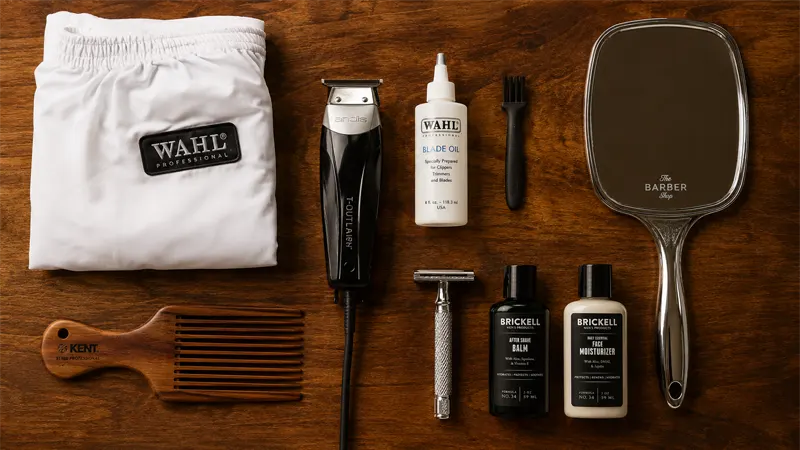
- Quality hair trimmer (T-blade or detail trimmer) — Andis T-Outliner, Wahl Detailer, or Babyliss Pro recommended. Avoid cheap clippers with dull blades.
- Adjustable mirror setup — A 3-way mirror or two mirrors angled so you can see all sides of your head simultaneously.
- Blade oil and brush — Keep your trimmer clean and sharp.
- Hand-held mirror — For checking back of head.
- Optional: Single-blade safety razor — For the crispest finish (only if experienced).
- Aftercare: Aftershave balm or alcohol-free moisturizer for irritation prevention.
Step-by-Step DIY Process
- Position yourself. Set up your mirrors to see your face and sides clearly. Good lighting is critical — direct overhead light works best.
- Identify your existing line. Look at where your barber left the line last time. THIS is your boundary — never go beyond it.
- Start at the front (forehead). Use your trimmer with the closest setting. Move slowly along the existing line, removing only the hairs that have grown back into the previous "clean zone."
- Work the temples. Create or maintain the 90-degree angles at the temples. This is the trickiest part — go slow and use the existing line as reference.
- Define the sideburns. Match the line of the previous trim. Both sideburns should end at the same height — use your earlobe as a reference point.
- Touch up the back (with hand mirror). The neckline is the hardest to see. Use a hand mirror angled at the back of your head while looking at the main mirror.
- Verify symmetry. Check that both sides match. Use your eyebrow line as a reference for the temple height.
- Apply aftercare. Wipe down with a cool cloth, then apply moisturizer or aftershave balm to prevent razor bumps.
Maintenance Schedule
How often you need touch-ups depends on hair growth rate and how sharp you want to stay:
| Growth Rate | Touch-Up Frequency | Cost per Year |
|---|---|---|
| Slow grower | Every 14 days | $520–780 |
| Average | Every 10–12 days | $650–950 |
| Fast grower | Every 7–10 days | $780–1500 |
| Special occasions only | Weekly or as needed | $50–200 per event |
10 Common Line Up Mistakes
❌ Going to an inexperienced barber for your first line up
Fix: Find a barber whose Instagram shows clean line up examples. The line up is the first place to evaluate a barber's skill — if their lines aren't sharp on other clients, yours won't be either.
❌ Letting your barber push your hairline back repeatedly
Fix: Track where your hairline is now. If you notice it moving backward over multiple visits, speak up. Switch barbers if necessary.
❌ Trying to fix uneven sides yourself
Fix: If your sides are uneven, take it to a professional. DIY corrections almost always make asymmetry worse.
❌ Waiting too long between touch-ups
Fix: After 2–3 weeks, the regrowth makes your haircut look "old." Touch up at the 1–2 week mark for maximum freshness.
❌ Not asking for symmetry verification
Fix: Always ask the barber to show you both sides in the mirror before finishing. A small adjustment is easy in the chair; impossible after you leave.
❌ Using dull trimmer blades for DIY
Fix: Dull blades pull hair instead of cutting cleanly. Replace your trimmer blade every 6–12 months. Oil after every use.
❌ Pressing too hard with clippers
Fix: Sharp blades cut without pressure. Pressing causes skin irritation, ingrown hairs, and rounded corners.
❌ Skipping aftercare
Fix: Razor irritation can lead to razor bumps and pseudofolliculitis barbae. Apply aftershave balm or moisturizer immediately after.
❌ Cutting against the grain
Fix: Always cut WITH the direction of hair growth. Against the grain causes irritation, ingrown hairs, and uneven results.
❌ Not communicating with new barbers
Fix: Every new barber needs your history. Show photos of your previous line ups. Explain where the line should sit. Don't assume they'll figure it out.
Cultural History of the Line Up
The line up haircut has deep roots in Black American barbershop culture, where precision edge work has been celebrated for generations. Black barbers developed the sharp 90-degree line up as a way to bring artistry and craftsmanship to short and textured haircuts — particularly fades, afros, and waves.
From there, the technique spread into Latino barbershop tradition, particularly Mexican-American and Puerto Rican barbershops where the Edgar cut (with its razor-sharp boxy line) became culturally iconic. The Edgar specifically became the signature haircut of Latino youth across the Americas in the 2010s and 2020s.
By the 2020s, the line up had entered mainstream men's grooming — every major barbershop chain offers it, every major fade requires it, and it's considered a baseline expectation for any modern men's haircut. The Black and Latino barbering communities that developed the technique deserve credit for what's now a universal grooming standard.
Pro Tips From Master Barbers
Aftercare for Healthy Skin
Line ups create micro-irritation along the hairline. Without proper aftercare, this can lead to razor bumps, ingrown hairs, and dark spots. Follow these steps:
- Immediately after the cut: Apply a cool, damp cloth for 30 seconds to calm any irritation.
- Within 1 hour: Apply alcohol-free aftershave balm or moisturizer to the lined-up areas. Avoid products with mint, menthol, or alcohol that sting.
- Day 2: Continue moisturizing morning and night. Avoid harsh facial cleansers in the line up zone.
- Days 2–7: Watch for any signs of razor bumps. If you see small inflamed bumps, apply hydrocortisone cream and avoid further trimming until they clear.
- Day 7+: Resume normal grooming. The skin should be fully recovered.

- Blowout Taper Haircut Guide — pairs with line up for sharp finish
- Modern Mullet Fade Guide — mullet styles need line ups
- Korean Perm for Men — line ups complete K-pop looks
- Viking Haircut Guide — sharp edges complement Viking undercuts
- Cowlick Hair Management — line ups work around cowlick patterns
- African Hair Braiding — braided styles enhanced by line ups
Line Up Haircut — Frequently Asked Questions
How often should I get a line up?
Most men need touch-ups every 1–2 weeks to maintain sharp edges. Fast growers may need weekly visits. Slow growers can stretch to 14 days. The line up grows out faster than the rest of your haircut, so touch-up visits between full cuts are common.
Can a line up damage my hairline?
Yes, if done incorrectly. A skilled barber works within your natural hairline. Bad barbers may push the hairline backward over time, permanently altering your natural growth pattern and making receding hair appear earlier. Always verify your barber respects your natural boundaries, and switch if you notice your hairline moving back.
How long does a line up haircut take?
15–20 minutes for just a line up touch-up. As part of a full haircut, it's typically the final 10–15 minutes of the appointment. Premium barbers spending more time on detail work may take 25–30 minutes for elaborate edge work.
What's the difference between line up, shape up, and edge up?
All three terms refer to the same technique — sharpening the edges of your hairline. Regional terminology varies: NYC and East Coast barbershops typically say "line up," LA and West Coast say "edge up," Chicago and Midwest say "shape up." Some barbers use "outline." All produce the same crisp edge work.
Does a line up hurt?
Not when done correctly. Clipper work is painless. Straight razor work creates light skin irritation similar to shaving, but no pain. Sharp pain or burning during a line up indicates the barber is pressing too hard or using dull tools — speak up immediately.
Can I get a line up if I'm balding?
Yes, but adjust your approach. A line up can actually IMPROVE the appearance of receding hairlines by creating a clean, intentional border instead of an irregular receding edge. Some men with significant hair loss embrace a fully shaved or buzz cut style WITH a line up, which looks intentional rather than balding.
How much does a line up cost?
As an add-on to a full haircut: usually free or $5–15. As a standalone touch-up service: $10–30 at most barbershops, $30–50 at premium shops. Discount chain salons sometimes charge $5–10 for just a line up.
Can I do a line up myself at home?
Yes, with the right tools and patience. Use a quality T-blade trimmer (Andis or Wahl), set up multiple mirrors, and only touch up the existing line — don't try to redesign it. The golden rule: when in doubt, do less. Save complex work for your barber.
What clipper guard size is used for a line up?
Line ups use NO guard — just the bare clipper blade or a T-blade trimmer at zero. The blade cuts at skin level for the crispest possible edge. For the surrounding fade, guards range from 0 (skin) to 4 (longest), but the actual LINE itself is always bare-blade work.
Will a line up work on curly hair?
Yes — line ups look especially striking on curly and textured hair because of the contrast between the soft curl texture and the sharp geometric line. Afros, curly tops, and 360 waves all benefit dramatically from a line up. Use curl cream or moisturizer after trimming to prevent dryness around the cut edges.
What's the difference between a line up and a fade?
A fade is the gradual blend from short hair on the bottom to longer hair on top — it's about LENGTH transition. A line up is the sharp DEFINED EDGE at your hairline — it's about creating crisp borders. Most modern haircuts combine both: a fade going up the sides PLUS a line up at the front and temples. They're complementary techniques.
This guide reflects current 2026 barbering best practices. Individual results depend on hair type, growth pattern, and your barber's skill. For DIY work, take your time and prioritize hairline preservation over aggressive trimming. Consult a licensed barber for personalized advice based on your hair type and face shape.
