


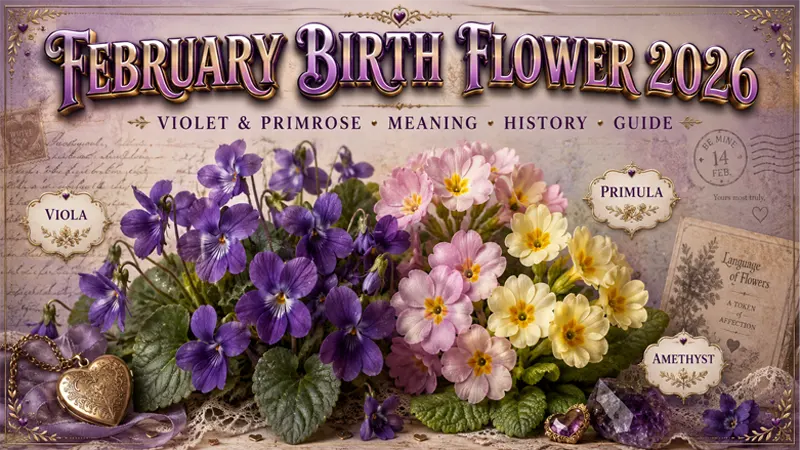

Quick answer: February's primary birth flower is the violet (Viola), symbolizing faithfulness, modesty, devotion, and everlasting love — with deep ties to Greek mythology, Christian Marian symbolism, and the original St. Valentine's Day legend. The secondary February birth flower is the primrose (Primula), Latin for "first" — meaning the first flower of spring, symbolizing young love, renewal, and hope. Some sources also list the iris as an alternative secondary flower. February's birthstone is the amethyst, whose purple hue mirrors the violet beautifully. People born in February span two zodiac signs: Aquarius (Jan 20–Feb 18) and Pisces (Feb 19–Mar 20).
Meet February's Birth Flowers
February is the month of love — Valentine's Day, romance, and the first hints of spring beneath winter's surface. February's birth flowers reflect this perfectly, with both the violet and the primrose carrying centuries of romantic, spiritual, and mythological symbolism.
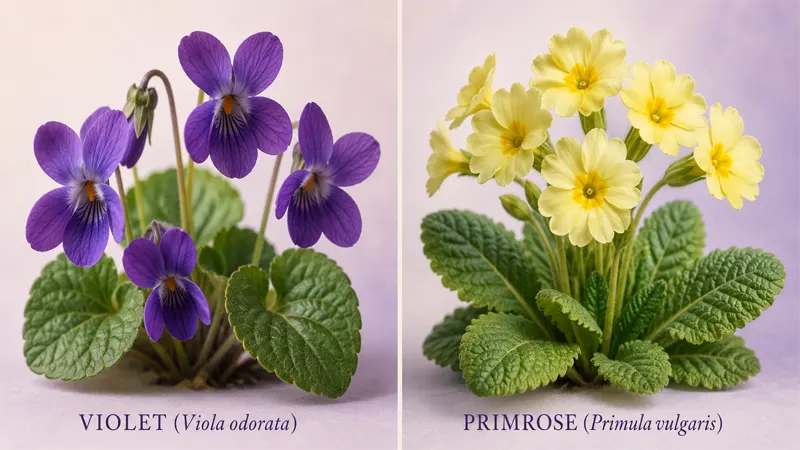
The violet (Viola) is February's primary birth flower — a small, low-growing bloom with heart-shaped leaves and five-petaled flowers typically in deep purple, though variations exist in blue, white, yellow, and cream. The violet's symbolism is rooted in faithfulness, modesty, and enduring love — and remarkably, violets were the original Valentine's Day flower before red roses claimed that distinction in the 20th century.
The primrose (Primula) is February's secondary birth flower — its name literally meaning "first" (from Latin primus), referring to its role as one of the earliest flowers to bloom as winter releases its grip. Where the violet represents faithful love that endures, the primrose represents young love and new beginnings. Together, they cover love's full emotional arc.
Some traditional sources list the iris as an alternative secondary February flower, particularly in older British references. We focus primarily on violet and primrose here, with notes on iris where relevant.
Violet Meaning & Symbolism
The violet carries one of the richest symbolic vocabularies of any flower. Across cultures and centuries, violets have consistently represented:
- Faithfulness and loyalty — a gift of violets traditionally promises constancy
- Modesty and humility — reinforced by the violet's small, ground-hugging stature
- Everlasting love — the original Valentine's Day flower
- Spiritual wisdom and remembrance — used in funerary rituals across cultures
- Innocence and purity — associated with the Virgin Mary in Christian tradition
- Female love and Sapphic symbolism — historically used as a coded symbol within the LGBTQ+ community
- Hidden depth — the violet's elusive fragrance reflects mystery and selective revelation
The violet's botanical name Viola odorata means "sweet-scented violet" — the most fragrant of all violet species. Its other Latin name is "Our Lady of Modesty", signifying the Virgin Mary's humble nature in Christian floriography.
The Sappho Connection
One of the most overlooked aspects of violet symbolism is its connection to female love. The ancient Greek poet Sappho (born c. 630 BCE on the island of Lesbos) wrote frequently about violets in her love poetry to women. In one fragment, she describes a beloved wearing "garlands of violets" — and across many of her poems, violets appear as symbols of romantic affection between women.
This Sapphic legacy carried through history. In the early 20th century, women in the LGBTQ+ community used violets as a discreet symbol of female love, exchanging violet bouquets as a coded gesture. The 1926 Broadway play The Captive popularized this association, and violet sales reportedly dropped temporarily after the play was shut down by authorities who recognized the symbolism. Today, the violet remains a celebrated symbol within Sapphic and lesbian community traditions.
Violet Mythology & Origin Stories
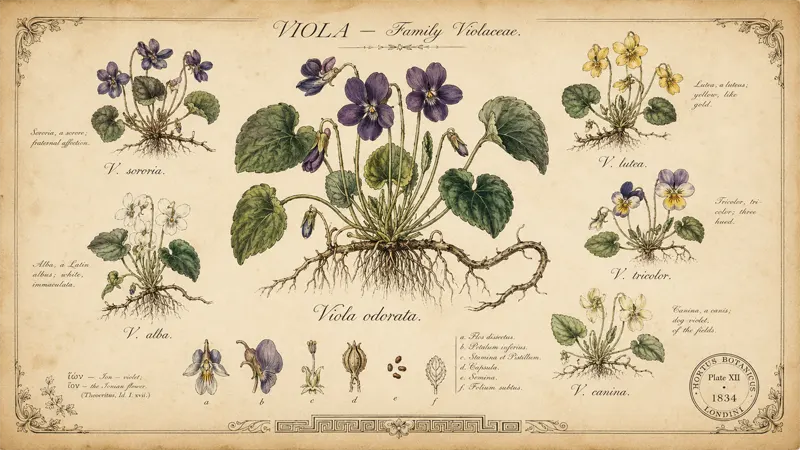
Few flowers have inspired as many origin myths as the violet. Ancient Greek mythology offers several different stories explaining how violets came to exist — each adding a layer of symbolic depth.
🏹 Artemis & the Nymph
One of Artemis's nymph companions had sworn to remain a maiden for life. When Artemis's twin brother Apollo began pursuing the nymph romantically, Artemis transformed her into a violet to protect her chastity. This explains why violets are associated with modesty and innocence.
🐄 Io's Tears
Zeus fell in love with the mortal Io and, to hide her from his jealous wife Hera, transformed her into a white heifer. Io's tears of grief as she grazed in barren fields became violets — sweet flowers to comfort her exile. This story connects violets to bittersweet love and sorrowful beauty.
🎵 Orpheus's Lute
According to one Greek myth, the violet first sprang from the spot where the legendary musician Orpheus laid his enchanted lute (or flute). The flowers bloomed where music had touched the earth, becoming a symbol of artistic beauty and emotional expression.
🌒 Persephone's Underworld
In the Persephone myth, violets bloomed in the underworld where she ruled as queen — and reappeared on earth each spring upon her return. This story makes violets symbols of rebirth, hope, and the cycle between darkness and light.
💌 St. Valentine & the Purple Ink Legend
According to Christian tradition, St. Valentine of Rome was imprisoned for his faith in the 3rd century CE. The night before his execution on February 14th, he crushed violet flowers growing outside his cell window to make purple ink, which he used to write a farewell letter to his jailer's daughter. He signed it "Your Valentine" — beginning the tradition of romantic notes on February 14th. The violet thus predates the rose as Valentine's Day's original flower.
✝️ The Virgin Mary & the Annunciation
In Christian tradition, when the Angel Gabriel told Mary she would bear Jesus, violets bloomed around her to showcase her chastity and faithfulness. The botanical species Viola odorata earned the name "Our Lady of Modesty" because of this association. Medieval monks called violets "flowers of Trinity" due to their spiritual symbolism and groups of three leaves.
Violet's Cultural History
Violets have been culturally significant for over 2,500 years.
Ancient Greece & Rome (500 BCE – 500 CE)
The violet was the sacred flower of Athens, used as the city's symbol. Greek poets wove violet imagery into love poetry — Sappho prominently featured violets as symbols of female romantic love. The Greek philosopher Pythagoras cultivated violets for their calming properties. The Greeks used violet petals for love potions, salad garnish, and ceremonial garlands.
The Romans adopted violet cultivation enthusiastically. Roman violet wine was a delicacy at banquets, and violets featured in funerary rituals as symbols of remembrance for the dead. The violet's role in Roman funeral practice gave us the word "violet" itself, from the Latin viola.
Medieval & Renaissance Europe
Medieval European herbalists used violets to sweeten wine and to treat headaches, insomnia, and skin conditions. Christian monasteries cultivated violets as Marian symbols, planting them around churches and altars dedicated to the Virgin Mary. Renaissance painters featured violets in countless religious works, signaling humility and divine love.
Victorian Era & Floriography
The Victorians elevated violet symbolism to a coded romantic language. A purple violet meant "I'll always be true to you." A cream-colored violet conveyed "Let's take a chance on love together." Sending violets carried a specific, traditional promise — making them ideal for Valentine's Day expressions of love before red roses took over.
Modern Era
Today, violets serve multiple purposes: as ornamental garden flowers (over 650 species exist), as edible decoration (crystallized violets on pastries are a French specialty), as a perfume note (violets contain ionone, a unique fragrance compound), and as cultural symbols (the violet remains the state flower of Illinois, Rhode Island, New Jersey, and Wisconsin).
Violet Colors & What Each Means
Like carnations, violets carry color-specific meanings — though their palette is more limited:
Purple Violet
The classic violet color. Symbolizes faithfulness, devotion, and "I'll always be true." Used for romantic gifts and to promise loyalty in Victorian floriography.
Blue Violet
Symbolizes trust, tranquility, and watchfulness. Often associated with calm, contemplative love rather than passionate romance.
White Violet
Innocence, purity, and modesty. Used for newborn baby gifts, baptisms, and as a symbol of pure intentions in romantic gestures.
Yellow Violet
Modest worth and rural happiness. Less common than purple violets but carries gentle, humble symbolism perfect for friendship gestures.
Cream Violet
"Let's take a chance on love together." A specifically romantic Victorian meaning — softer than the purple violet's promise of fidelity, more about new mutual possibility.
Bicolor Violet
Often blue and yellow (or purple and yellow). Symbolizes love that bridges differences — bringing together opposite qualities in harmony.
Primrose Meaning & Symbolism
The primrose's symbolism is fundamentally about firsts — first love, first flowers of spring, first hopes after a long winter. Its name literally means "first" in Latin, and its symbolism reflects everything that emerges in the earliest moments of warmth and renewal.
- Young love — the freshness of romantic affection in its earliest stages
- Hope and renewal — the promise that life continues after winter
- "I can't live without you" — the specific Victorian floriography meaning
- Youth and femininity — each petal sometimes said to represent a stage of a woman's life
- Protection — Medieval European folklore used primroses as protective charms against evil
- Fairy magic — Celtic and Scottish folklore deeply ties primroses to the fairy world
- Spiritual clarity — meditative, contemplative connection to spring
The primrose's downward-curving petals form a delicate cup or "saucer" shape, with five petals that almost always feature a yellow center regardless of the outer petal color. This consistent yellow core is part of why the primrose became associated with the sun's return after winter.
Primrose Mythology & Folklore
The primrose has accumulated rich folklore across European cultures, particularly in Celtic, Norse, and Christian traditions.
Norse: Sacred to Freya
In Norse mythology, the primrose was sacred to Freya (also spelled Freyja), the Norse goddess of love, beauty, fertility, and war. Norse worshippers laid primroses on altars dedicated to her. Some Norse traditions believed Freya herself transformed into a primrose when visiting the mortal world. The primrose's role as Freya's flower made it a powerful symbol of feminine love and divine beauty across Scandinavia.
Greek & Roman: Sacred to Aphrodite & Venus
In Ancient Greece, primroses were associated with Aphrodite (goddess of love). The Romans linked primroses to Venus, their own love goddess. Both traditions used primrose petals in love rituals and aphrodisiac preparations. The primrose's role as a "goddess flower" across multiple love deities cemented its connection to romantic symbolism.
Celtic Fairy Folklore
Celtic folklore is particularly rich in primrose magic. The flowers were believed to be sacred to the fairy folk — planting primroses by the door of your home would invite fairy blessings. Conversely, picking primroses on certain days could anger the fairies. Scottish legend tells that eating primroses would grant the eater the ability to see fairies. Primroses planted at the entrance to fairy mounds were said to mark the boundary between the human world and the fairy realm.
Medieval Christian Symbolism
Medieval European Christians wore primroses around the neck as protection against sickness and evil spirits. Primroses growing wild around monasteries were considered blessed, and monks distilled primrose wine for medicinal purposes. The yellow center of the primrose was sometimes interpreted as a Marian symbol — the light of Mary's love at the center of devotion.
Shakespeare's Favorite Flower
The primrose was reportedly William Shakespeare's favorite flower. He mentioned primroses in multiple works, including A Midsummer Night's Dream, Hamlet, The Winter's Tale, and Cymbeline. The "primrose path" appears as a Shakespearean phrase meaning a path of easy but dangerous pleasure — symbolic of temptation and youthful indulgence.
Charles Darwin's Scientific Curiosity
The famous naturalist Charles Darwin studied primroses extensively, fascinated by their unusual flower structure. He documented "heterostyly" — the phenomenon where primrose plants have either long-style or short-style flowers (never both). His research on primroses contributed significantly to evolutionary biology and plant reproduction theory. Darwin's primrose work was published in 1877.
UK Primrose Day
Primrose Day is celebrated annually on April 19th in Britain, marking the death anniversary of Prime Minister Benjamin Disraeli (1881), whose favorite flower was the primrose. The Primrose League, founded in 1883 to promote Conservative political ideals, grew to over 2 million members by 1910. Members wore primroses as buttonholes and garlands. Though the League has faded, Disraeli's statue in London's Parliament Square is still decorated with primroses every April 19th.
Primrose Colors & What Each Means
Yellow Primrose
The most traditional primrose color, symbolizing happiness, joy, and the return of sunshine. Classic spring renewal.
Pink Primrose
Grace, femininity, gentle affection, and renewal. Often gifted for baby showers or to celebrate feminine milestones.
Purple Primrose
Spiritual healing, intuition, and depth. Connected to spiritual practices and deeper emotional connection.
White Primrose
Purity, innocence, and devotion. Suitable for baby gifts, weddings, and to express pure intentions.
Red Primrose
Bold love and passion. Less traditional but increasingly popular for romantic Valentine's Day gestures involving primroses.
Bicolor Primrose
Many primrose varieties feature striking color combinations. Symbolizes the harmony of multiple feelings — joy and passion together.
February Birthday Personality Profile
February spans two zodiac signs, each connecting beautifully but differently to the month's birth flowers:
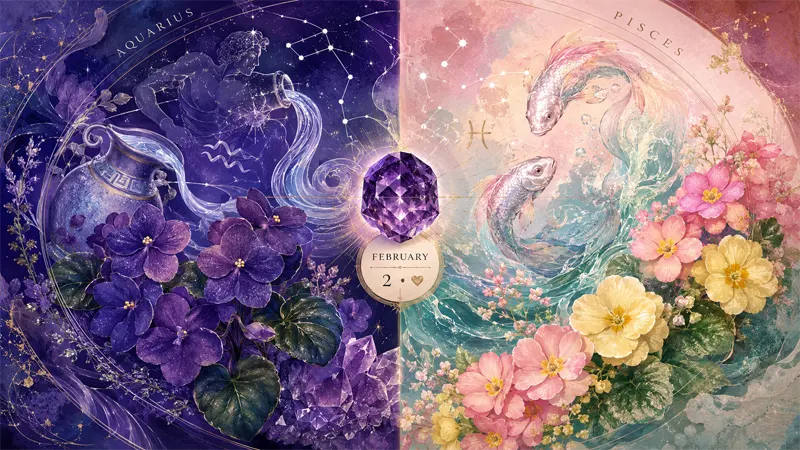
♒ Aquarius (January 20 – February 18)
Aquarians embody the violet. Both have hidden depths revealed selectively. Both carry quiet symbolic power.
- Independent and original thinkers
- Humanitarian values
- Loyal to chosen relationships
- Intellectually curious
- Loves hidden meaning and depth
- Selectively shares their inner world
♓ Pisces (February 19 – March 20)
Pisceans embody the primrose. Both connect to mysticism and fairy folklore. Both speak of beginning and emotional openness.
- Emotionally deep and intuitive
- Creative and imaginative
- Spiritually connected
- Empathetic toward others
- Romantic and idealistic
- Drawn to the magical and unseen
Growing Guide — Violets
Violets are among the easiest birth flowers to grow at home, especially for shade gardens.
- Choose your variety. Sweet violets (Viola odorata) for fragrance and traditional purple blooms. Wood violets (Viola sororia) for native US gardens. Pansies (Viola tricolor) for showier larger blooms with similar care.
- Position in partial to full shade. Violets thrive under deciduous trees where they get spring sun before tree canopies fill in, then shade in summer.
- Provide moist, well-drained soil. Rich in organic matter. Add compost or leaf mold.
- Plant in early spring or fall. Violets establish best in cooler weather. Avoid summer planting.
- Water consistently. Keep soil moist but not waterlogged. Violets dislike drying out completely.
- Mulch around plants. Light mulch helps retain moisture and keeps roots cool.
- Allow self-seeding. Most violet species reseed naturally, creating colonies over time.
- Divide every 3-4 years. If clumps become too dense, divide in early spring or fall.
Growing Guide — Primroses
Primroses require slightly more specific care than violets but reward with abundant late-winter blooms.
- Choose your variety. Common primrose (Primula vulgaris) for traditional yellow blooms. Polyanthus primroses for color variety. Auricula primroses for collectors.
- Plant in dappled or partial shade. Primroses dislike full afternoon sun in warm climates but appreciate morning sun.
- Use rich, moist, well-drained soil. Add peat moss, perlite, and compost to improve texture and water retention.
- Plant after last hard frost. If transplanting from indoors, wait until outdoor temperatures consistently stay above freezing.
- Don't bury the crown. Plant primroses with their crown (where stems meet roots) at soil level — burying causes rot.
- Water at the base, not the foliage. Wetting leaves causes fungal issues. Water consistently — primroses dislike both drought and waterlogging.
- Fertilize lightly. Use a diluted balanced fertilizer once monthly during growing season.
- Deadhead spent flowers. Removing faded blooms encourages continued flowering.
12 February Birth Flower Tattoo Ideas
February birth flower tattoos are especially popular for Valentine's Day-themed designs and romantic commemorations.
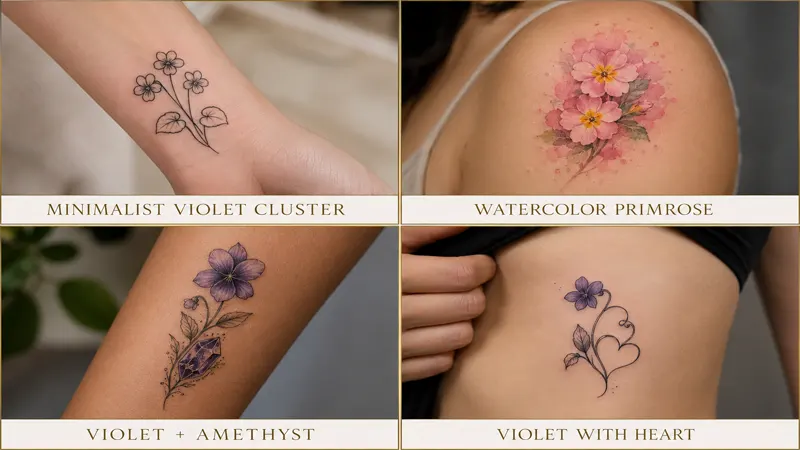
1. Minimalist Violet Cluster
Three small violets in line art, perfect for wrist or behind-ear placement.
2. Vintage Botanical Violet
Victorian flower-dictionary style with detailed shading. Forearm placement.
3. Violet + Heart Combination
Violet with subtle heart shape — playing on Valentine's Day symbolism.
4. Watercolor Primrose
Soft watercolor washes in pinks or yellows. Shoulder or upper arm.
5. Sappho Violet (Sapphic Symbol)
Symbolic violet tattoo honoring Sapphic heritage. Discreet placement.
6. Primrose + Fairy Element
Primrose with delicate fairy wings or fairy silhouette, honoring Celtic folklore.
7. Violet Garland (Greek)
Connected chain of violets in classical Greek garland style.
8. February Date + Flowers
Floral design integrated with birthday in elegant script.
9. Violet + Amethyst Combo
Violet combined with February's amethyst birthstone in purple ink.
10. Primrose Path
Trail of small primroses winding across skin, Shakespearean reference.
11. Heart-Shaped Violet Leaves
Just the heart-shaped violet leaves without flowers — subtle Valentine reference.
12. Couple's Matching Violets
Matching violet tattoos for partners — purple violet meaning "I'll always be true."
Gift Ideas for February Birthdays
February babies enjoy unique gifting opportunities thanks to Valentine's Day in the same month. The birth flowers tie beautifully into the love theme.
Fresh & Floral
- Violet posy — small traditional bouquet promising faithfulness. Especially meaningful from romantic partner.
- Potted primroses — long-lasting indoor or outdoor plant. Available in many colors.
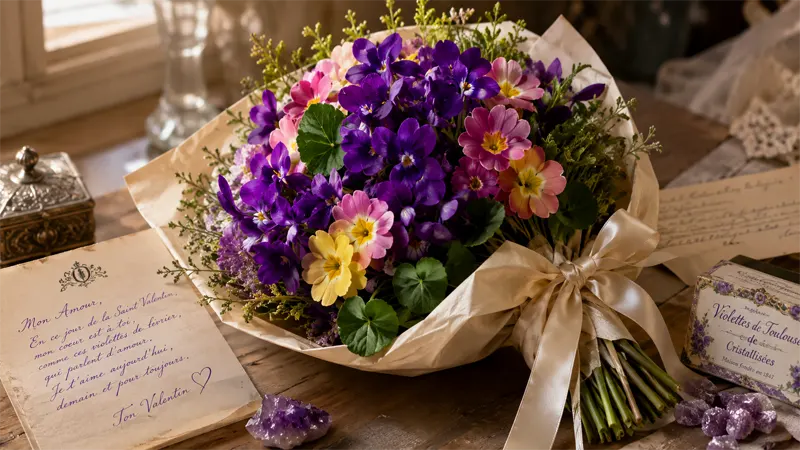
- Mixed violet + primrose arrangement — captures both birth flowers in one bouquet.
- Candied violet petals — French specialty, edible and beautiful for cake decoration.
- Iris bouquet — for those who prefer iris as the alternative secondary flower.
Keepsake & Jewelry
- Violet pendant necklace — delicate gold or silver violet charm jewelry.
- Amethyst + violet ring — combining February's birthstone with birth flower.
- Pressed violet art — real pressed violets preserved in glass.
- Custom botanical print — illustrated violet or primrose print with personalized details.
- Violet perfume — perfumes featuring ionone (violet's signature scent compound). Try Lorenzo Villoresi, Penhaligon's Violetta, or Caron's Aimez-moi.
Experience & Edibles
- Violet syrup or violet liqueur — Crème de Violette for cocktails, especially the classic Aviation cocktail.
- Violet-themed afternoon tea — many high-end tea rooms feature violet-flavoured offerings.
- Primrose seeds and growing kit — for gardening enthusiasts.
- Sapphic-themed gift — for LGBTQ+ February-born loved ones, lean into violet's Sapphic heritage.
February's Valentine's Day Connection
February uniquely combines a birthday for many with the world's most celebrated romantic holiday. February's birth flowers have direct historical ties to Valentine's Day that pre-date the rose's modern dominance.
- Original Valentine flower: Violets, not roses, were the traditional Valentine's Day flower for centuries.
- St. Valentine's violet ink: The 3rd-century saint's farewell letter was written in violet-petal ink, beginning the Valentine letter tradition.
- Greek love potions: Ancient Greek love spells used violets, predating the saint by centuries.
- Sappho's violets: Ancient Greek love poetry by Sappho frequently featured violets in romantic contexts.
- Modern revival: Some florists now offer "traditional Valentine" bouquets featuring violets and primroses rather than red roses — particularly for vintage-themed weddings or those embracing pre-Victorian romantic traditions.
Pairing with Amethyst (February Birthstone)
February's birthstone is the amethyst — a beautiful purple quartz gemstone. The color match between amethyst and purple violets creates an exceptionally cohesive birth-month gift palette.
- Purple Violet + Amethyst: Maximum symbolic intensity. Both purple, both representing faithfulness and protection. Popular for engagement and anniversary gifts.
- White Violet + Amethyst: Contrast between purity and depth. Elegant for memorial or remembrance jewelry.
- Yellow Primrose + Amethyst: Sun and twilight combination. Cheerful yet meaningful.
- Mixed February Bouquet + Amethyst Pendant: The complete February gift — multiple flowers and the birthstone together.
Amethyst's traditional meanings — protection, sobriety, spiritual wisdom, calming influence — complement the violet's faithfulness symbolism beautifully. Together they create one of the most symbolically rich birth-month gift combinations.
Cross-Cultural Variations
February's birth flower assignments vary across cultures and traditions:
- British tradition: Some older British sources list iris (rather than primrose) as the secondary February flower. Iris symbolizes faith, hope, and wisdom — also fitting for the month.
- American tradition: Violet + primrose is the most common pairing in modern US florist tradition.
- Norse heritage: Where Norse-influenced traditions persist (Scandinavia), the primrose carries deeper cultural weight due to its connection to Freya.
- Greek tradition: Violets retain particularly deep cultural significance in Greece, where they were the sacred flower of Athens. Modern Greek violet sweets and pastries continue ancient traditions.
- French tradition: Crystallized violets and violet syrup (Liqueur de Violette) are major French culinary traditions. The city of Toulouse is famous for violet cultivation.
- Korean tradition (hanakotoba): Both violets and primroses appear in the Korean daily flower calendar with similar symbolic meanings to Western traditions.
- Chinese tradition: Violets feature in Chinese poetry and represent humility and friendship.
The Science of Violet's Elusive Scent
One of the violet's most fascinating qualities is its fragrance behavior. Violet scent is famously "elusive" — you can smell it strongly one moment and then completely lose it the next. This isn't subjective experience or sensitivity issue. It's chemistry.
Violets contain a compound called ionone — an unusual aromatic molecule. Ionone has a remarkable property: it temporarily desensitizes the human olfactory receptors that detect it. Within seconds of smelling violets, your nose literally turns off the receptors that perceive the scent. Then, after a brief recovery period, the receptors reactivate and you smell the violet again.
This makes violets one of the few flowers with a "vanishing fragrance" — appearing and disappearing as your sensory receptors cycle. The phenomenon explains why violet perfumes feel mysterious and difficult to grasp. Perfumers love this quality — it creates a scent that constantly surprises and renews.
Edible Uses of February's Birth Flowers
Both violets and primroses are edible (for humans — see pet warning above) and have centuries of culinary use.
Violet Culinary Uses
- Candied violets: Crystallized whole violet flowers — a French specialty for decorating pastries, especially in Toulouse
- Violet syrup: Used in cocktails, lemonades, and desserts. Provides a delicate floral sweetness.
- Crème de Violette: French liqueur essential to classic cocktails like the Aviation
- Violet salad garnish: Fresh violet petals add color and subtle flavor to salads
- Violet tea: Made from dried violet flowers and leaves — calming herbal tea
- Violet jelly and jam: Old European traditional preserves
- Violet ice cream: Modern artisanal ice cream features violet flavoring
Primrose Culinary Uses
- Primrose tea: Made from fresh or dried flowers and leaves — used traditionally for headaches and coughs
- Primrose wine: Old English country wine made from primrose flowers
- Salad garnish: Bright primrose petals add color and mild peppery flavor
- Cake decoration: Fresh primroses make beautiful cake toppers
- Crystallized primrose: Similar to candied violets, primroses can be sugared and preserved
- Primrose oil: Evening primrose oil (different species) is a popular supplement
Important: African Violet vs True Violet
True violets are outdoor woodland plants in temperate climates. African violets are tropical houseplants. While both are beautiful, only true violets carry the February birth flower symbolism, mythology, and edible uses described in this guide.

- Complete Birth Flowers by Month Guide — all 12 months at a glance
- January Birth Flower — Carnation & Snowdrop (previous month)
- March Birth Flower — Daffodil & Jonquil (next month)
- June Birth Flower — Rose & Honeysuckle (compare love symbolism)
- May Birth Flower — Lily of the Valley & Hawthorn (compare spring symbolism)
- April Birth Flower — Daisy & Sweet Pea (compare innocence symbolism)
February Birth Flower — Frequently Asked Questions
What is the birth flower for February?
February has two birth flowers: the violet (Viola) as the primary flower and the primrose (Primula) as the secondary flower. The violet symbolizes faithfulness, modesty, and everlasting love. The primrose symbolizes young love, renewal, and new beginnings. Some traditional sources list iris as an alternative secondary flower.
Why are violets the original Valentine's Day flower?
According to Christian tradition, St. Valentine of Rome was imprisoned in the 3rd century CE and crushed violet flowers from outside his cell window to make purple ink. He used this ink to write a farewell letter to his jailer's daughter the night before his execution on February 14th, signing it "Your Valentine." Ancient Greek love potions also used violets centuries before this. Roses only became the dominant Valentine's flower in the 20th century through commercial marketing.
What do violet colors mean?
Purple violet: "I'll always be true to you" — faithfulness and devotion. Blue violet: trust, tranquility, watchfulness. White violet: innocence and purity. Yellow violet: modest worth and rural happiness. Cream violet: "Let's take a chance on love together." Bicolor violet: love bridging differences.
Are African violets the same as true violets?
No. African violets (Streptocarpus, formerly Saintpaulia) are NOT true violets. They belong to a completely different plant family (Gesneriaceae) and are native to East Africa. True violets (genus Viola, family Violaceae) are temperate-zone woodland plants. Only true violets carry February birth flower symbolism. African violets share only superficial visual similarity.
What is the violet's connection to Sappho and LGBTQ+ symbolism?
The ancient Greek poet Sappho (born c. 630 BCE on Lesbos) wrote frequently about violets in love poetry to women. In the early 20th century, women in the LGBTQ+ community adopted violets as a discreet symbol of female love. The 1926 Broadway play "The Captive" popularized this association. Today the violet remains a celebrated symbol within Sapphic and lesbian community traditions.
Why does the primrose mean "first"?
The name "primrose" comes from the Latin "primus" meaning "first" — referring to its role as one of the first flowers to bloom as winter ends. Some sources translate it as "prima rosa" or "first rose," though the flower isn't botanically related to roses. The primrose's symbolism of new beginnings and young love stems directly from its early-spring blooming behavior.
What is Primrose Day?
Primrose Day is celebrated annually on April 19th in Britain, marking the death anniversary of Prime Minister Benjamin Disraeli (1881), whose favorite flower was the primrose. The Primrose League, founded in 1883 to promote Conservative ideals, grew to over 2 million members by 1910. Members wore primroses as buttonholes. Though the League has faded, Disraeli's statue in London is still decorated with primroses each April 19th.
Why does violet fragrance disappear and reappear?
Violets contain ionone, an aromatic compound with an unusual property: it temporarily desensitizes the olfactory receptors that detect it. Within seconds of smelling violets, your nose literally turns off those receptors. After a brief recovery period, the receptors reactivate and you smell the violet again. This creates the "vanishing fragrance" effect — appearing and disappearing as your sensory receptors cycle.
Can I grow violets and primroses at home?
Yes. Violets grow easily in USDA zones 3-9 in partial to full shade with moist, well-drained soil. They're one of the easiest birth flowers to grow. Primroses also prefer dappled shade and rich, moist soil. Primroses need slightly more attention — keep crown at soil level (don't bury), water at the base not the leaves, and provide consistent moisture without waterlogging.
Are violets and primroses edible?
Yes, both are edible for humans. Violets: candied/crystallized, made into syrup and liqueur (Crème de Violette), used in salads, teas, jellies, and ice creams. Primroses: used in salads, teas, wines, cake decoration. Always use organic flowers from untreated sources — never eat flowers from commercial florists. WARNING: Primroses are TOXIC to cats, dogs, and horses.
What are the personality traits of February babies?
February spans two zodiac signs. Aquarians (Jan 20-Feb 18) embody violet traits: independent, original, loyal to chosen relationships, intellectually curious, loves hidden depth and meaning. Pisceans (Feb 19-Mar 20) embody primrose traits: emotionally deep, creative, spiritually connected, empathetic, drawn to mysticism and the magical. Both share romantic sensibilities — fitting for the month of Valentine's Day.
What was Shakespeare's favorite flower?
The primrose was reportedly Shakespeare's favorite flower. He mentioned primroses in multiple works including A Midsummer Night's Dream, Hamlet, The Winter's Tale, and Cymbeline. The phrase "primrose path" appears in Shakespearean works meaning a path of easy but dangerous pleasure — symbolic of temptation. Charles Darwin also studied primroses, researching their "heterostyly" (different style lengths) — contributing to evolutionary biology.
This guide reflects current understanding of February birth flower symbolism rooted in ancient Greek and Roman mythology, Christian Marian symbolism, Norse traditions, Victorian floriography, and modern floral practice. Personality traits are based on traditional astrology and floriography associations. Primroses are toxic to pets — keep away from cats, dogs, and horses. For medical questions about edible flowers, consult a qualified professional. Only consume flowers from organic, untreated sources.
