


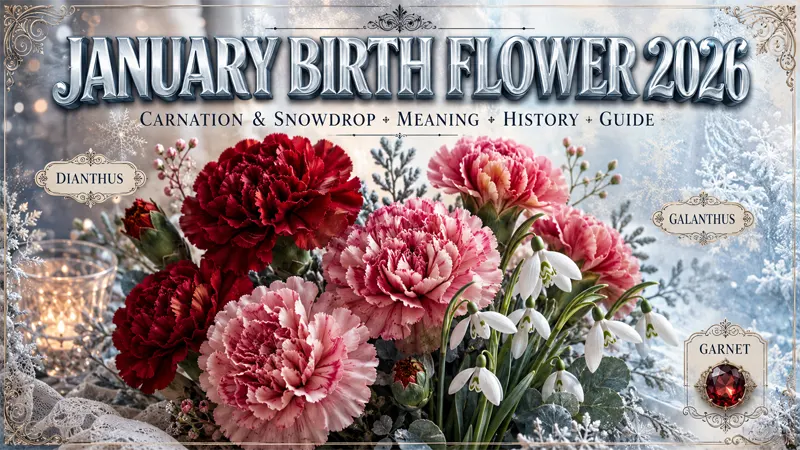

Quick answer: January's primary birth flower is the carnation (Dianthus caryophyllus), symbolizing love, fascination, and distinction with a 2,000-year history. The secondary January birth flower is the snowdrop (Galanthus), representing hope, rebirth, and quiet resilience as it pushes through frozen winter ground. Together, they reflect the spirit of January babies — bold and ruffled like the carnation, yet delicately determined like the snowdrop. January also pairs with garnet as the birthstone, completing a symbolic trio of protection, devotion, and renewal. People born in January span two zodiac signs: Capricorn (Dec 22–Jan 19) and Aquarius (Jan 20–Feb 18), each connecting differently to the month's floral symbolism.
Meet January's Birth Flowers
January is one of the most symbolically rich months in the birth flower calendar — partly because it claims two flowers that capture the full character of midwinter, and partly because both blooms carry over two millennia of cultural meaning.
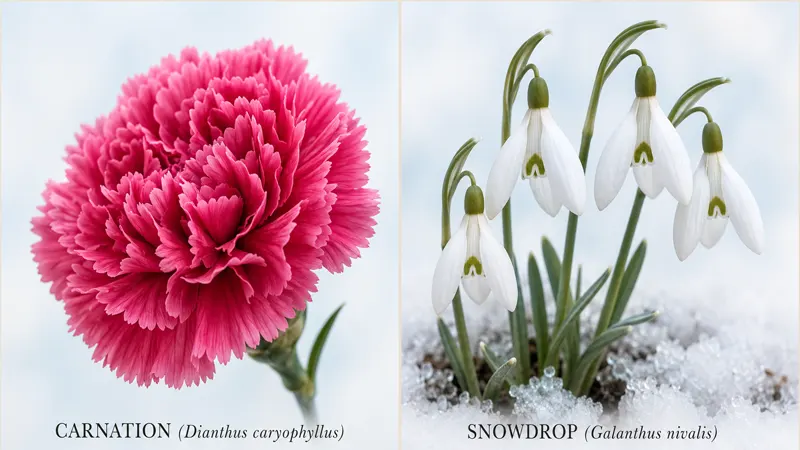
The carnation (Dianthus caryophyllus) is January's primary birth flower — a ruffled, spice-fragranced bloom that's been cultivated continuously for over 2,000 years. Named by the ancient Greek botanist Theophrastus, the carnation's botanical name Dianthus literally means "flower of the gods" (from Greek dios meaning divine and anthos meaning flower).
The snowdrop (Galanthus) is January's secondary birth flower — a delicate, downward-bowing white bloom that pushes through frozen ground when nothing else dares to grow. Where the carnation is bold and culturally cultivated, the snowdrop is quiet and wild, representing the resilience and hope that lives even in the coldest darkness.
Together, these two flowers cover January's full emotional range: the warm, enduring declarations of love that keep us connected through cold months, and the small, brave courage of something pushing through ice toward spring. If you're born in January — or shopping for someone who is — understanding both blooms gives you depth most birthday gifts lack.
Carnation Meaning & Symbolism
The carnation's symbolism is rooted in its name, its history, and its remarkably wide color palette. Across cultures and centuries, carnations have consistently represented:
- Love and fascination — the carnation's most universal meaning, dating back to ancient Greek and Roman ceremonies
- Devotion and admiration — particularly strong in maternal love (carnations became central to Mother's Day)
- Remembrance and honor — used for memorial occasions across Europe and worn in the Netherlands to honor WWII resistance
- Distinction and class — a Victorian symbol of refinement and elevated status
- Pride and beauty — Spain's national flower in deep red represents passion and dignity
- Political solidarity — red carnations symbolize labor movements globally and Portugal's 1974 Revolution of Carnations
The carnation's Latin name root "carnis" means "flesh" — a reference to its original pink hue that resembled the color of human skin. Some etymologists also trace the name to "coronation," referencing the flower's use in ancient Greek ceremonial crowns.
Carnation Colors & What Each Means
Carnations come in nearly every color, and unlike many flowers, each carnation color carries its own distinct symbolic meaning. This is one reason carnations remain so popular — you can communicate something specific by choosing the right shade.
Red Carnation
Deep love, admiration, and passionate affection. Used to declare romantic love and pride. Also carries political symbolism — red carnations represent labor movements and Portugal's 1974 Carnation Revolution.
Pink Carnation
Gratitude, a mother's love, and remembrance. According to Christian tradition, pink carnations grew from the Virgin Mary's tears as she watched Christ carry the cross. Anna Jarvis chose pink carnations as the official Mother's Day flower in 1907.
White Carnation
Pure love, good luck, innocence, and remembrance of those who have passed. White carnations are worn in the Netherlands on Remembrance Day to honor WWII veterans and the resistance.
Yellow Carnation
Disappointment, rejection, or dejection in Victorian floriography. Today, the meaning is gentler — friendship and cheerfulness — but be aware of the traditional negative connotation when gifting.
Purple Carnation
Capriciousness and unpredictability. In some European cultures (especially France), purple carnations are traditional funeral flowers. Symbolic of changeability and the unexpected.
Striped Carnation
Regret, refusal, or "I cannot be with you." Striped carnations in Victorian floriography communicated a polite but firm rejection. Today they're often chosen simply for their dramatic visual appearance.
Carnation History & Mythology
The carnation's documented history stretches back further than almost any cultivated flower — over 2,000 years of continuous cultivation across Mediterranean civilizations.
Ancient Greece & Rome
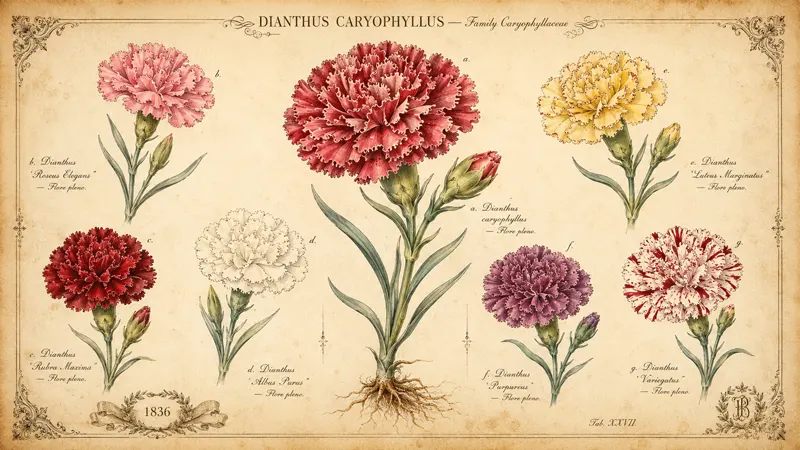
Carnations originated in the Mediterranean region and were among the first flowers humans cultivated for purely aesthetic reasons. Greek botanist Theophrastus (371–287 BCE) gave the carnation its scientific name Dianthus, meaning "flower of the gods." The Greeks and Romans wove carnations into ceremonial crowns and garlands worn during religious festivals, athletic competitions, and weddings. Roman frescoes and mosaics frequently feature carnation imagery, indicating the flower's deep cultural significance.
Christian Mythology
In Christian tradition, carnations are associated with a touching legend: pink carnations are said to have grown from the tears the Virgin Mary shed as she watched Christ carry the cross to Calvary. This story explains why pink carnations specifically came to represent maternal love and Mother's Day. The carnation became a Marian symbol throughout medieval Christian art, appearing in countless Renaissance paintings of the Madonna and Child.
Renaissance to Victorian Eras
European cultivation expanded dramatically during the Renaissance, with carnations appearing in formal gardens and breeding programs. In Elizabethan England, carnations were used to spice wine and ale as an inexpensive substitute for cloves. By the Victorian era, floriography had assigned each carnation color a distinct meaning, and the flower became central to the language of flowers used for coded communication.
Modern Era — Politics & Mother's Day
In 1907, American activist Anna Jarvis selected the pink carnation as the official flower of Mother's Day, citing her mother's love of the flower. Within decades, carnations became inseparable from Mother's Day celebrations worldwide. In 1974, Portugal's bloodless military coup — the Carnation Revolution — was named after the red carnations placed in soldiers' rifle barrels by civilians. To this day, red carnations symbolize freedom and revolution across Portugal.
The carnation was introduced to the United States in the 1850s, and within two decades, more than 50 varieties were commercially available. Today, carnations remain among the most popular cut flowers globally — partly for their meaning, partly for their exceptional vase life and affordability.
Snowdrop Meaning & Symbolism
Where the carnation is bold and cultivated, the snowdrop is delicate and wild. The snowdrop's symbolism is shaped by one extraordinary fact: it blooms when nothing else does, pushing through frozen ground in late January and early February when winter still holds the landscape in its grip.
This single biological trait — flowering through frost — has given the snowdrop its core meanings:
- Hope — the promise that warmth and life will return, even in the darkest moment
- Rebirth and renewal — the first sign of spring's coming, often before the calendar acknowledges it
- Purity and innocence — reinforced by the snowdrop's exclusively white color (no other color variations exist naturally)
- Resilience and quiet strength — the ability to thrive in conditions that would defeat almost any other flower
- Consolation and sympathy — gentle comfort offered in times of mourning or hardship
- Spiritual clarity — used in poetry as a metaphor for clarity and contemplation
The snowdrop's bowed, downward-facing posture — its petals curving toward the ground like a small head in humility — reinforces these symbolic associations. Where carnations announce themselves, snowdrops whisper.
Snowdrop Mythology & Folklore
Despite (or because of) its small size, the snowdrop has accumulated layers of mythology and folklore across European cultures.
The Adam & Eve Origin Myth
In Christian tradition, when Adam and Eve were expelled from the Garden of Eden, they wandered into a barren winter landscape. Eve wept in despair at the cold and lifelessness. An angel appeared to comfort her and breathed upon falling snowflakes, transforming them into small white flowers — the first snowdrops. The flowers were a sign that warmth, life, and hope would eventually return. This story explains why snowdrops became associated with consolation and hope in floriography.
Greek & Persephone Connection
Some classical scholars connect the snowdrop to the Greek myth of Persephone, queen of the underworld who returned to earth each spring. The snowdrop's emergence from frozen ground mirrors Persephone's annual return — life rising from death, light returning after darkness.
Medieval European Folklore
Medieval monks planted snowdrops around monasteries as symbols of purity and the Virgin Mary's tears (the three white petals were said to represent the Virgin's tears). The flowers became associated with Candlemas (February 2), the Christian feast celebrating the presentation of Jesus at the Temple. In some regions, snowdrops are still called "Candlemas Bells" or "Fair Maids of February."
Victorian Bad Luck Superstition
Medicinal Folklore
European folk medicine used snowdrops to treat various ailments. Modern science has vindicated this folklore: snowdrops contain galantamine, a compound used today in medications to treat Alzheimer's disease. This makes the snowdrop one of the few traditional folk remedies with documented modern pharmaceutical applications.
Snowdrop Biology & Unique Properties
The snowdrop's ability to bloom through frozen ground isn't poetic license — it's biological engineering. Here's what makes the snowdrop extraordinary:
- Anti-freeze proteins: Snowdrops produce proteins that lower the freezing point of their cell fluids, allowing them to survive temperatures that would kill most plants.
- Thermogenesis: Snowdrops can generate their own heat — actually warming the surrounding soil and snow to clear a path for their stems.
- Hardened leaf tips: The leaf tips are specially adapted to push through frozen, compacted soil.
- Ant dispersal: Snowdrop seeds have an oil-rich outer coating called an elaiosome that attracts ants. The ants carry the seeds away to their nests, eat the coating, and discard the still-viable seed — naturally dispersing snowdrops across landscapes.
- Galantamine production: The bulbs contain galantamine, an alkaloid compound now used in Alzheimer's medications.
Why January Has Two Birth Flowers
Most months in the birth flower calendar have a primary and secondary flower, and January is no exception. The reasons for January's dual assignment are particularly fitting:
- Practical availability: Carnations grow readily in Mediterranean climates and thrive in greenhouses year-round, making them accessible even in the depths of winter. Snowdrops emerge from frozen European soil specifically in late January and early February — making them seasonally authentic to the month.
- Symbolic balance: The carnation represents the warm, enduring love that keeps us connected through cold months. The snowdrop represents the small, brave hope of new life returning. Together they cover January's full emotional range.
- Visual contrast: The carnation is bold, ruffled, colorful, and abundant. The snowdrop is delicate, simple, white, and rare. The pair offers options for vastly different aesthetic preferences and gifting occasions.
- Cultural breadth: Carnations dominate Mediterranean and modern Western flower traditions. Snowdrops carry deep symbolism in Northern European, particularly British, folklore. Both deserve recognition.
January Birthday Personality Profile
January spans two zodiac signs, and each connects differently to January's birth flowers. Here's how the symbolism aligns with personality traits:
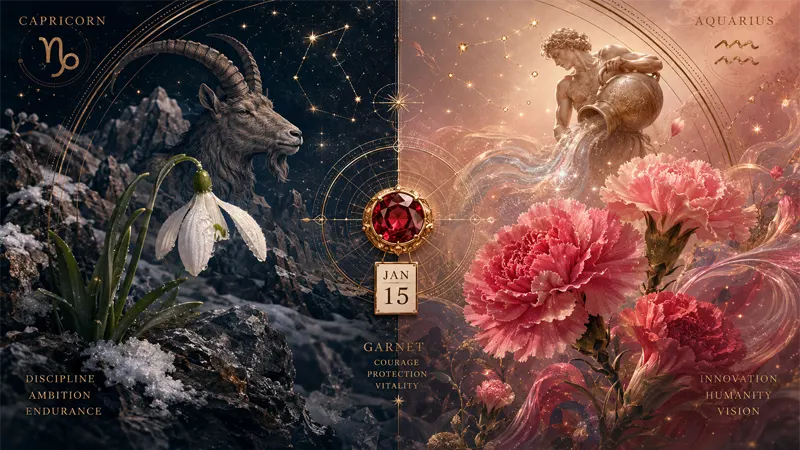
♑ Capricorn (December 22 – January 19)
Capricorns embody the snowdrop. Both grow patiently through harsh conditions. Both achieve quietly but profoundly.
- Disciplined and ambitious
- Patient and persistent
- Quietly determined
- Loyal to chosen relationships
- Strong sense of duty
- Often successful through steady effort
♒ Aquarius (January 20 – February 18)
Aquarians embody the carnation. Both are vibrantly distinctive. Both have a 2,000-year history as flowers of causes and social movements.
- Original and independent thinkers
- Humanitarian and socially engaged
- Intellectually curious
- Values-driven
- Strong sense of fairness
- Forward-thinking and innovative
If you're a January baby, both flowers may resonate — perhaps the snowdrop's quiet resilience speaks to you in moments of personal struggle, while the carnation's bold history of standing for causes resonates when you're advocating for what matters. Many January-born people find they identify with one flower in different life chapters.
Growing Guide — Carnations
Carnations are among the easier birth flowers to grow at home, making them a popular choice for January birthday gardens. Here's how to grow them successfully:
- Choose your variety. Border carnations (low, bushy) suit garden beds; spray carnations produce multiple blooms per stem; perpetual-flowering carnations are best for indoor pots.
- Plant in spring or early summer. Most carnations are planted as young plants rather than seeds, though seeds can be started indoors 6-8 weeks before the last frost.
- Position in full sun. Carnations need at least 4-6 hours of direct sunlight daily for healthy blooms and strong stems.
- Provide well-drained soil. Carnations hate waterlogged roots. Sandy or loamy soil with good drainage works best. Add compost for nutrients.
- Maintain neutral to slightly alkaline pH. Carnations prefer pH 6.5-7.5. Test your soil and add lime if too acidic.
- Water moderately. Once established, water deeply but infrequently. Let the top inch of soil dry between waterings. Avoid wetting the foliage.
- Pinch back young plants. Removing the growing tip when plants are 4-6 inches tall encourages bushier growth and more blooms.
- Fertilize monthly. Use a balanced flower fertilizer (10-10-10) during the growing season.
- Deadhead spent blooms. Removing fading flowers encourages continued blooming throughout the season.
- Watch for pests. Aphids, thrips, and spider mites can affect carnations. Treat with insecticidal soap at first sign of infestation.
Growing Guide — Snowdrops
Snowdrops are surprisingly easy to grow once established, but they have one crucial requirement that catches many gardeners off-guard: timing.
- Plant "in the green" — NOT as dry bulbs. This is the single most important rule. Plant snowdrops as actively growing plants just after they've finished flowering (typically March-April), not as dry bulbs in autumn. The Royal Horticultural Society strongly recommends this approach because dry snowdrop bulbs have a notoriously high failure rate.
- Choose a partially shaded spot. Snowdrops thrive in dappled shade under deciduous trees — they get full sun in early spring before tree canopies fill in, then shade in summer.
- Provide moist, well-drained soil. Snowdrops like soil rich in organic matter that retains moisture but doesn't waterlog. Add leaf mold or compost.
- Plant at the right depth. Plant snowdrop bulbs (when planting "in the green") at the same depth they were previously growing — usually about 3-4 inches deep.
- Space generously. Plant in clumps of 6-12 bulbs spaced 2-3 inches apart. Snowdrops look best in natural-looking drifts.
- Don't disturb after planting. Snowdrops dislike disturbance. Once planted, leave them alone except to divide every 5-7 years if clumps become too dense.
- Let foliage die back naturally. After flowering ends, let the leaves yellow and die back on their own. This feeds the bulb for next year's bloom.
- Divide after flowering. If you want to spread snowdrops, divide clumps "in the green" immediately after flowering and replant divisions in new locations.
12 January Birth Flower Tattoo Ideas
January birth flower tattoos are increasingly popular, with carnation designs slightly outnumbering snowdrops due to their visual variety. Here are 12 design concepts to consider:
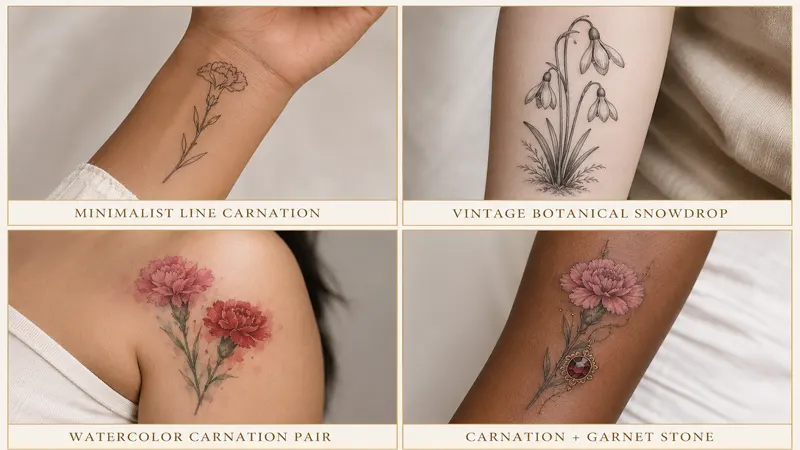
1. Minimalist Carnation Line
Single-line carnation outline, perfect for wrist or behind-ear placement.
2. Vintage Botanical Carnation
Detailed Victorian flower-dictionary style with shading. Forearm or thigh placement.
3. Snowdrop Cluster
Three or five small snowdrops in a downward-facing cluster. Ribcage or back placement.
4. Watercolor Pink Carnation
Soft watercolor washes in pinks. Shoulder or upper arm.
5. Carnation + Snowdrop Pair
Both flowers combined to honor January fully. Symbolic of duality.
6. Carnation with Birth Date
Floral design integrated with birthday in elegant script.
7. Geometric Frame Carnation
Carnation contained within a hexagon or circular geometric frame.
8. Snowdrop & Garnet
Snowdrop combined with garnet birthstone in red ink accents.
9. Floral Bouquet (Family)
Multiple birth flowers representing family members born across different months.
10. Carnation Mandala
Carnation worked into a mandala pattern for sacred geometry feel.
11. Snowdrop Behind Ear
Tiny snowdrop placement behind the ear or on the inner wrist.
12. Black & Grey Carnation Realism
Photorealistic black and grey shaded carnation. Larger placement, sleeve or back.
Gift Ideas for January Birthdays
January birthdays present a fun challenge — the holidays are over, the weather is cold, and people may have just received many gifts. Birth flower-themed presents stand out as personal and thoughtful. Ideas by category:
Fresh & Floral
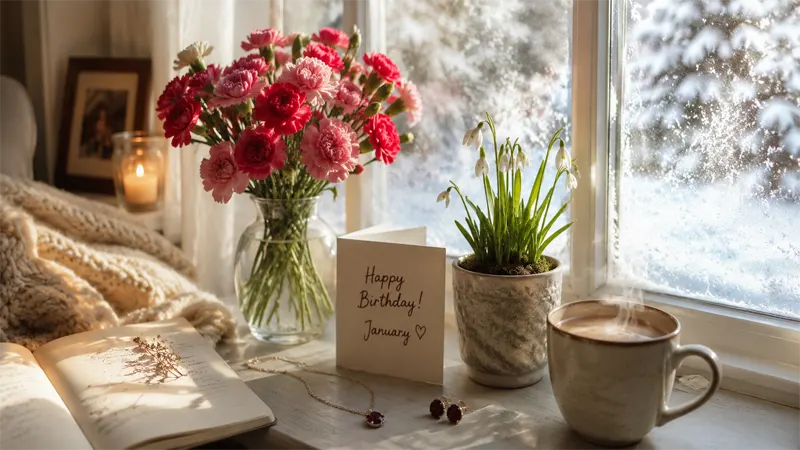
- Carnation bouquet — long-lasting, photogenic, available year-round. Choose colors based on relationship (pink for mom, red for romantic, white for friendship).
- Potted snowdrops — a living gift that returns every winter as a reminder of the birthday. Plant later or keep as houseplant.
- Mixed January bouquet — combine carnations with snowdrop-themed accessories (ribbons, cards) if real snowdrops aren't available.
Keepsake & Jewelry
- Carnation pendant necklace — delicate gold or silver carnation charm jewelry.
- Garnet + carnation ring — combining January's birthstone with birth flower for a powerful symbolic gift.
- Pressed snowdrop art — real pressed snowdrops preserved in glass frame.
- Custom botanical print — illustrated carnation print with personalized name and birth date.
- Carnation embroidered scarf — wearable art with subtle floral motif.
Experience & Garden
- Snowdrop garden trip — visit a famous snowdrop garden in late January/early February (the UK has dozens of public snowdrop gardens).
- Carnation-themed afternoon tea — many tea rooms offer floral menus featuring edible carnation petals.
- Carnation seeds and growing kit — for gardening enthusiasts who want to grow their own.
- Snowdrop bulb collection — order high-quality snowdrops "in the green" for spring planting.
Weddings & Memorials
January birth flowers serve double duty in life-event contexts:
Winter Wedding Use
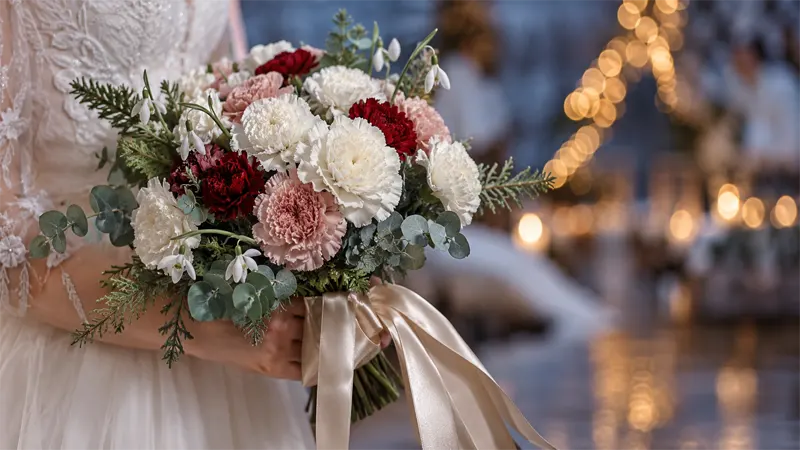
Carnations are surprisingly popular for January and February winter weddings. Their reliability (available year-round), affordability (often half the cost of premium blooms), and color range make them ideal for elaborate wedding arrangements. Red and white carnations create dramatic, classic winter wedding palettes. Pink carnations work beautifully for spring wedding moods.
Snowdrops in wedding bouquets are rarer because they're so delicate and seasonally limited, but they're occasionally incorporated into very small posies for January or February weddings — particularly weddings with British heritage influence. Their "purity" symbolism makes them meaningful for brides.
Memorial Use
White carnations are traditional memorial flowers in many cultures, particularly for honoring mothers and grandmothers who have passed. The pink carnation's connection to Mother's Day extends naturally into memorial contexts. White carnations are also worn on Remembrance Day in the Netherlands to honor WWII veterans.
Snowdrops are sometimes planted at gravesites because they bloom around the anniversary of late January and early February deaths, creating a recurring natural memorial that returns each year on or near the anniversary.
Pairing with Garnet (January Birthstone)
January's birthstone is the garnet, typically a deep red gemstone (though garnets can also be green, orange, yellow, pink, or purple). Garnet pairs beautifully with both January birth flowers, creating layered symbolism:
- Red Carnation + Red Garnet: Maximum symbolic intensity for love, devotion, and passionate commitment. Popular for anniversary gifts.
- Pink Carnation + Red Garnet: A softer, maternal feeling — perfect for mothers, grandmothers, or expressing deep gratitude.
- White Snowdrop + Garnet: Contrast between purity and intensity. Often used for memorial or remembrance jewelry.
- White Carnation + Pink Garnet: A gentler combination, often used for new beginnings, baby shower gifts, or wedding favors.
Garnet itself has symbolism deeply connected to January: it represents protection, grounding, loyalty, and enduring commitment. Combined with the carnation's love symbolism and the snowdrop's hope symbolism, the trio creates the most complete January gift symbolism possible.
Cross-Cultural Variations
January's birth flowers aren't fixed identically across all cultures. Here are notable regional variations:
- Spain & Portugal: Red carnations carry particular national significance. The carnation is Spain's national flower, and the 1974 Portuguese Carnation Revolution made red carnations a symbol of freedom and democracy.
- South Korea: In Korean hanakotoba (their parallel daily-flower system), carnations are particularly associated with parental love and are traditionally given on Parents' Day (May 8). Children pin red carnations to their parents' clothing.
- Japan: White carnations were traditionally Mother's Day flowers; the colors became flexible in modern times. Snowdrops are not particularly traditional but are gaining popularity.
- China: Carnations are gifted for celebrations and weddings, though the Chinese floral tradition has more focus on peonies and lotus.
- France: Purple carnations are traditional funeral flowers, so the gifting symbolism differs significantly from English-speaking countries. Lily of the valley (May 1) is the dominant cultural flower rather than carnations.
- Britain: Snowdrops have particularly deep cultural roots — "snowdrop walks" through famous gardens are major February tourist events. Carnations are popular but less culturally specific.
The Carnation's Famous Fragrance
One of the carnation's underrated qualities is its spicy, clove-like fragrance. This isn't accidental — the same compound that gives cloves their scent (eugenol) is present in many carnation varieties, particularly older heritage cultivars.
During the Elizabethan era, carnations were used to spice wine and ale as a cheaper substitute for imported cloves. Today, carnation fragrance is used in:
- Perfumery: Many high-end perfumes feature carnation notes (Comme des Garçons "Carnation," Frédéric Malle's "Carnal Flower")
- Aromatherapy: Carnation essential oil is used for emotional grounding and stress relief
- Edible decoration: Edible carnation petals add both color and a subtle spicy flavor to salads, desserts, and cocktails
- Traditional European herbal medicine: Carnation extract has been prescribed for coronary and nervous system issues
8 Ways to Celebrate Your January Birth Flowers
- Plant a January-themed garden bed. Plant carnations and snowdrops together for spring and winter blooms.
- Get a January birth flower tattoo. See the 12 tattoo ideas above for inspiration.
- Wear January birth flower jewelry. Carnation pendants, garnet rings with floral motifs.
- Make pressed flower art. Press carnations or snowdrops and frame them for home decor.
- Visit a famous snowdrop garden. The UK alone has dozens of public snowdrop walks in late January/February.
- Cook with carnation petals. Edible carnation petals work in salads, cocktails, and cake decoration.
- Send a meaningful flower gift. Use carnation color symbolism to communicate specific feelings.
- Learn the Victorian floriography vocabulary. Understanding flower meanings adds depth to every gift.
- Complete Birth Flowers by Month Guide — all 12 months at a glance
- December Birth Flower — Narcissus & Holly (previous month)
- February Birth Flower — Violet & Primrose (next month)
- May Birth Flower — Lily of the Valley & Hawthorn (compare spring symbolism)
- June Birth Flower — Rose & Honeysuckle (compare love symbolism)
- November Birth Flower — Chrysanthemum & Peony (compare resilience)
January Birth Flower — Frequently Asked Questions
What is the birth flower for January?
January has two birth flowers: the carnation (Dianthus caryophyllus) as the primary flower and the snowdrop (Galanthus) as the secondary flower. The carnation symbolizes love, fascination, and admiration; the snowdrop symbolizes hope, rebirth, and resilience. Both bloom or are widely available during the cold January period.
What does the January birth flower symbolize?
Carnations symbolize love, devotion, and admiration — with each color carrying its own specific meaning (red for love, pink for gratitude, white for purity). Snowdrops symbolize hope, rebirth, and resilience because they push through frozen ground when nothing else dares to bloom. Together they represent both warmth and quiet strength.
Why does January have two birth flowers?
The dual assignment is practical and symbolic. Carnations are readily available year-round in greenhouses and Mediterranean climates, while snowdrops actually bloom in late January-early February in cold climates. Together they cover the full emotional range of January: the warm enduring love of carnations and the hopeful resilience of snowdrops emerging from frost.
What does each carnation color mean?
Red carnations: deep love and passionate affection (also political solidarity). Pink carnations: gratitude and a mother's love. White carnations: pure love, innocence, and remembrance. Yellow carnations: traditionally disappointment, modernly friendship. Purple carnations: capriciousness or, in France, funeral flowers. Striped carnations: regret or "I wish I could be with you."
Is the snowdrop really bad luck?
In Victorian English superstition, bringing a single snowdrop into a house was considered an omen of death — particularly the death of someone in the household. Bringing multiple snowdrops as a bouquet was considered fine. This superstition persists in some rural English communities. Today, most people gift snowdrops freely, but if you're sensitive to British folklore, gift them as a posy of multiple blooms rather than a single flower.
Can I grow carnations and snowdrops at home?
Yes. Carnations are easy to grow in USDA zones 6-9 with full sun and well-drained soil. Snowdrops grow in zones 3-7 in partial shade. Critical rule for snowdrops: plant them "in the green" (as actively growing plants after flowering, around March-April) rather than as dry bulbs in fall — dry bulbs have very high failure rates.
What is the difference between carnations and pinks?
Both are in the Dianthus genus. Carnations (Dianthus caryophyllus) are the larger, traditional cut flowers with multi-layered ruffled blooms. "Pinks" (other Dianthus species like Dianthus plumarius) are typically smaller, often more fragrant, and primarily garden plants rather than cut flowers. Both are technically members of the carnation family.
What are the personality traits of January babies?
January spans two zodiac signs. Capricorns (Dec 22-Jan 19) embody snowdrop traits: disciplined, persistent, quietly determined, patient, loyal. Aquarians (Jan 20-Feb 18) embody carnation traits: original, independent, humanitarian, intellectually curious, socially engaged. Both signs share resilience and strength of character — the unifying themes of January birth flowers.
What birthstone goes with January birth flowers?
January's birthstone is the garnet — typically a deep red gemstone, though garnets can be green, orange, pink, or purple. Garnet symbolizes protection, grounding, loyalty, and enduring commitment. It pairs beautifully with carnations (especially red carnations for maximum symbolic intensity) and creates striking contrast with white snowdrops.
Are carnations or snowdrops better for January birthday gifts?
It depends on the recipient. Choose carnations for longer-lasting fresh bouquets, color variety (matching specific meanings), and accessible affordability. Choose snowdrops for symbolic weight, British or European heritage recipients, or as a living potted plant that returns each winter. Many gifters choose both — a primary bouquet with secondary snowdrop accents.
Why do pink carnations represent Mother's Day?
American activist Anna Jarvis selected the pink carnation as the official flower of Mother's Day in 1907, citing her own mother's love of the flower. Christian tradition adds depth: pink carnations are said to have grown from the Virgin Mary's tears as she watched Christ carry the cross. The combination of personal history and religious symbolism cemented the pink carnation's role in Mother's Day celebrations worldwide.
What's the medicinal use of snowdrops?
Snowdrops contain galantamine, an alkaloid compound now used in modern medications to treat Alzheimer's disease and other cognitive conditions. European folk medicine used snowdrops for various ailments long before modern pharmacology vindicated the tradition. This makes snowdrops one of the few traditional folk remedies with documented modern pharmaceutical applications. Note: do NOT consume snowdrops or their bulbs as a home remedy — they're toxic in unprocessed form.
This guide reflects current understanding of January birth flower symbolism rooted in Victorian floriography, ancient Greek and Roman traditions, and modern floral practice. Personality traits are based on traditional astrology and floriography associations, not scientific assessments. For medical or pharmaceutical questions about snowdrop-derived compounds (galantamine), consult a qualified medical professional. Snowdrops and unprocessed bulbs are toxic if consumed.
