


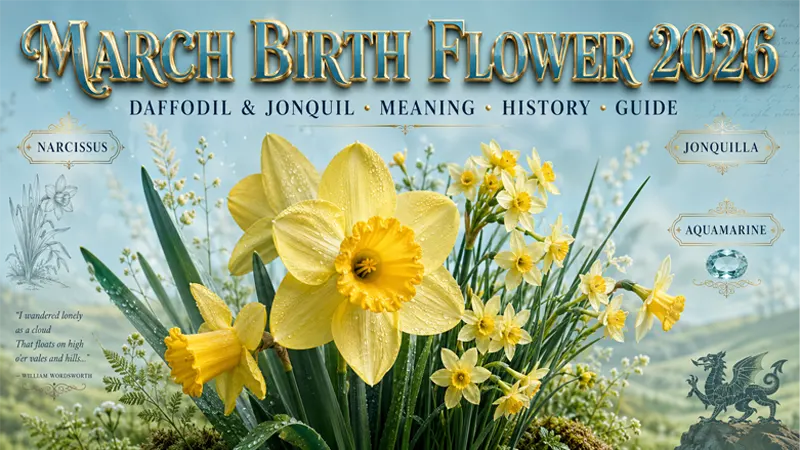

Quick answer: March's primary birth flower is the daffodil (Narcissus pseudonarcissus), the iconic yellow trumpet-shaped bloom that announces spring's arrival. It symbolizes rebirth, new beginnings, hope, and good fortune. The secondary March birth flower is the jonquil (Narcissus jonquilla) — a smaller, more fragrant variety from the same genus, symbolizing affection and a desire for love to be returned. All jonquils are technically daffodils, but not all daffodils are jonquils. March's birthstone is the aquamarine. People born in March span two zodiac signs: Pisces (Feb 19–Mar 20) and Aries (Mar 21–Apr 19).
Meet March's Birth Flowers
March is the threshold month — winter's last gasps meeting spring's first breath. Few flowers capture this transition more perfectly than the daffodil and jonquil. Both emerge from cold soil while frost still threatens, announcing through bright yellow blooms that warmer days are inevitable.
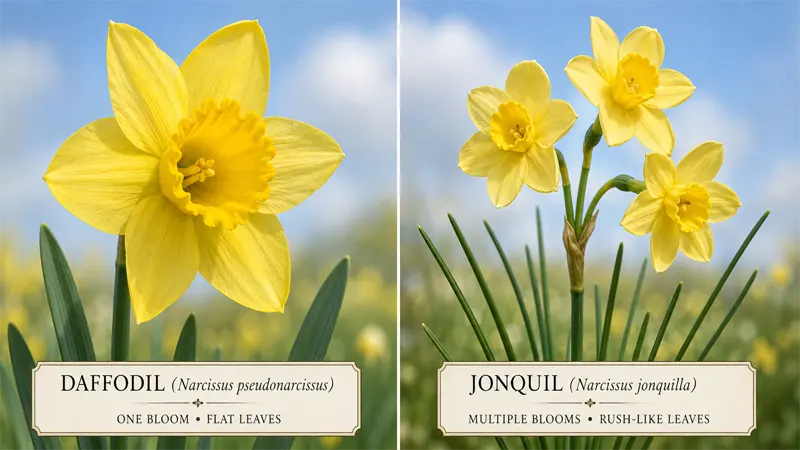
The daffodil (Narcissus pseudonarcissus) is March's primary birth flower — the iconic spring bloom with its trademark trumpet-shaped corona surrounded by six petal-like tepals. Daffodils are perhaps the most recognizable spring flowers in the world, symbolizing rebirth, new beginnings, and good fortune. There are over thousands of registered daffodil cultivars in shades of yellow, white, orange, and even soft pink.
The jonquil (Narcissus jonquilla) is March's secondary birth flower — a specific variety within the daffodil family distinguished by its intense fragrance, multiple blooms per stem, and thin, rush-like leaves. Where the daffodil is bold and visual, the jonquil is intimate and aromatic. Where daffodils symbolize fresh starts, jonquils symbolize romantic affection and the desire for love returned.
Daffodil Meaning & Symbolism
The daffodil's symbolism centers on one core concept: rebirth and new beginnings. Its appearance through frozen winter soil — often through the last lingering snow — makes it the universal symbol of fresh starts across virtually every Western culture.
- Rebirth and new beginnings — the most universal daffodil meaning
- Hope and optimism — the visual promise that warmth returns
- Joy and cheerfulness — reinforced by the daffodil's bright yellow color
- Good fortune and prosperity — particularly when gifted in bunches
- Resilience — daffodils push through frozen ground when nothing else dares
- Self-reflection and self-awareness — drawing from the Narcissus mythology
- Easter and resurrection — strong Christian symbolism due to spring blooming
- Welsh national identity — the daffodil is Wales's national flower
- Cancer awareness — adopted by the American Cancer Society for "Daffodil Days"
The Single vs Bunch Folklore
One of the most important daffodil traditions involves a specific superstition: a single daffodil given as a gift is believed to bring misfortune, while a bunch of daffodils brings good luck. This folklore originated in Wales and spread throughout the UK. The reasoning combines several factors — single flowers traditionally were associated with mourning, while abundance symbolized prosperity and good wishes.
The Greek Myth of Narcissus
The daffodil's botanical name Narcissus comes from one of the most famous Greek myths — and understanding this story adds significant depth to the flower's symbolism.
🌊 The Story of Narcissus
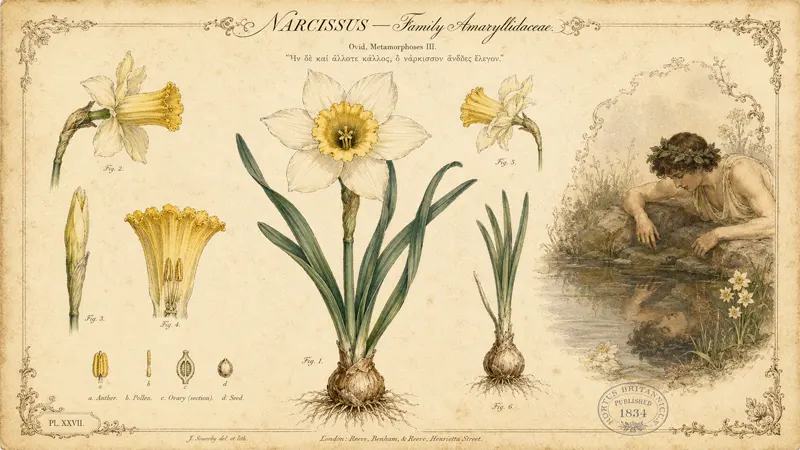
Narcissus was a beautiful Greek youth, the son of the river god Cephissus and the nymph Liriope. He was so handsome that everyone who saw him — men, women, and nymphs alike — fell in love with him. But Narcissus rejected all admirers, considering himself too beautiful for any of them.
The nymph Echo fell desperately in love with him but could only repeat words others spoke (her own punishment from Hera). When she finally approached Narcissus, he cruelly rejected her, and she wasted away until only her voice remained — the "echo" we still hear today.
The goddess of revenge, Nemesis, decided to punish Narcissus for his cruelty. She led him to a clear pool of water, where Narcissus saw his own reflection for the first time. He immediately fell in love with the beautiful face looking back at him — not realizing it was himself.
Unable to leave the pool, unable to reach or embrace his beloved reflection, Narcissus wasted away by the water's edge until he died. Where his body fell, a beautiful yellow flower bloomed — the daffodil, eternally bowing toward water as Narcissus once did.
This myth gave us not only the flower's name but the psychological term "narcissism" — excessive self-regard. The story is told in Ovid's Metamorphoses (8 CE), which remains the most famous version. The daffodil's slight downward bow, with the trumpet pointing toward the ground as if gazing into water, is botanically natural but culturally interpreted as Narcissus eternally captivated by his reflection.
Roman Funeral Associations
The ancient Romans associated daffodils with the underworld and used them in funeral rites. The flower's connection to Narcissus's death — and its growth from his corpse — gave it a dual symbolism: beauty bound to mortality. Even today, daffodils sometimes appear in memorial contexts despite their primary symbolism of rebirth.
Daffodil Colors & What Each Means
Yellow Daffodil
The classic daffodil color. Symbolizes joy, cheerfulness, hope, and the return of sunshine. Most popular for birthdays and Easter celebrations.
White Daffodil
Innocence, purity, and spiritual reflection. Often used for weddings, baptisms, and memorial occasions when the rebirth theme is desired with gentler tone.
Orange Daffodil
Passionate energy, confidence, and warmth. Less traditional than yellow but increasingly popular. Often features as orange centers on white-petaled daffodils.
Pink Daffodil
Pride, uniqueness, and gentle love. Modern hybrids feature soft peach-pink centers. Perfect for showing affection that's romantic or platonic.
Bicolor Daffodil
The classic two-tone daffodil — typically yellow petals with white trumpet or vice versa. Symbolizes balance, harmony, and the bridging of contrasts.
Yellow + Orange Daffodil
The most dramatic visual daffodil. Bold yellow petals with vibrant orange trumpet. Symbolizes celebration, victory, and triumphant joy.
Daffodils in Culture & Literature
Wales & St. David's Day (March 1)
The daffodil is one of the two national symbols of Wales (alongside the leek). Welsh tradition holds that whoever sees the first daffodil of the season will be blessed with wealth in the coming year. On St. David's Day (March 1), Welsh people traditionally wear daffodils as a symbol of national pride. The Welsh names for daffodil — "cenhinen Bedr" (Peter's leek) and "blodyn Mawrth" (flower of March) — both reflect the flower's cultural importance.
William Wordsworth's "Daffodils" (1804)
The English Romantic poet William Wordsworth wrote what may be the most famous flower poem in English literature — "I Wandered Lonely as a Cloud," commonly called simply "Daffodils." Published in 1807, the poem describes Wordsworth's encounter with a "host of golden daffodils" beside Ullswater in England's Lake District. The poem ends with the famous lines about how memories of those daffodils later filled his heart with pleasure during quiet, reflective moments.
Wordsworth's poem cemented the daffodil's literary status. It remains one of the most-memorized poems in the English-speaking world and is often the first poem children learn about flowers.
American Cancer Society "Daffodil Days"
Since 1973, the American Cancer Society has held "Daffodil Days" — an annual spring fundraising campaign featuring daffodils as the symbol of hope for cancer patients and survivors. The daffodil's connection to rebirth, hope, and the triumph of life over winter made it the natural choice. Similar campaigns exist in Canada, Australia, the UK, and Ireland. Today, the daffodil is recognized internationally as a symbol of cancer awareness and patient hope.
Easter and Christian Symbolism
Daffodils' early spring blooming makes them strongly associated with Easter — the Christian celebration of resurrection. In many European countries, daffodils are the dominant Easter flower. Some Christian traditions call the daffodil the "Lent Lily" because it blooms during Lent (the 40 days before Easter).
Jonquil Meaning & Symbolism
The jonquil shares the daffodil's broader symbolism of rebirth and spring, but adds a distinctly more romantic and sensual layer:
- Desire and longing — the most distinctive jonquil meaning
- "I desire a return of affection" — the specific Victorian floriography message
- Affection and gratitude — softer, more intimate than daffodils
- Forgiveness — gifted to communicate "I forgive you" or "please forgive me"
- Sympathy and condolence — appropriate for grief and loss situations
- Friendship and lasting bonds — particularly meaningful relationships
- Good fortune and prosperity — strong cultural meaning in China
- Home protection — Mediterranean tradition of planting near doorways
The jonquil's intensely sweet fragrance — often compared to jasmine or honey — is largely responsible for its association with sensual desire and romantic longing. Where the daffodil is visually bold, the jonquil seduces through scent. A bouquet of jonquils will perfume an entire room within hours.
Jonquil's Mediterranean & Persephone Heritage
Persephone & the Underworld
While Narcissus mythology dominates daffodil lore, the jonquil has its own Greek mythological connection. According to one tradition, when Persephone was abducted by Hades (god of the underworld), she was collecting flowers in a field. The lilies she had been gathering dropped from her arms as Hades snatched her, and they transformed into jonquils on the spot. Some traditions say jonquils grow along the banks of the River Styx in the underworld, blooming in the realm of the dead.
This connection gives jonquils a slightly more melancholy undertone than daffodils — beautiful blooms emerging from places of loss and separation. The Persephone connection also explains why jonquils are sometimes used in sympathy bouquets despite their generally cheerful appearance.
Mediterranean Origins
Jonquils are native to the Mediterranean region — particularly Spain, Portugal, and southern France. The name "jonquil" comes from the Spanish word "junco" meaning "rush" or "reed," referring to the plant's distinctively thin, round leaves that resemble rush stems rather than the flat leaves of standard daffodils.
Roman soldiers reportedly transported jonquils to England during the Crusades, where they naturalized in British gardens and eventually spread throughout Europe and beyond. Mediterranean traditions held that jonquils planted near doorways would protect homes and welcome positivity.
Chinese Cultural Significance
In Chinese culture, jonquils (along with narcissus generally) symbolize good fortune, prosperity, and success. Forcing narcissus bulbs to bloom on Lunar New Year is a traditional way to invite good luck for the coming year. The flowers are particularly associated with male prosperity and the success of careers and businesses.
Daffodil vs Jonquil — Spot the Differences
These two flowers confuse people constantly. Here's how to tell them apart in your garden or at the florist:
| Feature | Daffodil (Narcissus pseudonarcissus) | Jonquil (Narcissus jonquilla) |
|---|---|---|
| Blooms per stem | Usually one large bloom | Multiple smaller blooms (2-6) |
| Bloom size | Larger (3-4 inches) | Smaller (1-2 inches) |
| Leaves | Flat, sword-shaped | Round, thin, rush-like |
| Fragrance | Mild or none | Strong, sweet (jasmine/honey-like) |
| Trumpet shape | Long, prominent trumpet | Short, almost flat corona |
| Color range | Yellow, white, orange, pink, bicolor | Almost exclusively yellow |
| Native region | Northern Europe | Mediterranean (Spain, Portugal) |
| Bloom time | Early spring (March) | Mid to late spring (March-April) |
March Birthday Personality Profile
March spans two zodiac signs — and as one florist put it, "they're polar opposites." Yet both connect beautifully to March's birth flowers:
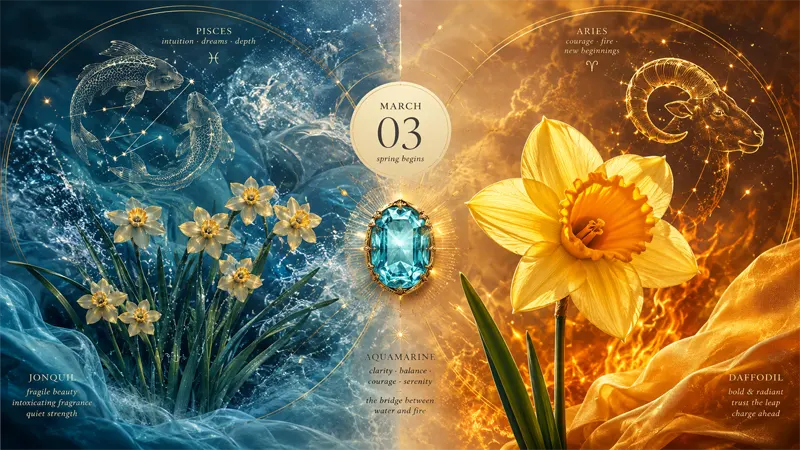
♓ Pisces (February 19 – March 20)
Pisceans embody the jonquil. Both connect to water symbolism, emotional depth, and intoxicating sensual experience.
- Emotionally deep and intuitive
- Creative and artistic
- Spiritually connected
- Empathetic and compassionate
- Drawn to beauty and fragrance
- Capable of deep transformation
♈ Aries (March 21 – April 19)
Aries embodies the daffodil. Both charge ahead, push through obstacles, and announce themselves boldly.
- Bold and confident
- Direct and energetic
- Natural leaders
- Optimistic and forward-looking
- Pioneering and competitive
- Quick to initiate new ventures
If you're a Pisces March baby, the jonquil's romantic intensity and underworld associations may resonate. If you're an Aries, the daffodil's bold spring announcement perfectly matches your energetic nature.
Growing Guide — Daffodils
Daffodils are among the easiest birth flowers to grow, and an established planting can return year after year for decades — some daffodil fields have bloomed for over 50 years from single plantings.
- Plant in fall, before the first frost. Daffodil bulbs need a cold dormancy period to develop roots and trigger spring blooming. Plant 6-8 weeks before ground freezes.
- Choose a sunny location. Daffodils need full sun or partial shade — at least 4-6 hours of direct sunlight daily for best blooms.
- Provide well-drained soil. Daffodils hate soggy roots. Sandy loam works best. Add compost or grit to heavy clay soils.
- Plant bulbs 6 inches deep. The general rule: plant bulbs at a depth 2-3 times their height. Space bulbs 4-6 inches apart.
- Water thoroughly after planting. Then leave alone — daffodil bulbs in winter don't need additional watering until growth begins in spring.
- Add bone meal for nutrients. Sprinkle bone meal in the planting hole for slow-release phosphorus that supports strong roots.
- Let foliage die back naturally. This is critical. After flowers fade, leave the leaves to yellow and wither naturally — this feeds the bulb for next year's blooms. Remove faded flowers but keep foliage for at least 6 weeks.
- Divide every 5-10 years. When clumps become so dense that flowering decreases, dig up bulbs after foliage dies back, separate, and replant in fall.
Growing Guide — Jonquils
Jonquils grow similarly to daffodils but prefer slightly warmer climates due to their Mediterranean origins.
- Plant bulbs in autumn. Just like daffodils, jonquils need a cool period to develop roots. Plant 4-8 weeks before first frost.
- Choose a sunny spot. Jonquils prefer full sun more than standard daffodils. They tolerate light shade but bloom best with maximum sunlight.
- Use well-drained, slightly alkaline soil. Avoid heavy clay or soggy locations. Add lime if your soil is acidic.
- Plant 3-4 inches deep. Smaller bulbs than daffodils, so plant slightly shallower. Space 3-4 inches apart.
- Water thoroughly after planting. Once established, jonquils are surprisingly drought-tolerant — their Mediterranean origins make them comfortable with dry summers.
- Apply mulch lightly. Light mulch protects bulbs from extreme cold while allowing air circulation.
- Let foliage die back. Same rule as daffodils — never cut back leaves until they yellow and wither.
- Plant near doorways for tradition. Mediterranean folklore suggests planting jonquils near home entrances brings protection and welcome.
12 March Birth Flower Tattoo Ideas
March birth flower tattoos are increasingly popular, with daffodils slightly outnumbering jonquils due to their bolder visual impact.
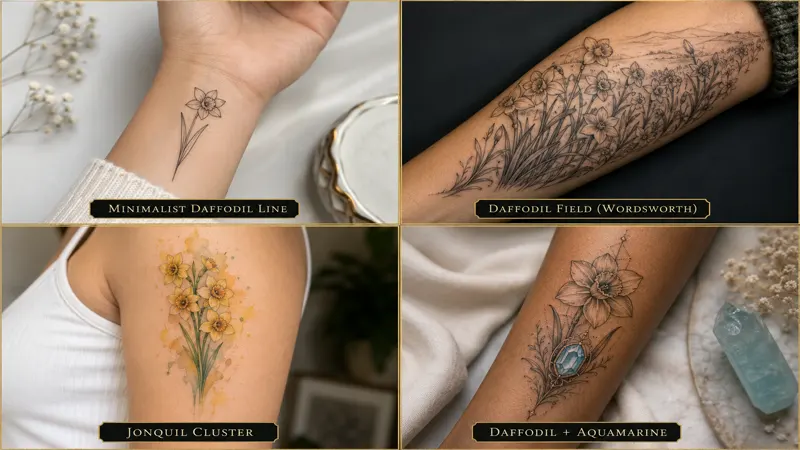
1. Single Line Daffodil
Minimalist single-line botanical outline. Wrist, ankle, or behind-ear placement.
2. Vintage Botanical Daffodil
Detailed Victorian flower-dictionary style with shading. Forearm placement.
3. Jonquil Cluster
Multiple jonquils on single stem — accurate to the botanical reality.
4. Watercolor Yellow Daffodil
Soft watercolor washes with golden yellow tones. Shoulder placement.
5. Welsh Heritage Daffodil
Daffodil with subtle Welsh dragon or red dragon element for heritage pride.
6. Wordsworth Quote Daffodils
Daffodil illustration with handwritten Wordsworth quote: "host of golden daffodils."
7. Cancer Awareness Daffodil
Daffodil paired with awareness ribbon — honoring cancer survivors.
8. Narcissus + Mirror
Daffodil reflected in still water — referencing the Greek myth of Narcissus.
9. Daffodil Field
Multiple daffodils in field formation — Wordsworth-inspired and visually impressive.
10. Daffodil + Aquamarine
Daffodil combined with aquamarine birthstone in blue ink accents.
11. Easter Daffodil
Daffodil with subtle cross or Easter motif for Christian symbolism.
12. Geometric Frame Daffodil
Daffodil contained within hexagon or circular frame for modern aesthetic.
Gift Ideas for March Birthdays
Fresh & Floral
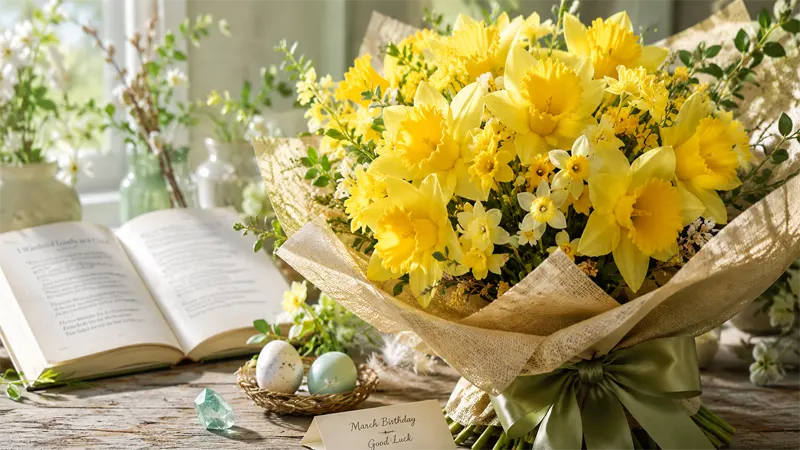
- Daffodil bouquet — always in a bunch of 3 or more (never single, per folklore). Long-lasting and visually impactful.
- Jonquil fragrance bouquet — for someone who appreciates intense floral perfume.
- Daffodil bulb gift — a recurring spring reminder year after year. Plant in fall.
- Mixed Narcissus bouquet — daffodils + jonquils + paperwhites for variety.
- Easter daffodil arrangement — for March birthdays falling near Easter.
Keepsake & Jewelry
- Daffodil pendant necklace — delicate gold or yellow-toned daffodil jewelry.
- Aquamarine + daffodil ring — combining March's birthstone with birth flower.
- Pressed daffodil art — real pressed daffodils preserved in glass frame.
- Custom Wordsworth print — daffodil illustration with poem excerpt.
- Welsh-themed daffodil gift — for those with Welsh heritage, daffodils carry national pride.
Experience & Garden
- Visit a daffodil garden — Keukenhof in the Netherlands, Daffodil Hill in California, Brent and Becky's Bulbs in Virginia.
- Donate to American Cancer Society "Daffodil Days" — meaningful gesture in honor of recipient.
- Daffodil bulb growing kit — for gardening enthusiasts.
- Welsh St. David's Day experience — March 1 cultural celebration.
Pairing with Aquamarine (March Birthstone)
March's birthstone is the aquamarine — a beautiful pale blue gemstone in the beryl family. The color contrast between bright yellow daffodils and pale blue aquamarine creates one of the most striking birth-month gift palettes.
- Yellow Daffodil + Aquamarine: The classic contrast pairing. Sunny gold against sea-blue. Visually stunning and symbolically rich (rebirth + tranquility).
- White Daffodil + Aquamarine: Soft, peaceful combination. Wedding-appropriate.
- Jonquil + Aquamarine: The fragrant pairing — beautiful for romantic gifts.
- Mixed March Bouquet + Aquamarine Pendant: The complete March gift combining multiple flowers with the birthstone.
Aquamarine's symbolic meanings — courage, calm, communication, water-element protection — complement the daffodil's hope and renewal symbolism. Together they form one of the most visually striking and meaningful birth-month gift combinations.
Medicinal & Modern Pharmaceutical Uses
Daffodils have a long medicinal history — and modern science has vindicated some traditional uses spectacularly.
Ancient & Traditional Medicine
- Ancient Rome: Daffodil bulbs and roots were applied as poultices to treat tumors.
- Traditional European folk medicine: Used for joint pain, wounds, burns, and bruises.
- Greek/Roman cosmetics: Daffodil extract was used in early skincare preparations.
Modern Pharmaceutical Use — Galantamine
Daffodils contain galantamine — the same alkaloid compound found in snowdrops. Modern pharmaceutical companies, particularly a bioresearch facility in Wales, extract galantamine from daffodils to manufacture drugs that slow the progression of Alzheimer's disease and other cognitive conditions. This makes the daffodil one of the few traditional folk medicine plants with documented modern pharmaceutical applications.
Daffodil Latex & Mixed Bouquets
An unusual practical concern: when daffodil stems are cut, they release a milky latex sap. This sap is irritant to other flowers in mixed bouquets — daffodils literally poison other cut flowers, dramatically shortening their vase life. If you want to combine daffodils with other flowers:
- Cut daffodils first and place in plain water alone for 12-24 hours to release the latex.
- Change the water completely after the soaking period.
- Then add daffodils to mixed arrangements with other flowers.
- Alternatively, keep daffodils in their own vase.
Cross-Cultural Variations
March's birth flowers carry different cultural significance worldwide:
- Wales: Daffodil is the national flower, worn on St. David's Day (March 1). Sometimes called "Peter's leek" in Welsh.
- England: Daffodils are the Easter flower and feature in Wordsworth's most famous poem.
- China: Narcissus (including jonquils) symbolize good fortune for Lunar New Year. Forcing bulbs to bloom on Chinese New Year is traditional.
- Spain/Portugal: Jonquils' native homeland. Cultural significance as fragrance plants and traditional doorway protectors.
- America: Cancer awareness (American Cancer Society "Daffodil Days" since 1973).
- Greece: Daffodils carry the weight of the Narcissus myth — beautiful but tied to vanity and self-destruction.
- Korea (hanakotoba): Narcissus represents respect and renewal.
- Christian tradition globally: Easter Lent Lily, symbolizing resurrection.
- Complete Birth Flowers by Month Guide — all 12 months at a glance
- February Birth Flower — Violet & Primrose (previous month)
- April Birth Flower — Daisy & Sweet Pea (next month)
- May Birth Flower — Lily of the Valley & Hawthorn (compare spring symbolism)
- December Birth Flower — Narcissus & Holly (related Narcissus genus)
- January Birth Flower — Carnation & Snowdrop (compare hope symbolism)
March Birth Flower — Frequently Asked Questions
What is the birth flower for March?
March has two birth flowers: the daffodil (Narcissus pseudonarcissus) as the primary flower and the jonquil (Narcissus jonquilla) as the secondary flower. Both belong to the Narcissus genus. The daffodil symbolizes rebirth, new beginnings, and hope. The jonquil symbolizes desire, affection, and a return of love. Both bloom in early spring.
What's the difference between a daffodil and a jonquil?
All jonquils are technically daffodils, but not all daffodils are jonquils. Daffodils typically have one large bloom per stem, flat sword-like leaves, and modest fragrance. Jonquils have multiple smaller blooms per stem (2-6), round chive-like leaves, and intensely sweet fragrance. The name "jonquil" comes from Spanish "junco" meaning rush, referring to the thin reed-like leaves.
Why does the daffodil symbolize rebirth?
Daffodils push through frozen ground in late winter when nothing else blooms, often appearing through lingering snow. This dramatic emergence from cold dormancy made them universal symbols of rebirth, new beginnings, and hope across virtually every Western culture. They're strongly associated with Easter and the Christian resurrection theme.
What is the Narcissus myth?
According to Greek mythology, Narcissus was a beautiful youth who fell in love with his own reflection in a pool of water. Unable to leave his reflection and unable to embrace it, he wasted away by the water's edge and died. Where his body fell, the first daffodil bloomed — eternally bowing toward water. This myth gave us both the flower's name and the psychological term "narcissism."
Is it bad luck to give a single daffodil?
According to British and Welsh folklore, yes. A single daffodil is believed to bring misfortune, while a bunch of daffodils brings good luck and prosperity. Always give daffodils in groups of three or more — ideally five or more. This superstition is still strongly held in British culture, so be careful when reducing a bouquet to just one bloom.
Why is the daffodil the national flower of Wales?
The daffodil is one of two Welsh national symbols (alongside the leek). Welsh tradition holds that seeing the first daffodil of the season brings a year of wealth. On St. David's Day (March 1), Welsh people traditionally wear daffodils as a symbol of national pride. The Welsh names "cenhinen Bedr" (Peter's leek) and "blodyn Mawrth" (flower of March) both reflect cultural importance.
What is Wordsworth's daffodil poem?
"I Wandered Lonely as a Cloud" (1804), often called simply "Daffodils," is a famous poem by William Wordsworth. It describes his encounter with a "host of golden daffodils" beside Ullswater in England's Lake District. Published in 1807, it remains one of the most-memorized poems in English-speaking literature. The poem cemented the daffodil's literary status forever.
Are daffodils toxic to humans and pets?
Yes. All parts of daffodils — bulbs, leaves, flowers, and especially sap — contain toxic alkaloids. Ingestion causes severe nausea, vomiting, and digestive distress in humans and animals. The sap can cause skin irritation ("daffodil itch"). Keep bulbs away from children and pets. Wash hands after handling cut flowers. This toxicity does make daffodils excellent for keeping deer and rodents away from gardens.
Why are daffodils used for cancer awareness?
Since 1973, the American Cancer Society has held "Daffodil Days" — annual spring fundraising featuring daffodils as the symbol of hope for cancer patients. The daffodil's connection to rebirth, hope, and the triumph of life over winter made it the natural choice. Similar campaigns exist in Canada, Australia, the UK, and Ireland. Today, daffodils are internationally recognized as cancer awareness symbols.
Can I grow daffodils and jonquils at home?
Yes. Both are among the easiest birth flowers to grow. Plant bulbs in fall before first frost. Daffodils grow in USDA zones 3-8; jonquils in zones 4-9 (slightly warmer-tolerant). Both need well-drained soil and at least 4-6 hours of sun daily. Critical: let foliage die back naturally after flowering to feed the bulb for next year. Daffodil plantings can return for 50+ years.
Why do daffodils kill other flowers in vases?
When cut, daffodil stems release a milky latex sap that's toxic to other flowers, dramatically shortening their vase life. To combine daffodils with other flowers: cut daffodils first, soak in plain water alone for 12-24 hours to release the latex, then change water completely before adding to mixed arrangements. Or keep daffodils in their own dedicated vase.
What's the medicinal use of daffodils?
Daffodils contain galantamine, an alkaloid compound now used in modern Alzheimer's disease medications. A pharmaceutical facility in Wales extracts galantamine from daffodils to produce drugs that slow cognitive decline. Ancient Romans used daffodil bulbs for tumors and joint pain. WARNING: Despite pharmaceutical applications, daffodils are toxic if consumed — never use as a home remedy. The galantamine compound requires careful pharmaceutical extraction.
This guide reflects current understanding of March birth flower symbolism rooted in Greek mythology, Welsh national tradition, English Romantic literature, Mediterranean folklore, and modern floral and pharmaceutical practice. Personality traits are based on traditional astrology and floriography associations. Daffodils and jonquils are toxic to humans and pets — never consume any part of the plant. The galantamine compound requires pharmaceutical extraction and processing; do not attempt home remedies. For medical questions about galantamine-based medications, consult a qualified medical professional.
