


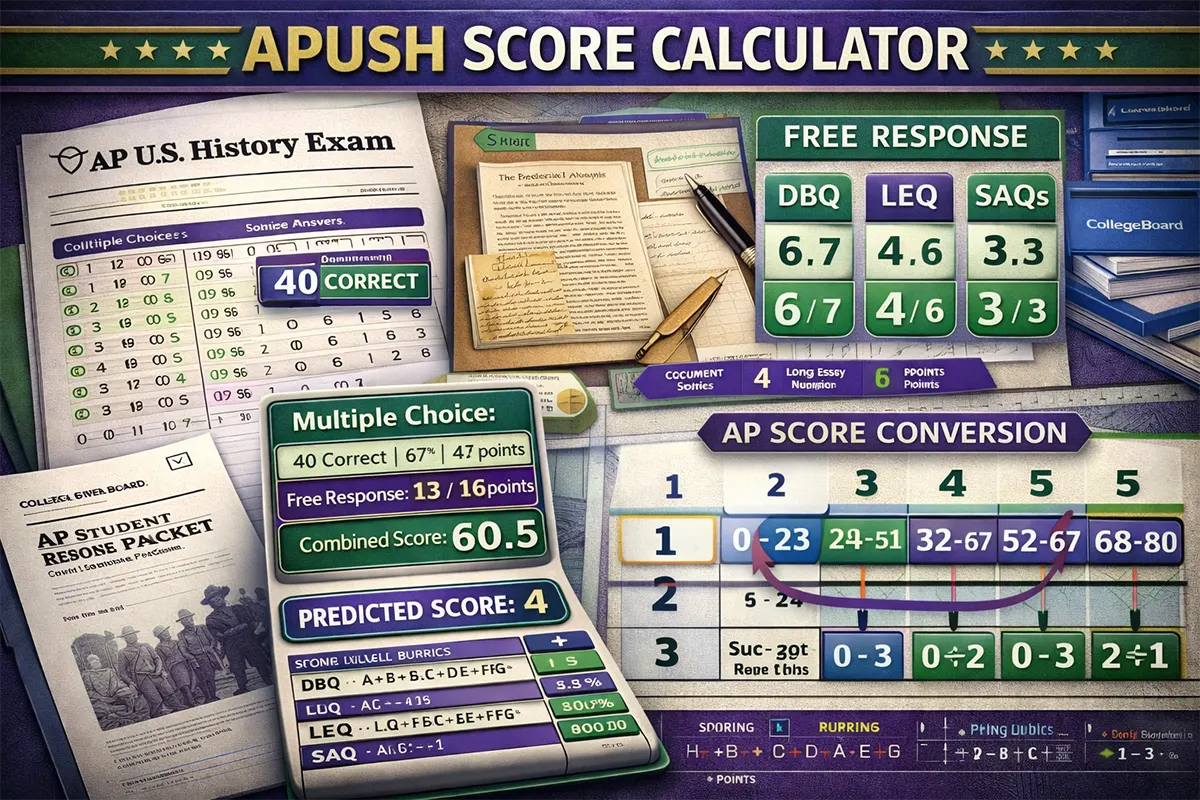
Wondering where you stand before AP exam day? This free APUSH score calculator lets you plug in your estimated multiple-choice and free-response scores and instantly see a predicted 1–5 AP score. Built for students, tutors, and teachers who want a quick, reliable projection based on the latest College Board scoring guidelines.
Table of Contents
ToggleWhat Does the APUSH Score Calculator Do?
The AP US History exam combines 55 multiple-choice questions, 3 short-answer questions (SAQs), 1 document-based question (DBQ), and 1 long essay question (LEQ). Each section carries a different weight, and raw scores are converted to a composite before being mapped to the 1–5 scale. Doing this math by hand is tedious—our APUSH score calculator handles it in seconds.
- Instant composite score — enter your estimates and get an immediate 1–5 prediction.
- Section-level breakdown — see how MCQ, SAQ, DBQ, and LEQ each contribute to your total.
- Goal planning — experiment with different scores to find the combination you need for a 3, 4, or 5.
- Updated for 2026 — reflects the current AP US History exam format and scoring curves.
The calculator uses publicly available scoring data released by the College Board and aligns with the most recent exam format. While no predictor is 100% exact—actual cut scores shift slightly each year—this tool gives you a strong ballpark estimate to guide your study plan.
🇺🇸 APUSH Score Calculator
AP United States History — Predict Your 1–5 Score
| Section | Raw Score | Weighted Points | Contribution |
|---|---|---|---|
| Multiple Choice | — | — | |
| Short Answer | — | — | |
| DBQ | — | — | |
| LEQ | — | — | |
| Total Composite | — | — | — |
📈 How to Reach the Next Score Level
—
How the APUSH Score Calculator Works
Exam Structure & Weights
The AP US History exam has two main sections, each worth 50% of the final score:
| Section | Component | Points Available | Weight of Final Score |
|---|---|---|---|
| Section I – Part A | Multiple Choice (55 questions) | 55 | 40% |
| Section I – Part B | Short Answer (3 questions) | 9 (3 pts each) | 20% |
| Section II – Part A | Document-Based Question | 7 | 25% |
| Section II – Part B | Long Essay Question | 6 | 15% |
The Calculation Method
The calculator converts your raw scores into a weighted composite score out of 140 points (the approximate scaled maximum). Here is the formula:
Composite = (MCQ correct × 1.0909) + (SAQ points × 3.3333) + (DBQ points × 5.0) + (LEQ points × 3.75)
These multipliers reflect how each section’s raw score is scaled to match its percentage weight of the total. Once the composite is calculated, it is mapped against approximate score boundaries:
| AP Score | Composite Range (approx.) | Qualification |
|---|---|---|
| 5 | 106 – 140 | Extremely Well Qualified |
| 4 | 80 – 105 | Well Qualified |
| 3 | 58 – 79 | Qualified |
| 2 | 39 – 57 | Possibly Qualified |
| 1 | 0 – 38 | No Recommendation |
Important: The College Board does not publish exact cut scores in advance. The boundaries above are estimates drawn from historical data and can shift by a few points each year depending on exam difficulty and student performance.
Practical APUSH Score Examples
Example 1: Aiming for a 5 — Sarah’s Practice Exam
Sarah scored 48 out of 55 on the MCQ section during a full practice exam. She earned 8 out of 9 on the SAQs, 6 out of 7 on the DBQ, and 5 out of 6 on the LEQ.
- MCQ contribution: 48 × 1.0909 = 52.36
- SAQ contribution: 8 × 3.3333 = 26.67
- DBQ contribution: 6 × 5.0 = 30.00
- LEQ contribution: 5 × 3.75 = 18.75
- Total composite: 127.78 → Predicted AP Score: 5
Sarah’s strong performance across all sections puts her comfortably above the 106-point threshold for a 5. Even if one section dips slightly on exam day, she has a solid buffer.
Example 2: Borderline 3/4 — Marcus’s Midterm Check
Marcus got 35 out of 55 on MCQs, 6 out of 9 on SAQs, 4 out of 7 on the DBQ, and 3 out of 6 on the LEQ.
- MCQ contribution: 35 × 1.0909 = 38.18
- SAQ contribution: 6 × 3.3333 = 20.00
- DBQ contribution: 4 × 5.0 = 20.00
- LEQ contribution: 3 × 3.75 = 11.25
- Total composite: 89.43 → Predicted AP Score: 4
Marcus lands in the middle of the 4 range. If he improves his DBQ by just one point (from 4 to 5), his composite jumps to about 94—giving him even more breathing room. The calculator helps him pinpoint exactly where to focus.
Example 3: Working Toward a 3 — Priya’s Starting Point
Priya is early in her review and scored 25 out of 55 on MCQs, 4 out of 9 on SAQs, 3 out of 7 on the DBQ, and 2 out of 6 on the LEQ.
- MCQ contribution: 25 × 1.0909 = 27.27
- SAQ contribution: 4 × 3.3333 = 13.33
- DBQ contribution: 3 × 5.0 = 15.00
- LEQ contribution: 2 × 3.75 = 7.50
- Total composite: 63.10 → Predicted AP Score: 3
Priya is above the 58-point cutoff for a 3, but just barely. She can use the calculator to model what happens if she gains 5 more MCQ points and 1 more DBQ point—pushing her composite to around 78 and securing that 3 with confidence. Planning your study targets with real numbers makes a big difference.
Important Things to Know About APUSH Scoring
Score Boundaries Change Annually
The College Board uses a process called equating to adjust cut scores each year so that a “3” in 2026 represents the same level of achievement as a “3” in any other year. This means composite boundaries can shift by 2–5 points in either direction. Treat the calculator’s output as a strong estimate, not a guarantee.
Free-Response Scoring Is Rubric-Based
SAQs, DBQs, and LEQs are graded by trained AP readers using specific rubrics published by the College Board. Self-scoring your own essays can be tricky—students tend to either over- or under-estimate by 1–2 points. For the most realistic prediction, have a teacher or tutor score your practice essays against the official rubrics.
Common Mistakes to Avoid
- Confusing raw scores with scaled scores — your MCQ “number correct” is not your final score. The calculator applies the proper weights.
- Ignoring SAQs — worth 20% of the exam, SAQs are often under-practiced. Gaining even 1 extra point here adds roughly 3.3 composite points.
- Skipping the LEQ — even a partially written LEQ earning 2–3 points adds 7.5–11.25 composite points. Never leave it blank.
Tips from AP Exam Readers
Answer every MCQ—there is no penalty for guessing. On the DBQ, always try to address all seven documents even briefly; the rubric awards points for evidence usage. For the LEQ, pick the prompt you know best and build a clear thesis supported by specific historical evidence. If you’re studying alongside other exams, you might also want to check your readiness with our uni grade calculator to keep your overall academic targets on track.
Frequently Asked Questions About APUSH Score Calculation
How accurate is this APUSH score calculator?
The calculator is based on historical scoring data and the official exam format. It provides a reliable estimate within 1–3 composite points of actual results. However, since the College Board adjusts cut scores annually, treat it as a projection rather than an exact result.
Does the calculator reflect the 2026 AP US History exam format?
Yes. It uses the current format: 55 MCQs, 3 SAQs, 1 DBQ, and 1 LEQ. If the College Board announces structural changes for a future exam year, we will update the tool accordingly.
How are the DBQ and LEQ scored?
The DBQ is scored on a 0–7 rubric covering thesis, contextualization, evidence (from documents and outside knowledge), analysis, and complexity. The LEQ uses a 0–6 rubric with similar categories. Points are awarded individually, so partial credit is common.
What composite score do I need for a 3?
Historically, a composite of approximately 58 out of 140 has been enough for a 3. That translates to getting roughly 55–60% of available points. Use the calculator to experiment with different section scores to find the combination that works for you.
Is there a penalty for wrong answers on the MCQ section?
No. Since 2011, the AP exams use rights-only scoring—you earn one point per correct answer and zero for incorrect or blank answers. Always answer every question, even if you need to guess.
Can I use this calculator for AP World History or AP Euro?
The exam structure for AP World History: Modern and AP European History is very similar, but the specific multipliers and cut scores differ slightly. This calculator is calibrated for APUSH only. We recommend looking for subject-specific tools for other AP History exams.
How should I self-score my practice essays?
Download the official scoring rubrics from AP Central and compare your response point by point. Better yet, swap essays with a study partner or ask your teacher to grade them. Self-scores tend to be off by 1–2 points in either direction.
What if my score is between two AP grades?
If your composite sits near a boundary (e.g., 77–80), your actual result could go either way depending on the year’s cut scores. Focus on the sections where you can gain points most efficiently—often the DBQ or SAQs—and aim for a comfortable margin above the threshold.
Start Calculating Your APUSH Score Now
Scroll up, enter your estimated scores, and see exactly where you stand. Use the results to build a targeted study plan that focuses on the sections where a few extra points make the biggest difference. For official exam details, scoring rubrics, and practice materials, visit the College Board’s AP Students portal. If you’re also preparing for standardized fitness tests, our ACFT calculator can help you track those scores too.
Related Calculators You May Find Useful
- Uni Grade Calculator — predict your university GPA and module grades.
- ACFT Calculator — calculate Army Combat Fitness Test scores.
- Sig Fig Calculator — quickly round numbers to correct significant figures.
- Fractions Calculator — add, subtract, multiply, and divide fractions.
- Factor Calculator — find all factors and prime factorization of any number.