



Quick answer: A Viking haircut combines long flowing hair on top with shaved or faded sides, often paired with a full beard and Norse-inspired braids. Popular styles include the Ragnar cut (shaved sides + central braid), Bjorn ponytail (long top with shaved sides), Viking man bun, braided mohawk, and the Thor look (long flowing hair with full beard). Expect 12–24 months to grow into the full warrior look from a short cut. Modern Viking haircuts can be office-friendly with the right variation, or extreme statement pieces for festivals and special interests.
What Is a Viking Haircut?
The modern Viking haircut blends three distinct elements: long hair on top (anywhere from shoulder-length to past the back), short or shaved sides (clean undercut, fade, or temple shave), and strategic styling (braids, ponytails, man buns, or simply flowing locks). The full look is almost always paired with a beard — often a long, well-groomed one — that creates the rugged Norse warrior aesthetic popularized by the History Channel's Vikings TV series and now mainstream in 2026 men's fashion.
What separates the Viking haircut from generic long-hair-and-undercut styles is the warrior energy. The cut signals strength, individuality, and confidence. It's been adopted by gym culture, fantasy communities, MMA fighters, musicians, and tradesmen, plus mainstream men who want to break away from the standard fade-and-textured-crop look that dominates barbershops.
This guide covers the historical roots versus modern fiction, 25+ specific styles, the 12–24 month grow-in journey, barber communication scripts, daily maintenance routines, and how to make Viking style work in modern office settings or full-on warrior aesthetic.
Historical Accuracy — What Vikings Actually Looked Like
Before we get into modern styles, it's worth knowing what's actually historical versus what's TV-show fiction. The truth is: we don't know exactly what Vikings looked like.
What History Actually Says
- From the Roskilde Viking Ship Museum: "The men had long fringes and short hair on the back of the head" — essentially a reverse mullet, opposite of modern Viking styles.
- From the Oseberg cart (around 800 CE): Engravings show some short bowl cuts with shaved sides AND many long-haired examples. Both styles existed.
- From Leo the Deacon (10th century): A description of a Norse warrior states: "He shaved his head completely, except for a lock of hair that hung down on both sides." This describes a partial shave with side locks — strikingly different from popular modern interpretations.
- From archeological combs: Vikings frequently used combs and grooming tools, suggesting hair was kept well-groomed regardless of length.
- From social structure: Free men likely wore longer hair as a class distinction from slaves, who were reported to have short-cropped hair.
- Beards: Definitely long and braided in many cases — this is well-documented through runestones and sculptures. The Norse god Frey has a long beard depicted in Viking-era artifacts.
What's Modern Fiction
- The "Ragnar cut" with shaved sides and long top — invented for the TV show
- Elaborate decorative braids with metal beads — mostly Hollywood styling
- The Bjorn warrior bun — TV-inspired
- Heavy temple shaves with geometric patterns — modern barbering aesthetic
25+ Popular Viking Haircut Styles for 2026
Here are the most-requested Viking styles in barbershops worldwide. We've grouped them by hair length and complexity:
Iconic Character-Inspired Styles
1. The Ragnar Cut
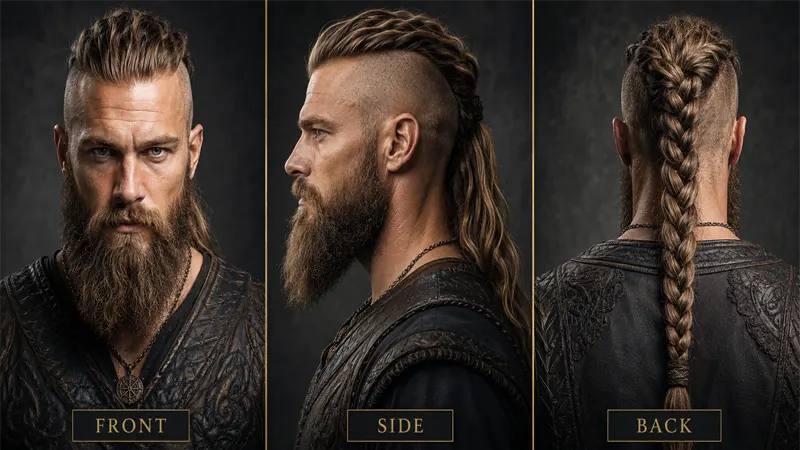
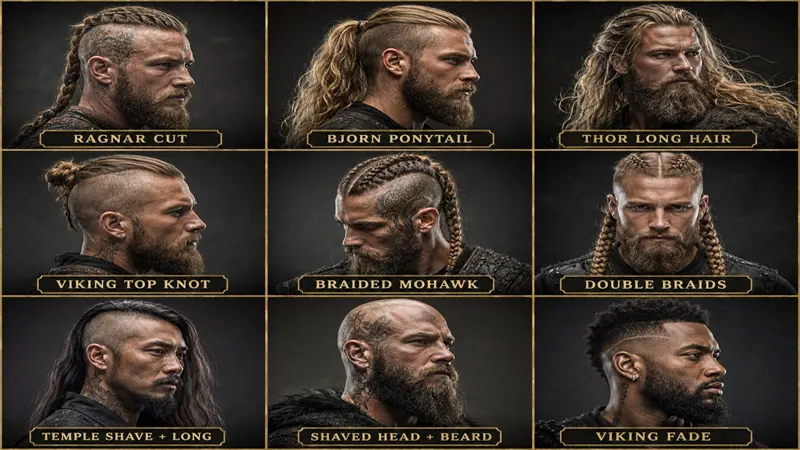
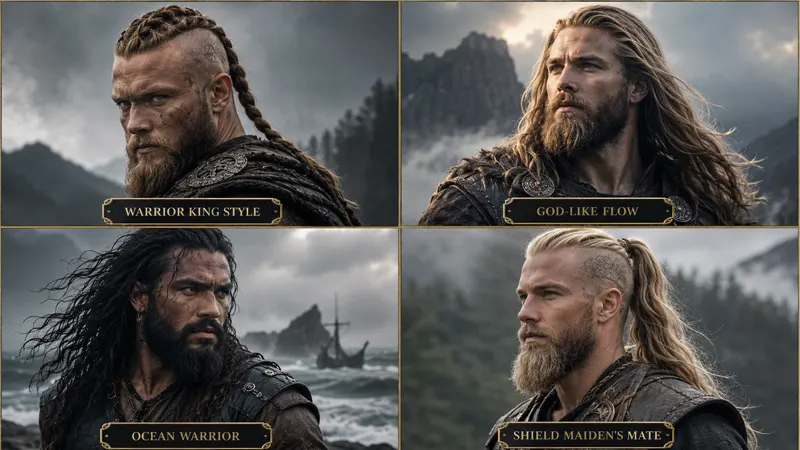
Inspired by Ragnar Lothbrok from Vikings. Shaved or faded sides, long top section, and a tight braided tail running down the back. The single most-requested Viking style in 2026.
2. The Bjorn Ponytail
Long ponytail (often braided) with shaved or faded sides. Bjorn Ironside's signature look. Bold but more wearable than the Ragnar.
3. The Thor Look
Long flowing hair brushed back, paired with a thick beard. No braids, no undercut — just full Norse warrior vibe. Inspired by Chris Hemsworth's Thor.
4. The Floki Wild Mane
Long, messy, intentionally wild hair with multiple small braids and rough texture. Channels Floki's chaotic energy.
5. The Ivar Side Shave
Long hair on top with one side shaved completely. Asymmetric and dramatic.
Long Hair Viking Styles
6. Long Loose Locks with Beard
The simplest Viking look — long natural hair brushed back, full beard. No special techniques required.
7. Single Long Braid Down the Back
A single thick braid running from crown to tip. Powerful and traditional.
8. Half-Up Half-Down Warrior
Top half pulled back into a knot or braid, bottom half flowing free. Balances effort with effortlessness.
9. Double Braids Over Shoulders
Two thick braids over the shoulders. Maximum Viking aesthetic. Best for special occasions or festivals.
10. Side Braid Crown
Long hair with a single thick braid running along one side, the rest loose. Asymmetric warrior energy.
11. Multiple Small Braids
Long loose hair with 4–6 small braids scattered throughout. Like our braid styles guide shows, small braids add detail to any look.
12. Viking Dreadlocks
Shoulder-length dreadlocks for the rugged primal warrior look. Combines Norse aesthetic with dreaded texture.
Shaved Sides + Long Top Styles
13. Temple Shave with Long Hair
Hair shaved at the temples (above the ears), long top and back. Most traditional Viking style.
14. Viking Undercut with Top Knot
Sides shaved, top long and tied into a high or mid-height bun. The classic 2026 Viking-hipster fusion.
15. Geometric Pattern Shave
Sides shaved with intricate geometric or runic patterns etched in. Adds artistic detail to any Viking style.
16. Braided Mohawk
Central strip braided, sides shaved completely. Tribal-Viking fusion. Maximum impact.
17. Viking Fade with Beard Blend
Modern barbershop precision (fade on sides) blended into a Viking beard. The most office-friendly Viking style.
18. Pompadour with Side Shave
Volume on top styled into a pompadour, shaved sides. Rockabilly meets Norse.
Short Viking Options
19. Shaved Head + Massive Beard
Completely bald (or buzzed) head paired with a long, full beard. Ideal for receding hairlines. Channels Floki later seasons or Ivar.
20. Buzz Cut with Viking Beard
Very short hair (1–3mm) with a thick, long beard. Low-maintenance with maximum beard focus.
21. Crew Cut Viking
Standard crew cut paired with a Viking beard. Office-friendly day-job Viking aesthetic.
22. Short Cornrows + Beard
Tight cornrows running back-to-front with a full beard. Combines Norse and braid traditions.
Special & Statement Styles
23. Reverse Mullet (Historical Accurate)
Long fringe, short back — what archeologists believe Vikings actually wore. Unique and historically authentic.
24. Wedding/Festival Elaborate Style
Multiple complex braids, beads, and decorative elements for special occasions. Salon-installed.
25. Viking with Highlights or Dye
Add red, blonde, or copper highlights to a Viking style for warrior-meets-rockstar energy.
26. Modern Mullet Viking Hybrid
Combines the modern mullet shape with Viking-style sides and beard. Bold 2026 trend crossover.
The 12–24 Month Growth Timeline
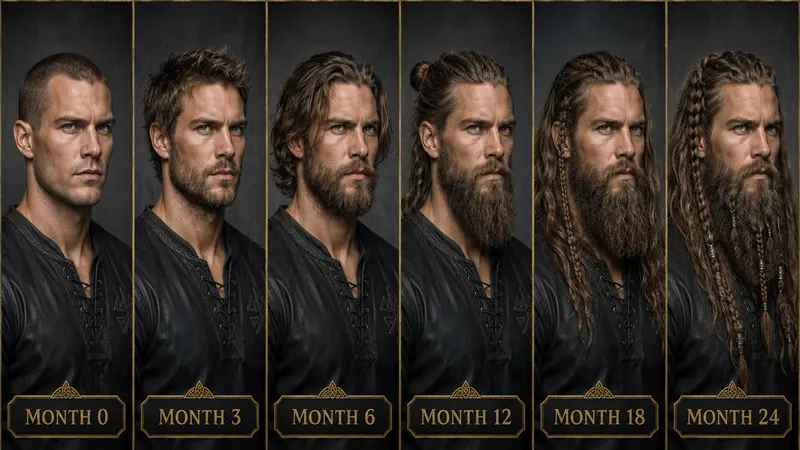
Going from a short modern cut to a full Viking look is a long journey. Most men underestimate how long this takes. Here's the realistic timeline:
Exact Barber Scripts
Bad communication is the #1 cause of disappointing barber appointments. Use these scripts:
For Your First Viking Undercut
"I'm going for a Viking look. I want a disconnected undercut — the sides taken down to about a #2 or #3 clipper guard with a clean line at the temple. Leave the top long — I'm growing it out, so don't cut more than half an inch off the top. We can blend the back into the top for now since I want this to grow into a Ragnar/Bjorn style over the next year."
For a Ragnar Cut
"Ragnar cut, please — like Travis Fimmel in Vikings. Shave the sides clean or take them down to skin. Keep the top long — I have [X] inches. The back I want kept long so I can braid it. Clean up any uneven ends but don't shorten significantly. Here are reference photos."
For Maintenance Trim (Long Hair)
"I'm growing my hair out for a Viking style. I just need a dusting of the ends — please don't take more than half an inch. Clean up split ends but maintain my length. The sides need refreshing at [X clipper guard]. Clean line at the temple."
For Going From Short to Viking
"I want to start growing toward a Viking look. Today I want a low-maintenance shape that grows in well — taper the sides moderately, leave the top long. As I come back over the next year, we'll progressively lengthen the top and tighten the sides. I'm in this for the long haul."
Beard Pairing by Face Shape
The Viking haircut is incomplete without a beard. Here's what works by face shape:
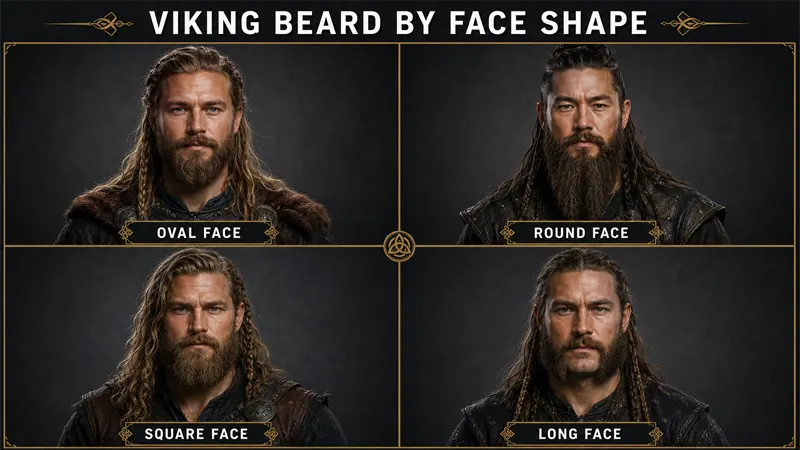
| Face Shape | Best Beard Style | Avoid |
|---|---|---|
| Oval | Almost any beard works — full beard, garibaldi, ducktail, braided | None really — you got lucky |
| Round | Long pointed beard (Ducktail, Garibaldi) — adds length to balance roundness | Short rounded beard, full circle beard |
| Square | Soft full beard, slightly rounded at the bottom to soften strong jaw | Sharp angular beards that emphasize jaw |
| Long / Oblong | Full-sided beard, mutton chops style — adds width | Long pointy beards that elongate the face |
| Heart-shaped | Full chin-focused beard — balances narrow chin | Goatee or stubble — leaves chin looking narrow |
| Diamond | Full beard with rounded shape — softens pointed features | Sharp angular shapes |
Best Viking Beard Styles
- Full Norse Beard: Long, thick, slightly groomed but not over-styled. The classic look.
- Braided Beard: 1–4 braids in the lower portion of the beard. Inspired by Norse god depictions.
- Long Pointed Beard: 6+ inches tapering to a point. Maximum Viking statement.
- Mustache + Goatee Combo: Inspired by the Norse god Frey — heavy mustache with a chin-only beard.
- Garibaldi: Wide, rounded, full beard reaching the chest. Traditional Viking length.
- Beard with Beads: Beads threaded into beard braids for decorative impact. Wedding/festival level only.
Daily Viking Hair & Beard Routine
Long hair and a long beard need maintenance. Here's the routine that prevents damage and keeps everything looking intentional:
Morning Routine (5–10 minutes)
- Detangle gently. Use a wide-tooth comb starting from the ends and working up. Never fight tangles — work them out gently.
- Apply leave-in conditioner. A light spray prevents dryness and keeps hair pliable for styling.
- Choose your style. Loose, half-up, ponytail, bun, or braided — based on your day's plans.
- Beard oil. 3–5 drops of beard oil massaged into the skin underneath and through the beard. Prevents dry skin and "beardruff."
- Beard comb or brush. Shape the beard with a wooden comb or boar bristle brush.
Weekly Routine
- Wash hair 2–3 times per week max. Long hair needs natural oils. Daily washing causes dryness and breakage.
- Deep condition once a week. Use a hair mask or thick conditioner left on for 10–15 minutes.
- Beard wash. Use a dedicated beard wash 2–3 times per week. Skip regular shampoo — too harsh for facial hair.
- Trim split ends every 8–12 weeks. Just a dusting to maintain healthy ends — don't lose length.
Monthly Maintenance
- Side trim every 4–6 weeks. Sides grow back fast. Maintain the undercut/fade.
- Beard shape trim monthly. Maintain the silhouette even while growing it out.
- Protein treatment monthly. Long hair gets weaker as it ages. Protein masks prevent breakage.
Making Viking Style Work at the Office
Not every Viking style works in conservative work environments. Here's how to adapt:
| Office Type | Works | Avoid |
|---|---|---|
| Conservative finance/law/corporate | Slicked-back medium-length hair with neat well-groomed beard, no undercut | Braids, undercuts, shaved sides, mohawks |
| Standard professional office | Man bun with subtle undercut, neat ponytail, beard trimmed to medium | Visible braids, extreme contrasts, long flowing hair down |
| Creative agency / tech startup | Most Viking styles work — including light braids and visible undercuts | Only truly extreme styles (mohawks with shaved patterns) |
| Trades / construction / manual | Almost anything works — Viking style is welcomed | Nothing that interferes with safety equipment |
| Customer-facing roles | Clean, well-groomed Viking style — neat ponytail, trimmed beard | Wild messy looks, extreme statement pieces |
Decision Flow — Should You Get a Viking Haircut?
🧭 Quick Decision Framework
→ Yes: Continue.
→ No: Try a shorter Viking variation (buzz cut + beard or crew cut + beard).
→ Yes: Continue — beard is essential.
→ No: Consider an alternative bold style like the modern mullet fade or blowout taper.
→ Yes: Continue.
→ No (conservative office): Limit to shorter office-friendly Viking variations.
→ Yes: Perfect.
→ No: Stick to shorter Viking styles (buzz cut + beard).
→ Yes: Go for it.
→ No (you'll feel costume-y): Consider modifying your approach — maybe just the beard without the long hair.
10 Common Viking Haircut Mistakes
❌ Quitting during the awkward phase (Month 3–6)
Fix: Push through. Every long-haired man went through this phase. Wear headbands, slick it back, hide it under hats if needed.
❌ Growing the hair without growing the beard
Fix: A Viking haircut without a beard looks incomplete. Start both at the same time.
❌ Not getting trims during growth
Fix: Trim split ends every 8–12 weeks. Untrimmed ends fray and break, keeping you stuck at the same length forever.
❌ Daily washing
Fix: Long hair needs natural oils. Wash 2–3 times per week max. Use conditioner more often than shampoo.
❌ Forcing braids in hair that's too short
Fix: Wait until you have at least 8 inches before attempting Viking braids. Short hair braids look amateur.
❌ Ignoring beard maintenance
Fix: Use beard oil daily and shape the beard monthly. "I'm just letting it grow naturally" produces patchy, unkempt results.
❌ Choosing a Viking style that doesn't suit your face shape
Fix: Use the beard/face-shape table above. Not every face works with every Viking style.
❌ Going overboard with accessories
Fix: Beard beads, leather wraps, and metal accessories work for festivals — not daily wear. Less is more.
❌ Using the wrong styling products
Fix: Long Viking hair needs lightweight products. Avoid heavy pomades that weigh down long strands. Sea salt spray and texture cream work best.
❌ Sleeping with long hair loose
Fix: Tie it in a loose braid or wear a silk wrap to bed. Cotton + free-flowing long hair = breakage and tangles.
Celebrity Viking Hair Inspiration
Many celebrities have rocked Viking-inspired styles. Look to these for inspiration:
- Travis Fimmel (Ragnar Lothbrok in Vikings): The original modern Viking haircut.
- Alexander Ludwig (Bjorn Ironside in Vikings): Long blonde locks with shaved sides.
- Chris Hemsworth (Thor): Long flowing hair with golden waves.
- Jason Momoa (Khal Drogo / Aquaman): Long dark hair with rugged warrior energy.
- Travis Fimmel (post-Vikings): Often photographed maintaining the modified Viking style.
- Fenris Wolf members (Wardruna): Real Norse-inspired music artists with authentic Viking aesthetics.
- Kratos (God of War): Game character with iconic Norse warrior look.
Pro Tips From Barbers
- Blowout Taper Haircut Guide — modern alternative for shorter hair
- Modern Mullet Fade Guide — bold style that pairs with Viking elements
- African Hair Braiding Guide — braid techniques applicable to Viking styles
- Slavic Braids Guide — related Eastern European braid tradition
- Line Up Haircut Guide — sharp edges for the cleanest undercut
- Dark Brown Hair with Highlights — color options for Viking hair
Viking Haircut — Frequently Asked Questions
How long does it take to grow a Viking haircut?
From a buzz cut, expect 12–24 months for the full Viking look. Hair grows about half an inch per month on average. Month 3–6 is the awkward phase. Month 6–9 you can finally tie a small ponytail. Month 9–12 you reach shoulder length. Month 12–18 you're at "true Viking" length. Month 18–24 you can attempt elaborate braids and historical styles.
Did Vikings actually wear their hair this way?
Mostly no. Most "Viking hairstyles" popularized today were invented by the History Channel TV show Vikings. Actual archeological evidence suggests Vikings had reverse mullets (long fringe, short back), partial shaves with side locks, and definitely long braided beards. Modern "Viking" styles are aesthetic homages, not historical accuracy.
Can I have a Viking haircut at the office?
It depends on your industry. Creative agencies, tech startups, trades, and most modern offices are fine with most Viking styles. Conservative finance, law, and traditional corporate settings work best with slicked-back medium hair and neat beards — avoid visible undercuts and braids. Customer-facing roles need clean, well-groomed variations.
Do I need a beard for a Viking haircut?
Strongly recommended. A Viking haircut without a beard looks incomplete — the warrior aesthetic requires both hair AND facial hair. If you can't grow a full beard, even substantial stubble or a goatee helps. If facial hair isn't an option for you, consider an alternative style instead.
What products work best for Viking long hair?
Lightweight products that don't weigh down long strands. Best options: sea salt spray for texture, lightweight leave-in conditioner for moisture, beard oil for facial hair, sulfate-free shampoo for color preservation. Avoid heavy pomades, gels with alcohol, and silicone-heavy products that build up.
How often should I wash long Viking hair?
2–3 times per week max. Long hair needs natural oils to stay healthy. Daily washing strips oils and causes breakage. Use dry shampoo between washes. Always use conditioner — more frequently than shampoo. Deep condition once a week with a hair mask.
How do I learn to braid my own hair?
Practice the basic 3-strand braid first — same technique used on shoelaces. YouTube has hundreds of "Viking braids for beginners" tutorials. Start with one simple braid down the back. Once mastered, progress to small face-framing braids, Dutch braids, and eventually more complex Norse-inspired patterns. Each new technique takes 5–10 attempts to master.
Will a Viking haircut suit me if I'm not blonde or Scandinavian?
Absolutely. The Viking aesthetic is about energy, not ethnicity. Jason Momoa rocks the look with dark hair. Men of all ethnicities and hair types can wear Viking styles. What matters is matching the style to your face shape, hair texture, and personal style — not your ancestry.
What if my hair is thin or balding?
Adapt the style. The shaved head + massive beard approach (like later-season Floki or Ivar) works perfectly for receding hairlines. A buzz cut with a long Viking beard maintains the warrior aesthetic without needing a full mane. Many of the most iconic Viking-inspired looks involve shaved heads — embrace that.
How much does a Viking haircut cost?
Initial cut: $40–100 depending on barber and location. Maintenance trims (sides): $30–60 every 4–6 weeks. Annual cost: $400–800. Add salon braiding services ($30–80 per visit) if you want professional Viking braiding for special occasions. The cut itself is cheap — the long-term commitment is what costs.
Can I get a Viking haircut if I'm in the military or have hair restrictions?
Limited options. Military and uniformed services typically prohibit long hair and visible undercuts. However, you can still embrace the Viking aesthetic with a regulation-cut hair plus a full Viking beard (if your branch allows beards). After service or in civilian roles, you can grow the hair out fully.
This guide reflects modern Viking hair aesthetics inspired by Norse heritage and popular media. Historical accuracy varies — many "Viking" styles are modern interpretations. Individual results depend on hair growth rate, texture, and styling skill. Always consult a barber experienced with long hair growth for personalized advice.
