



Quick answer: The modern mullet fade combines short faded sides with a longer, textured back — the classic "business in the front, party in the back" silhouette refined with clean fades, blended layers, and updated proportions. Unlike the harsh 80s mullet, today's version uses burst fades, low tapers, or skin fades on the sides paired with a back length of 3–6 inches. It works on straight, wavy, and curly hair, suits most face shapes, and takes roughly 3–5 months to grow into the full shape. The burst fade mullet is the most-requested 2026 variation.
What Is a Modern Mullet Fade?
The modern mullet fade is the cleanest, most wearable evolution of one of the most polarizing haircuts in men's grooming history. In 2026, it's nothing like the wild 80s version your dad used to rock — today's mullet uses precision fading, textured layers, and balanced proportions to create a haircut that works at the office, the gym, and on TikTok.
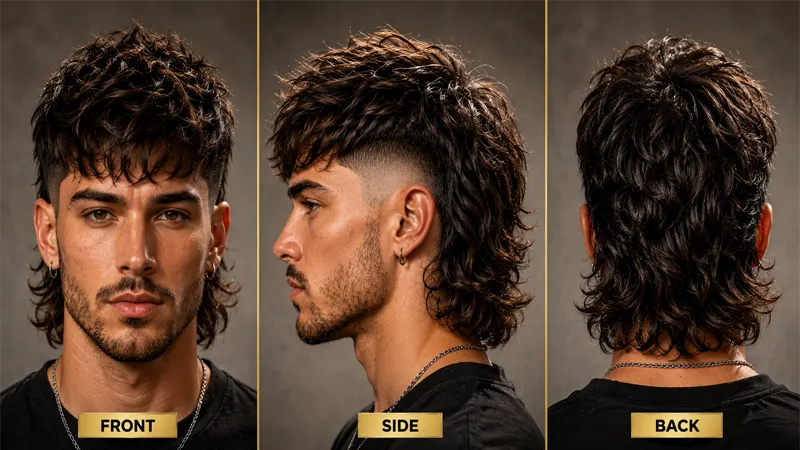
The core formula stays the same: short sides, longer back. What's changed is how those two elements connect. Modern barbers use burst fades (curved fade around the ear), taper fades (gradual transition at the temples), or drop fades (fade that curves down behind the ear) to soften the shape. The top is layered for texture and movement. The back falls anywhere from 3 inches (subtle) to 6 inches (statement) depending on how bold you want to go.
It works because it solves a real problem: most modern men's haircuts look identical from a distance. Buzz cuts, crew cuts, side parts, and standard fades all blur together. The mullet fade gives you a silhouette no one else has — without the costume-y feel of the old mullet.
Modern Mullet vs Classic Mullet — What Changed
If your image of a mullet is still Billy Ray Cyrus in 1992, you're working with outdated information. Here's exactly what's different:
| Feature | Classic Mullet (80s/90s) | Modern Mullet Fade (2026) |
|---|---|---|
| Sides | Untrimmed, bulky, same length as top | Fade or taper to skin or short stubble |
| Top | Flat, minimal styling | Textured, layered, voluminous |
| Back | Long, straight, can reach shoulders | 3–6 inches, layered for movement |
| Transition | Harsh disconnect between top and back | Blended layers, smooth flow |
| Maintenance | Low — let it grow | Moderate — barber every 3–4 weeks |
| Vibe | Rockstar / country / costume | Editorial / TikTok / K-pop / fashion |
The single biggest mistake guys make is asking for "a mullet" without specifying "modern." That ambiguity is how you end up with the 80s version. Always say "modern mullet fade" — or better yet, use one of the specific variations below.
The Four Fade Types — Pick Yours First
Before you pick a back length or texture, decide what type of fade you want on the sides. This single choice changes how aggressive the cut looks. Here are the four options dominating barbershops in 2026:
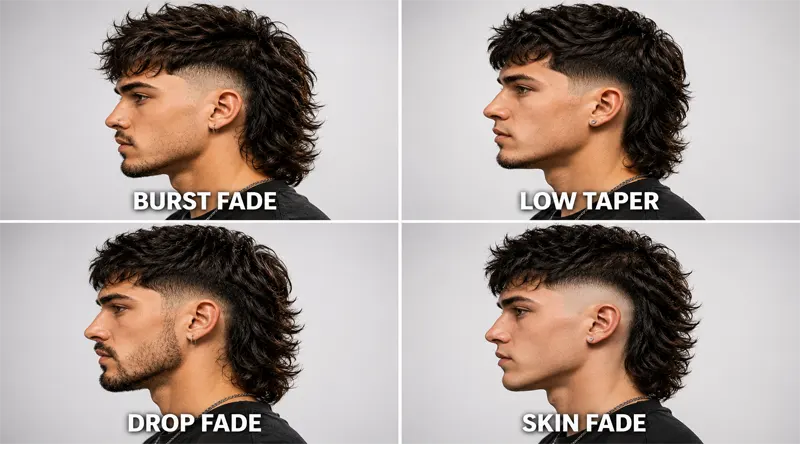
🔥 Burst Fade
The fade curves around the ear in a "burst" shape. Creates a natural softening between the longer back and short sides. The most-requested mullet fade in 2026.
📐 Low Taper Fade
Gradual fade starting just above the ears. The most conservative and office-friendly option. Doesn't show much skin.
💧 Drop Fade
Fade curves downward behind the ear, creating a dropped line that frames the longer back hair. Adds visual interest.
⚡ Skin Fade
Sides shaved to skin for maximum contrast against the longer top and back. The boldest option — needs more frequent touch-ups.
Exact Barber Scripts (Copy & Paste)
Walking into a barbershop and saying "I want a mullet" is the fastest way to get something you didn't want. Modern mullet variations are different enough that your barber needs precise instructions. Use one of these scripts:
For a Burst Fade Mullet (Most Requested)
"I want a modern burst fade mullet. Burst fade around the ears, taper down to short stubble at the bottom. Keep the top textured with layers — about 3 inches. Length in the back going to around 4 inches, layered so it flows naturally. No harsh disconnect."
For a Low Taper Fade Mullet (Office-Friendly)
"Low taper mullet, please. Subtle fade starting just above my ears — don't take it too high. Leave the top long enough to style with texture, around 3 inches. Back length around 3 to 3.5 inches, blended with layers. I want it to look modern but conservative enough for work."
For a Wolf Cut Mullet (Bold/Trendy)
"Wolf cut mullet with a burst fade. Choppy face-framing layers on top, length in the back at around 5 inches. I want texture and movement — definitely not blunt cuts. Keep the sides short with a burst fade around the ears."
For a Curly Mullet Fade
"Curly burst fade mullet. Burst fade on the sides, keep my curls full on top — don't thin them out. The back should be long enough to show the curl pattern, about 4 inches. Shape the curls, don't shorten them."
Modern Mullet Fade by Hair Type
Your hair texture decides which mullet variation will actually look good on you. Here's what to expect by type:
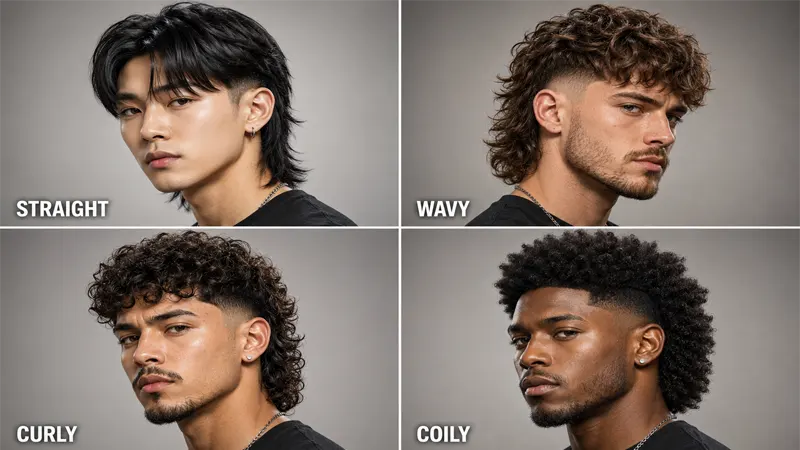
Straight Hair
Straight hair needs more layering to avoid looking flat. Without texture, a straight-hair mullet can look like an unintentional bowl cut. Ask your barber for point cutting on the back and top to add movement. Pair with the blowout taper styling technique on top to maximize volume.
Best variations: Low taper mullet, curtain mullet, K-pop mullet
Products: Sea salt spray + matte clay. Avoid pomades — they flatten straight hair.
Wavy Hair
Wavy hair is the ideal canvas for the modern mullet fade. Natural movement plays perfectly with the layered back and textured top. You can usually skip products entirely on days when you want a more lived-in look.
Best variations: Wolf cut mullet, shaggy mullet fade, textured burst fade mullet
Products: Sea salt spray + light texture paste. Air-dry whenever possible.
Curly Hair
Curly mullet fades are stunning when done right — the contrast between tight faded sides and bouncy curls on top creates maximum visual impact. Ask for a "curly burst fade mullet" specifically; this is a well-known barbering style and most professionals will know exactly what you want.
Best variations: Curly burst fade mullet, curly low taper mullet
Products: Curl cream on damp hair + light hold gel. Diffuse-dry to preserve the curl pattern.
Coily / Afro-Textured Hair
The modern mullet works on coily hair with adjustment — the "back" length is usually achieved through twists, locs, or shaped fro extending behind the ears. Ask for the sides to be a sharp burst or drop fade, with the back length maintained as your natural texture allows.
Best variations: Burst fade with afro back, locs mullet
Products: Leave-in conditioner + curl sponge for shape + edge control.
Top Modern Mullet Fade Variations for 2026
Once you've picked your fade type, you can layer on a specific style. These are the variations dominating 2026:
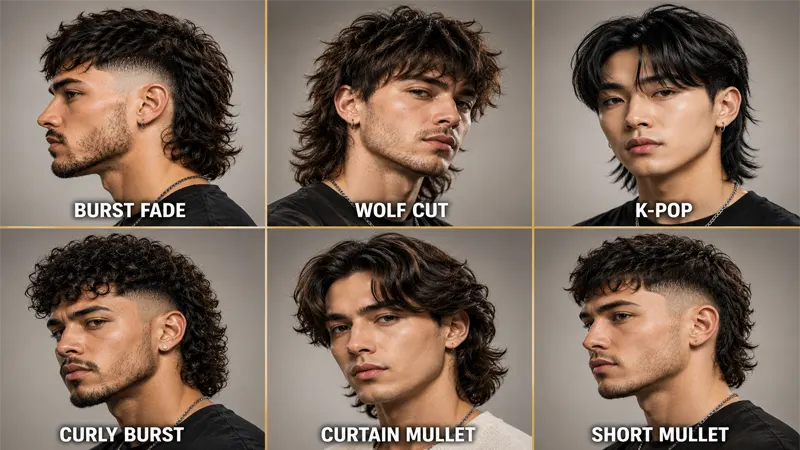
1. Burst Fade Mullet
The single most-requested variation of 2026. Curved fade around the ear, textured top, layered back. Most flattering all-rounder.
2. Wolf Cut Mullet
Hybrid combining wolf cut's choppy face-framing layers with mullet back length. Edgy, voluminous, fashion-forward.
3. K-Pop Mullet
Soft layers, natural volume, middle-parted curtain fringe meeting mullet back length. K-pop and Korean fashion-inspired.
4. Curly Burst Fade Mullet
Defined curls on top above a clean burst fade. Maximum visual contrast. Best for natural curl 3A–3C.
5. Curtain Mullet
Middle-parted curtain fringe in the front, longer flowing back. Soft, romantic, Harry Styles-inspired.
6. Mullet with Blowout Taper
Combines blowout volume on top with mullet back length. The "best of both worlds" style currently trending.
7. Short Mullet
Compact version with only 2–3 inches in the back. Office-friendly entry point to the trend.
8. Shaggy Mullet Fade
Heavy layering throughout for a 70s shag-inspired feel. Wild, voluminous, lived-in.
9. Drop Fade Mullet
Fade curves downward behind the ear, dropping the sideline to frame the longer back.
10. Mullet with Korean Perm
Soft perm on top adds permanent texture and curls. Holds the K-pop or wolf cut shape all day without product.
The 3-5 Month Growth Timeline
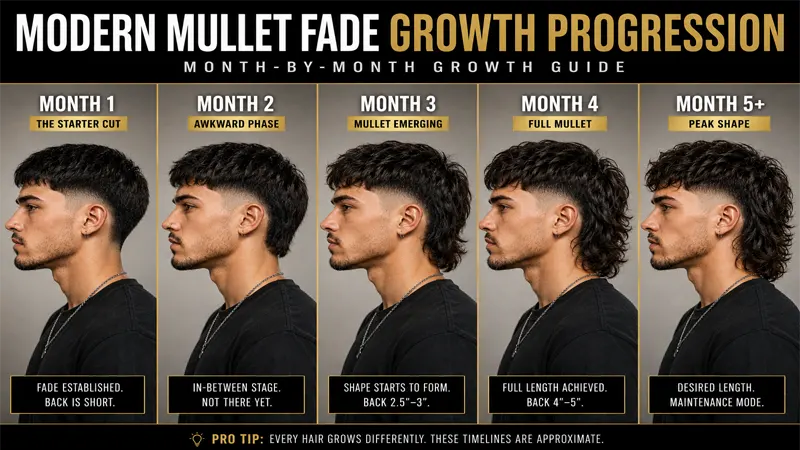
If you're starting with short hair, the modern mullet fade isn't an instant transformation — you need to grow into it. Here's the realistic timeline most men experience:
10 Common Modern Mullet Mistakes
Most mullet failures happen for the same reasons. Each one is fixable:
❌ Asking for "a mullet" instead of "a modern mullet fade"
Fix: Use the specific variation name (burst fade mullet, wolf cut mullet, K-pop mullet) so your barber doesn't default to 80s style.
❌ Cutting the back before it's grown out
Fix: Resist Month 2 panic. The mullet doesn't look like a mullet until Month 3. Hold the line.
❌ Letting the sides grow too long while the back grows
Fix: Maintain the fade every 3 weeks during the growth period. The contrast is what makes the mullet modern.
❌ Going for a high skin fade when your face is round
Fix: Round faces look wider with high fades. Stick to burst or low taper for vertical balance.
❌ Forgetting the textured top layer
Fix: A mullet without textured top looks dated. Always ask for layered cutting or point cutting on top.
❌ Wearing a fully grown-out mullet with no styling
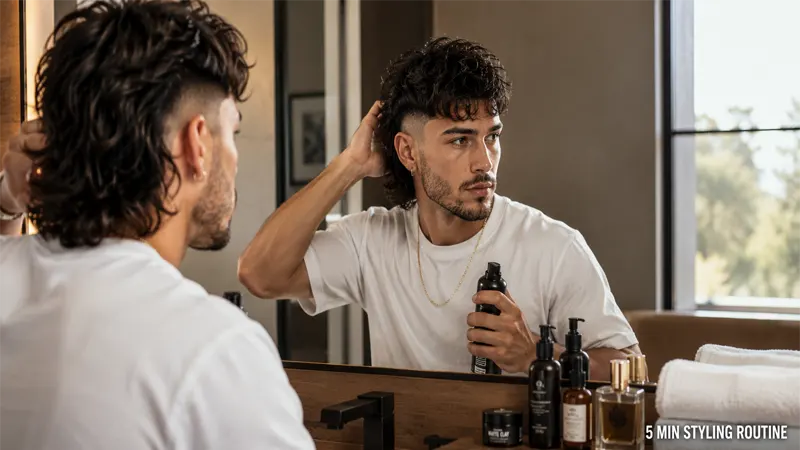
Fix: Always style the top and back with sea salt spray or texture paste. Unstyled mullets read as messy, not intentional.
❌ Choosing a wolf cut mullet with very straight hair
Fix: Wolf cuts need texture to work. Straight hair gets a perm or sticks to K-pop / low taper variations.
❌ Pairing a bold mullet with no facial hair
Fix: The cut needs framing. Pair with at least light stubble or a trimmed beard to balance the silhouette.
❌ Trying to DIY the back length
Fix: The back is the hardest part to cut yourself. Always pay a barber. The mullet stands or falls on back layering.
❌ Skipping the consultation
Fix: Always have a 5-minute conversation with your barber before they start. Show photos, describe what you do for work, get their honest opinion.
Should You Get a Modern Mullet Fade? — Decision Flow
🧭 Quick Decision Framework
→ Yes: Stick to a short mullet or low taper variation. Skip wolf cut/skin fade.
→ No: Continue to Step 2.
→ Yes: Continue.
→ No: Try a blowout taper instead — shorter commitment, similar visual impact.
→ Yes: Continue.
→ No: Reconsider — mullets fall apart without regular fade maintenance.
→ Yes: You're in the sweet spot. Go for it.
→ No: Thinner hair can work but requires careful layering. Find an experienced barber.
Modern Mullet Fade vs Other Trending Cuts
| Haircut | Visual Impact | Commitment | Office-Friendly | Best For |
|---|---|---|---|---|
| Modern Mullet Fade | High | 3–5 months grow-in | Depends on variation | Standing out |
| Blowout Taper | Medium-High | Immediate | Yes | Daily versatility |
| Wolf Cut | High | 2–3 months grow-in | No | Editorial / fashion |
| Textured Crop | Low-Medium | Immediate | Yes | Low maintenance |
| Viking Haircut | High | 6+ months grow-in | No | Bold alternative look |
| Crew Cut | Low | Immediate | Yes | Classic / no-fuss |
Modern Mullet by Face Shape
- Oval face: Any variation works. Burst fade mullet is the safest default.
- Round face: Add vertical height — go with mid burst fade and longer top. Skip high skin fades.
- Square face: Soften strong angles with wolf cut or curtain mullet. Avoid high-contrast skin fades.
- Long face: Balance proportions with shorter back length (3 inches max). Wider styling on the sides.
- Heart-shaped face: The K-pop mullet with curtain fringe balances a wider forehead.
- Diamond face: Burst fade with a curtain or layered top to soften pointed features.
How Much Does a Modern Mullet Fade Cost?
| Barbershop Tier | Cost Range | What You Get |
|---|---|---|
| Chain (Great Clips, Supercuts) | $25–40 | Risky for mullets. Many chain stylists aren't trained on modern variations. |
| Local barber | $30–55 | Good value. Check Instagram for their portfolio first to see if they cut modern mullets. |
| Specialty men's barbershop | $50–90 | Best choice for mullets. Likely fluent in burst fade, wolf cut, and K-pop variations. |
| Premium / celebrity barber | $80–200+ | Worth it only if you're trying a wolf cut or experimental variation. |
Important: Always check your barber's Instagram before booking. Mullets are a specialty cut. Look for at least 5 recent mullet photos in their portfolio. If they don't post any, find someone who does.
Pro Tips That Make a Real Difference
- Blowout Taper Haircut Guide 2026 — the volumetric cousin to the mullet
- Line Up Haircut Guide — the sharp edge that completes any fade
- Korean Perm for Men — pair with K-pop mullet for all-day texture
- Viking Haircut Guide — a bolder, longer alternative
- Dark Brown Hair with Highlights — color options for your mullet
- Cowlick Management Guide — fix common issues that affect mullet styling
Modern Mullet Fade — Frequently Asked Questions
What is the difference between a mullet fade and a modern mullet?
A modern mullet refers to the overall updated style — clean sides, textured top, layered back — that replaced the bulky 80s look. A "mullet fade" specifically describes the technique used on the sides: a fade rather than a uniform short cut. Most modern mullets in 2026 are mullet fades because the fade is what makes the cut look current.
How long does the back of a modern mullet need to be?
The standard range is 3 to 6 inches. Short mullets (3 inches) are office-friendly and subtle. Mid-length mullets (4 inches) are the most popular and versatile. Long mullets (5–6 inches) are statement looks for confident wearers. Anything beyond 6 inches starts looking like the 80s classic mullet.
How long does it take to grow a modern mullet fade?
3 to 5 months depending on your starting length and how fast your hair grows. Hair grows about half an inch per month on average. If you're starting with a short cut, expect to be in the "awkward phase" for Month 2, with a recognizable mullet shape emerging in Month 3.
What's the most popular mullet variation in 2026?
The burst fade mullet is the single most-requested variation in 2026 — it accounts for the largest share of mullet-related Google searches and barbershop bookings. It works for almost all face shapes and hair types, which makes it the safest "first mullet" choice.
Can I have a modern mullet at a corporate job?
It depends on your industry and the specific variation. Conservative finance, law, and traditional corporate roles work best with a short mullet (back length 3 inches max) and a low taper fade. Creative industries, tech, marketing, and most modern offices are fine with any variation. The skin fade and wolf cut mullets are typically too bold for most corporate settings.
Does a modern mullet work for thinning hair?
It can — but choose carefully. Thinning hair benefits from the shadow fade (subtle, no skin showing) paired with strategic layering that adds visible volume. Avoid skin fades, which expose the scalp on the sides. Avoid wolf cut variations that require thick hair. Stick to a short or medium mullet with a low taper fade.
How often do I need to maintain a modern mullet fade?
The sides need a fade touch-up every 3 weeks. The back needs trimming every 6–8 weeks to keep the layers shaped properly. If you don't maintain the fade, the cut quickly loses its "modern" feel and starts looking like an 80s mullet. Budget about $30–55 per visit at a quality barber.
What's the difference between a wolf cut and a mullet fade?
A wolf cut emphasizes heavy choppy face-framing layers — the whole hairstyle has a wild, shaggy texture. A mullet fade focuses on the silhouette (short sides, longer back) rather than the layering. A "wolf cut mullet" combines both: shaggy layered top with mullet back length. Most pure mullet fades have less choppy texture than wolf cuts.
Can I get a mullet fade if I'm older (40+)?
Yes — but choose the right variation. Older men should skip the wolf cut, K-pop, and skin fade variations (these read youthful and trendy). The low taper short mullet or the curtain mullet work elegantly at any age. Pair with a well-trimmed beard for sophistication.
Should I get a mullet or a blowout taper first?
If you've never done either, start with the blowout taper. It's an immediate transformation with no grow-in period, works in any professional setting, and gives you a sense of how short-sides + long-top styles suit your face. If you love the blowout taper experience and want to push further into trend territory, the mullet fade is the natural next step.
This guide reflects current 2026 men's grooming trends. Specific results depend on your barber's skill, your hair growth rate and texture, and styling consistency. Always communicate clearly and bring reference photos for best results.
