



Quick answer: Slavic braids are traditional hairstyles from Eastern European cultures including Russian, Polish, Ukrainian, Bulgarian, Czech, and Balkan traditions. They include the single thick "kosa" braid worn by unmarried women, the two-braid crown worn by married women, and elaborate multi-braid styles with ribbons, coins, and beaded accessories. In Old Slavic traditions, braids symbolized honor, marital status, and spiritual strength. Modern Slavic braids are worn for everyday style, traditional events, weddings, and folk performances. Hair length needed: shoulder-length minimum for basic styles; mid-back or longer for traditional crown braids.
What Are Slavic Braids?
Slavic braids refers to the traditional braiding styles practiced across Eastern European Slavic cultures — including Russian, Polish, Ukrainian, Belarusian, Czech, Slovak, Bulgarian, Serbian, Croatian, and broader Balkan traditions. While braiding hair exists in virtually every culture worldwide, Slavic braiding traditions are distinguished by specific styles, symbolic meanings, and accessories that developed over more than a thousand years of Eastern European folk practice.
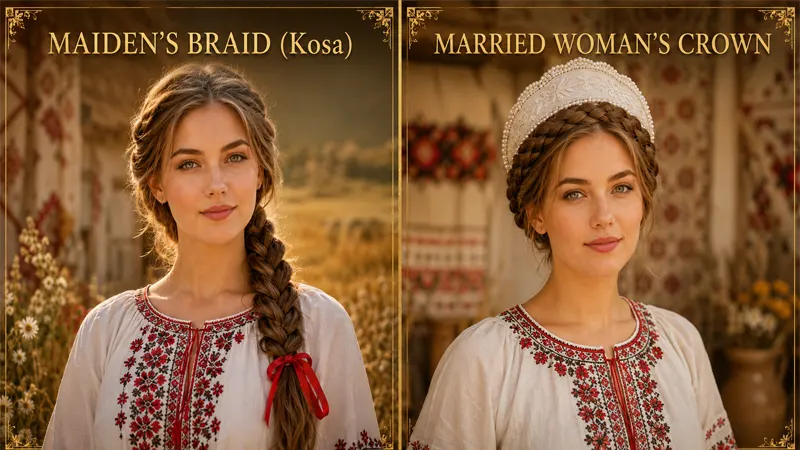
The Slavic word for braid is kosa (коса), and the cultural significance runs deep. In Old Russia, a single thick braid worn down the back signified a young unmarried woman seeking a husband. Two braids wrapped around the head indicated a married woman. The braid was a public declaration of social status, available for any neighbor or visitor to read at a glance.
While modern Slavic women wear braids more freely without these strict meanings, the styles themselves persist as cultural heritage — worn for traditional folk dances and music ensembles, weddings, religious holidays, festivals, and as everyday casual hairstyles. This guide covers 20+ specific Slavic braid styles, their regional variations across Eastern Europe, the symbolism behind each, step-by-step tutorials, and traditional accessories.
Cultural History & Symbolism
In Old Slavic traditions (pre-Christian and early Christian eras, roughly 800–1900 CE), hair carried sacred meaning. It was considered a connection to spiritual power, a reflection of vitality and beauty, and a visible signal of social and marital status. Women rarely cut their hair, growing it long and weaving it into braids that communicated their place in society.
The Symbolic Code of Slavic Braids
- Single braid down the back: Young unmarried woman, available for courtship.
- Single braid with one red ribbon at the end: Actively seeking a husband ("for marriage").
- Single braid with multiple ribbons mid-braid: Engaged or in committed courtship; wedding being planned.
- Two braids wrapped around the head (crown): Married woman.
- Two braids hanging down with white cap (or kokoshnik): Married woman in formal/everyday wear.
- Cut braid: Marriage ceremony or punishment (forced shame). A married woman's hair was often "tucked away" permanently after the wedding.
- Unbound (loose) hair: Reserved for intimate or sacred moments — wedding nights, magical rituals, mourning. Considered taboo for public wear.
The "Rozpletiny" Wedding Ritual
One of the most beautiful Slavic braid traditions was the rozpletiny — the un-braiding ceremony at a wedding. The bride's single maiden braid would be untied by her girlfriends, accompanied by tears and traditional songs lamenting her transition from maiden to wife. Her hair was then re-braided into two braids and covered with a white cap (the Polish oczepiny ceremony marked this exact moment). The maiden's single braid was sometimes cut and saved as a memento — a powerful symbolic transformation from one life stage to another.
Regional Variations Across Eastern Europe
While there are core shared elements across Slavic braiding traditions, each region has distinctive characteristics:
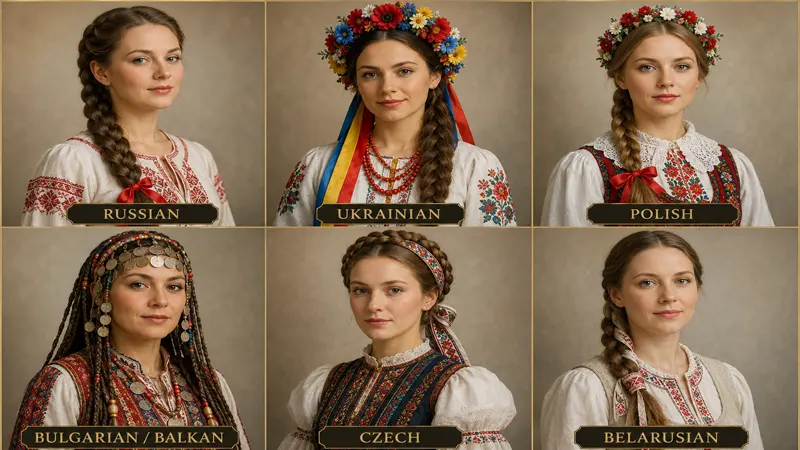
🇷🇺 Russian (Russkaya Kosa)
The classic single thick braid (3-strand) down the back, typically reaching the waist or longer. Often finished with a red ribbon. Russian folk dance ensembles still feature the traditional single-braid look prominently. Also includes the "wheat ear" (French braid in Russian) and "wheat ear with tail" variations.
🇵🇱 Polish (Warkocz)
Polish braids historically came in two forms — single braid for maidens and double braids for married women. The maiden's braid was traditionally adorned with a red ribbon at the end and worn with flower wreaths during festivals. The Polish word "warkocz" has lost etymology — possibly an ancient borrowing from Old Turkish.
🇺🇦 Ukrainian
Ukrainian braids are perhaps the most elaborate, featuring single thick braids paired with extensive flower crowns (vinok), ribbons in multiple colors symbolizing different meanings, and herbal additions. The Ukrainian flower wreath worn over braids is iconic and varies regionally within Ukraine.
🇧🇬 Bulgarian (Balkan Style)
Bulgarian and broader Balkan braids are the most ornate. Traditional Bulgarian Pomak village style features 30+ small braids fastened together with coins, beads, and ribbons — creating a textile-like effect across the head. Used especially for weddings and major celebrations.
🇨🇿 Czech & Slovak (Copánky)
Czech and Slovak traditions include the simple single braid plus distinctive styles featuring braids wrapped around the head with embroidered ribbons matching the wearer's folk costume. Each region of Bohemia and Moravia has subtle stylistic differences.
🇷🇸 Serbian / Croatian / Bosnian
South Slavic traditions blend Slavic and Mediterranean influences. Common styles include simple braids combined with elaborate metal hair ornaments, particularly for traditional dance and wedding wear. Specific village traditions across the Balkans add unique elements.
🇧🇾 Belarusian
Belarusian braid traditions share much with Russian and Ukrainian styles, but distinctively feature linen ribbons and modest woven crown styles. Traditional Belarusian costumes pair specific braid styles with specific embroidery patterns.
20+ Slavic Braid Styles for 2026
Here are the most popular Slavic braid styles in modern practice — from simple everyday looks to elaborate traditional wedding styles:
Traditional Maiden Styles (Single Braid)
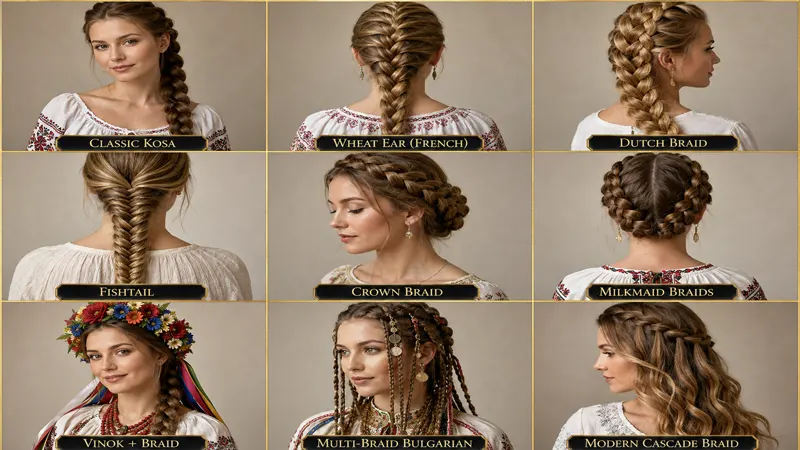
1. Classic Single Russkaya Kosa
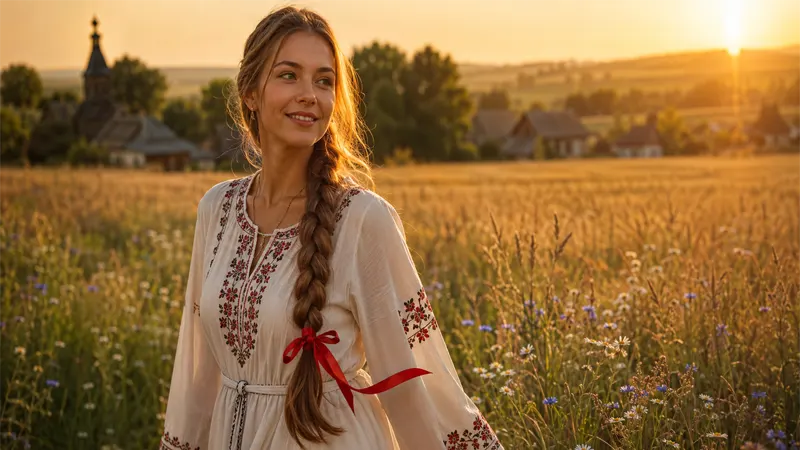
Single thick 3-strand braid down the back, finished with a ribbon. The most iconic Slavic style. Symbolizes unmarried status historically.
2. Wheat Ear (French Braid)
The Russian "kolosok" — a braid that picks up hair from the sides as it goes down, creating a wheat-ear pattern. Originated centuries ago in Eastern Europe.
3. Half-Wheat Ear
French braid down to mid-head, then transitions to a regular braid. Allows the braid to hang loose at the bottom while keeping the top neat.
4. Dutch Braid (Inverted)
Like a French braid but woven outward instead of inward — strands cross under instead of over, making the braid pop out from the head. Russian girls call this style "inside-out."
5. Fishtail Braid
Two-strand braid creating a "fish skeleton" pattern. Originally called "rybiy khvost" in Russian. Looks intricate but is technically simple.
6. Greek-Style Multiple Fishtails
Several fishtail braids arranged in an elaborate hairstyle. Called "Greek braids" in Russian tradition. Wedding-appropriate.
Married Woman / Crown Braid Styles
7. Traditional Crown Braid (Double)
Two thick braids wrapped around the head, meeting at the front or back. The classic married woman's style. Currently trending heavily among non-Slavic wearers.
8. Halo Braid
Single braid wrapped around the head like a halo. Elegant and works for special occasions. Often photographed at Slavic weddings.
9. Milkmaid Braids
Two braids crossed over the top of the head and tucked behind. Practical for farm work historically, now stylish. Heidi-style.
10. Double Side Braids
Two braids starting from temples on each side. Practical everyday style. Common among Russian athletes for sports.
Elaborate & Wedding Styles
11. Bulgarian Pomak Multi-Braid
30+ small braids fastened with coins, beads, and ribbons. Traditional Bulgarian Pomak village wedding style. Most elaborate Slavic braid tradition.
12. Ukrainian Vinok with Braids
Single or double braids paired with an elaborate flower crown (vinok). Traditional Ukrainian festival and wedding style. Multi-colored ribbons flow from the crown.
13. Polish Wreath Braid
Single braid worn with a fresh flower wreath, traditional for spring festivals and weddings. The wreath signified virginity in old tradition.
14. Multi-Strand Folk Braid
4, 5, or even 7-strand braids creating an elaborate weave pattern. Used for important folk dance performances.
15. Cascade Braid
Braid that releases strands as it goes down, creating a cascading waterfall effect. Modern interpretation of traditional folk styles.
Modern Adaptations
16. Half-Up Crown Braid
Top half braided into a small crown, bottom half flowing loose. Modern compromise between tradition and casual style.
17. Athletic Slavic Braid
Tight French braid (or two) secured top and bottom with rubber bands. The go-to style for Russian female athletes — tennis players, volleyball players, basketball stars.
18. Partial Slavic Braid
Small braid incorporated into otherwise loose hair. Subtle nod to tradition for everyday wear.
19. Slavic Braid Bun
Long braid coiled into an updo bun. Combines traditional braid technique with modern updo aesthetics. Wedding-friendly.
20. Boho-Slavic Mix
Loose flowing hair with subtle Slavic-inspired braids and flower accents. Bohemian fusion of traditional Slavic elements.
21. Fashion Editorial Slavic Braids
Modern fashion show interpretations of traditional braids. Mercedes-Benz Fashion Week Moscow regularly features complex braid creations.
22. Folk Performance Braids
Specifically designed for Russian/Slavic folk dance ensembles — must be secure enough for vigorous movement while looking traditional.
How to Create a Classic Slavic Braid (Step-by-Step)
The classic single Russkaya kosa is the foundation for nearly all Slavic braid styles. Here's how to create one:
What You'll Need
- A wide-tooth comb or detangling brush
- Hair spray (optional, for hold)
- Hair tie (clear elastic preferred)
- Red ribbon (traditional, optional)
- Mirror (helpful for self-braiding)
Step-by-Step Process
- Detangle thoroughly. Brush hair from ends to roots with a wide-tooth comb until completely smooth. Slavic braids work best on slightly day-old hair (one day after washing) when there's natural texture for grip.
- Gather your hair. Pull all hair back to the center of your head, ensuring the part is clean and even. For a traditional look, leave no loose strands at the temples.
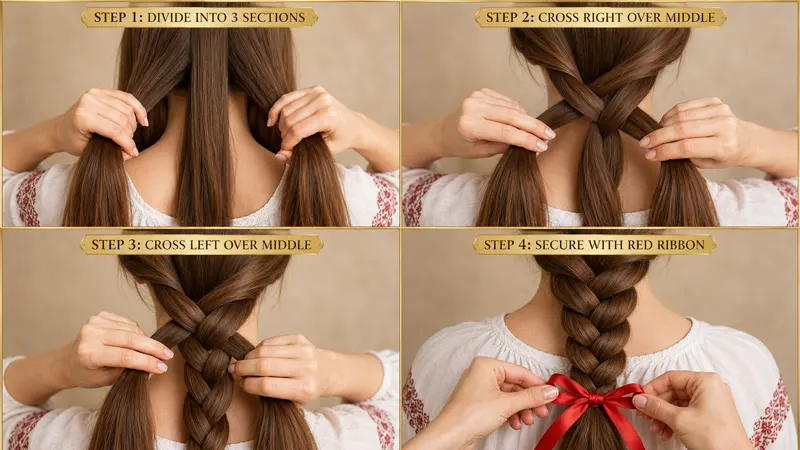
- Divide into three equal sections. Take your gathered hair and separate it into three exactly equal strands — left, middle, right. The strands should be the same thickness for an even braid.
- Cross the right strand over the middle. The right strand becomes the new middle.
- Cross the left strand over the middle. The left strand becomes the new middle.
- Continue alternating. Right over middle, then left over middle. Maintain consistent tension throughout — not too tight, not loose. Even tension creates the classic Slavic braid appearance.
- Reach the ends. Continue braiding all the way to the very end of your hair. Don't stop early.
- Secure with elastic. Use a small clear elastic about an inch from the end.
- Add a red ribbon (traditional). Tie a red ribbon over the elastic for the authentic Russian look. Single bow for unmarried, multiple ribbons for engaged.
- Smooth flyaways. Run your fingers gently along the braid to release any natural texture, then mist lightly with hairspray if you want hold.
Creating the Crown Braid (Two-Braid Wrap)
- Part your hair down the middle. Create a clean center part from forehead to nape.
- Braid each side separately. Create a tight 3-strand braid on each side of your head, starting just behind the ear.
- Secure both braids. Use small clear elastics at the ends.
- Cross the braids over your head. Take the left braid and bring it up and over the top of your head to rest above your right ear.
- Repeat with the right braid. Bring the right braid up and over to rest above your left ear, crossing over the first braid.
- Pin securely. Use bobby pins (multiple — at least 6–8) to secure both braids in place around the crown of your head.
- Tuck any ends. Hide the braid ends beneath the crown for a seamless appearance.
- Add accessories. Traditional finish includes a flower crown, ribbons woven through the braids, or a kokoshnik headpiece.
Traditional Slavic Braid Accessories
Accessories aren't just decorative — they carry symbolic meaning in Slavic braid traditions:
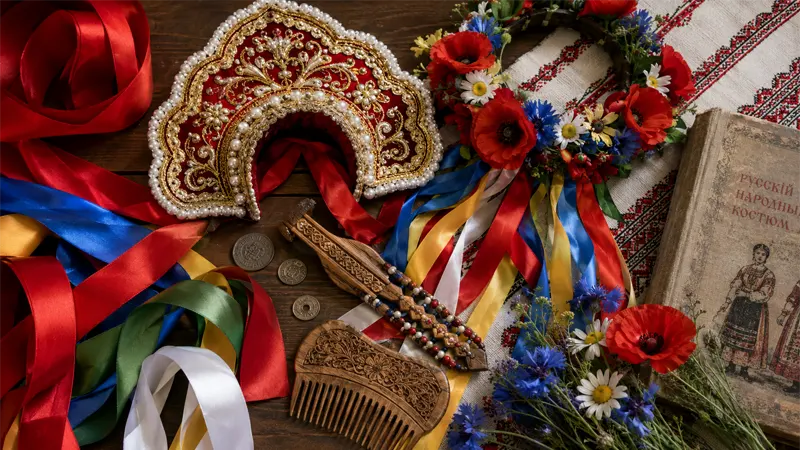
Ribbons (Lentochki)
- Red ribbon: Most traditional. Single red ribbon at the end of a single braid = unmarried but available.
- White ribbon: Wedding day color, purity.
- Blue ribbon: Traditional color in some regions for spiritual protection.
- Multi-colored ribbons: Festival wear; each color in Ukrainian tradition has specific meaning (red for love, yellow for prosperity, green for youth, blue for sky/water).
Headpieces & Crowns
- Kokoshnik (Russian): Elaborate crown-shaped headdress worn over braided hair, especially for formal/traditional events. Can be simple cloth or richly embroidered with pearls.
- Vinok (Ukrainian): Flower crown traditionally worn by unmarried girls. Made from fresh wildflowers in spring, dried flowers in winter, paper flowers historically for everyday wear.
- Krasota (Russian): Special headpiece for the wedding day, worn with braids.
- Polish flower wreath: Similar to Ukrainian vinok, worn during spring festivals and weddings.
Nakosniki (Braid Ornaments)
Decorative ornaments worn at the end of braids, traditionally made from birch bark, beads, embroidered cloth, or carved wood. Modern versions can include metal charms, woven elements, or even small bells.
Coins & Beads (Balkan Tradition)
In Bulgarian, Macedonian, and other Balkan traditions, braids were fastened with coins (sometimes Turkish or Roman) and beads. The number and type of coins displayed wealth and family status. Modern versions use replica coins or decorative metal beads.
Cultural Respect & Etiquette
Hair braiding traditions exist in virtually every culture worldwide — Slavic braids are one such tradition among many. Here's how to wear Slavic braid styles respectfully:
What to Avoid
- Don't combine Slavic braids with stereotyped costumes (e.g., "sexy Russian" Halloween costumes)
- Don't claim the style is exclusively from one specific Slavic culture if you're not from that culture
- Don't appropriate religious or wedding-specific elements (like the cut-braid symbolism)
- Don't dismiss the cultural meaning when others ask about the style
What to Embrace
- Learning the history and symbolism enhances the experience
- Supporting Slavic artisans for traditional accessories (vinki, nakosniki, kokoshniki)
- Sharing what you know when people ask about the style
- Acknowledging that braiding traditions are global — Slavic braids are one beautiful tradition among many
For comparative perspective on other braiding traditions, see our guide to African hair braiding — another rich braiding heritage from a different part of the world.
Hair Care for Slavic Braid Styles
Traditional Slavic braids work best on long, healthy hair. Caring for long hair so it can be braided beautifully requires consistent practice:
Growing Long Slavic-Braid Length Hair
- Trim only the ends every 8–12 weeks. A small trim prevents split ends from traveling up the hair shaft. Don't lose length.
- Use sulfate-free shampoo. Sulfates strip the natural oils that long hair needs. Slavic women historically used herbal infusions (chamomile, nettle, rosemary).
- Deep condition weekly. Long hair needs more moisture than short hair. A weekly hair mask is non-negotiable.
- Brush gently and from ends up. Start at the ends and work upward to detangle. Wide-tooth combs or boar bristle brushes work best.
- Protect at night. Sleep on silk or satin, or wrap your hair in a loose braid before bed. Cotton pillowcases cause friction breakage.
- Limit heat styling. Heat damages long hair. Air-dry whenever possible. Cap heat tools at 350°F.
Maintaining Your Slavic Braid Throughout the Day
- Mid-day touch-up: Small flyaway hairs can be smoothed with a tiny amount of hair oil or moisturizing cream.
- For multi-day wear: Tie your braid with a silk scarf at night to preserve it for another day. Many Slavic women wear the same braid for 2–3 days, refreshing it as needed.
- Don't redo too often: Constantly re-braiding stresses hair. Once a day or once every other day is sufficient.
8 Common Slavic Braid Mistakes
❌ Braiding wet or damp hair
Fix: Wet hair stretches and breaks easily. Always braid dry or barely damp hair for cleanest results and least damage.
❌ Tension too tight at the roots
Fix: Slavic braids should be smooth but not painful. Excessive tension at the roots causes hair loss (traction alopecia) over time.
❌ Uneven section sizing
Fix: For the classic 3-strand braid, all three sections must be exactly equal at the start. Unequal sections create lumpy, irregular braids.
❌ Skipping the part for crown braids
Fix: Two-braid crown styles require a clean center part. Use a fine-tooth comb to create a precise straight line from forehead to nape.
❌ Not enough bobby pins for crown braids
Fix: Crown braids need at least 6–8 bobby pins to stay secure throughout the day. Cross pins in an X-pattern for maximum hold.
❌ Using cotton hair ties
Fix: Cotton fabric hair ties grab and break hair. Use clear plastic elastics or fabric-covered hair ties designed for hair safety.
❌ Treating it as costume
Fix: Slavic braids are a living cultural tradition. Wear them as everyday or formal style — not as Halloween costume or stereotyped portrayal.
❌ Forcing the style on short hair
Fix: Most traditional Slavic styles need at least shoulder-length hair. If your hair is shorter, focus on modern adaptations like partial braids rather than forcing long-hair styles.
Pro Tips From Slavic Hairstylists
- African Hair Braiding Guide 2026 — different cultural braid tradition
- Braids for Boys Guide — braiding for younger family members
- Best Braiding Gel 2026 — products for smooth Slavic braids
- Hair Wrap Guide — Slavic headscarves and kokoshniki pair with braids
- Viking Haircut Guide — related Nordic braiding tradition
- Dark Brown Hair with Highlights — color options that complement Slavic braids
Slavic Braids — Frequently Asked Questions
What exactly are Slavic braids?
Slavic braids are traditional hairstyles from Eastern European Slavic cultures including Russian, Polish, Ukrainian, Belarusian, Czech, Slovak, Bulgarian, Serbian, and Balkan traditions. They include the classic single thick braid (kosa), the two-braid crown wrap worn by married women, the wheat ear French braid, and elaborate multi-braid styles with ribbons, coins, and traditional accessories. They've been worn for over 1,000 years across Eastern Europe.
What's the difference between a Slavic braid and a regular braid?
The braiding technique itself (3-strand braid) exists worldwide and isn't unique to any culture. What makes a braid "Slavic" is the specific styling: tight smooth tension, single thick braid for unmarried women, two-braid crown for married women, traditional ribbons (especially red), and accessories like vinok flower crowns or kokoshniki headpieces. The cultural context and symbolism define the style.
What does a single Slavic braid symbolize?
Historically, a single thick braid down the back signified an unmarried young woman in Old Slavic tradition. A red ribbon at the end indicated she was actively seeking a husband. Multiple ribbons mid-braid indicated engagement or active courtship. The wedding ceremony included the "rozpletiny" — un-braiding the maiden's braid and re-braiding into two married-woman braids covered with a cap.
Can non-Slavic people wear Slavic braids?
Generally yes, with respect. Slavic braiding traditions are not exclusively restricted, and the styles aren't sacred in a way that excludes outsiders. The key is wearing them respectfully — learning the history, supporting Slavic artisans for accessories, avoiding costume-style portrayals, and acknowledging the cultural source. Treat Slavic braids the same way you'd treat any cultural tradition you appreciate.
How do I make a traditional Russian braid?
Detangle hair thoroughly. Gather all hair at the back of your head and divide into three equal sections. Cross the right section over the middle, then the left section over the middle. Continue alternating until you reach the ends. Secure with a clear elastic. Tie a red ribbon for the traditional Russian touch. The whole process takes 5-10 minutes once you're practiced.
What hair length do I need for Slavic braids?
Minimum shoulder-length for basic single braids. Mid-back length for proper crown braids. Long hair (waist-length or longer) for traditional folk styles with multiple braids and elaborate accessories. Most authentic Slavic styles assume hair has never been cut significantly — historically, Slavic women rarely cut their hair.
How long do Slavic braids last?
One day if redone daily. Most Slavic women can wear the same braid for 2-3 days with overnight protection (silk scarf or pillowcase). For multi-day wear, secure with a silk scarf at night, and refresh any flyaways in the morning. Tighter braids hold longer; looser styles need redoing more frequently.
What accessories pair with Slavic braids?
Red ribbons (most traditional), kokoshniki (Russian crown headpieces), vinok (Ukrainian flower crowns), nakosniki (braid-end ornaments), coins and beads (Balkan tradition), embroidered headscarves, and pearl-trimmed accessories. Each region has specific traditional pieces — research your specific country's traditions for authenticity.
Are Slavic braids the same as Viking braids?
No, though both come from European braiding traditions. Slavic braids (Russian, Polish, Ukrainian, etc.) developed independently from Viking/Norse braids (Scandinavian). They share some visual similarities (long single braids exist in both), but the cultural contexts, specific styles, and accessories differ significantly. Slavic braids feature ribbons and flower crowns; Viking braids often feature metal beads and warrior aesthetics. See our Viking haircut guide for comparison.
Can I do Slavic braids on curly hair?
Yes, with adjustments. Curly hair creates a different texture than the smooth, satin-finish typical of traditional Slavic braids. To achieve a smoother look, apply a smoothing serum or light gel before braiding. The braid will still have natural curl texture, which can be beautiful in its own right — just understand that the visual result differs from straight-hair versions.
What's the cultural significance of cutting a Slavic braid?
Significant. In Old Slavic tradition, cutting a woman's braid was either ceremonial (during the wedding ritual marking transition from maiden to wife) OR a form of shame and punishment (for women who "lost their virtue" or were disgraced). The braid was considered sacred — losing it was a transformative event. Modern Slavic women freely cut their hair, but the historical symbolism remains culturally significant.
Where can I learn more about authentic Slavic braiding traditions?
Look into resources from Slavic cultural museums (the Russian Ethnographic Museum, the National Museum of Polish Folk Culture in Warsaw), folk dance ensemble websites, books on Slavic folk traditions, and modern Slavic stylists on YouTube and TikTok. Many traditional folk ensembles offer workshops on traditional braiding techniques. Russian publications like Russia Beyond provide accessible cultural articles.
This guide reflects living Slavic braiding traditions and modern interpretations. Specific styles, symbolism, and accessories vary by country, region, and village within Slavic culture. We've aimed to honor the diversity within these traditions while providing practical guidance. For authentic specialized advice, consult Slavic cultural communities, folk ensembles, or specialized stylists familiar with your specific country's heritage.
