


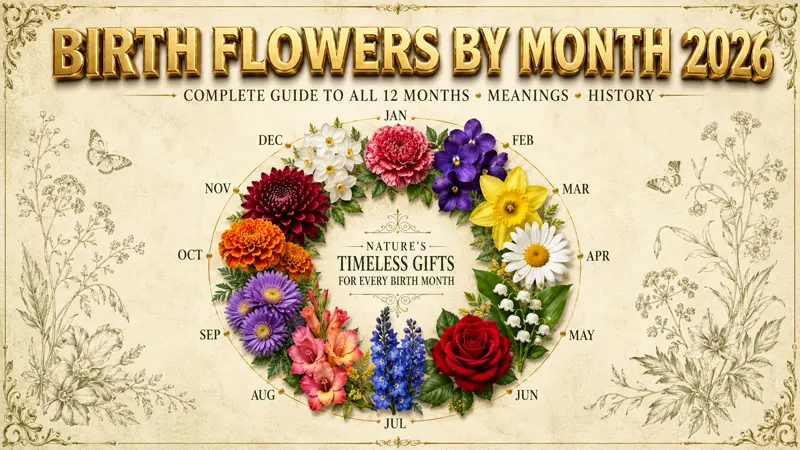

Quick answer: Every month of the year has at least one birth flower — a bloom traditionally associated with that month, similar to birthstones. The 12 primary birth flowers are: January Carnation, February Violet, March Daffodil, April Daisy, May Lily of the Valley, June Rose, July Larkspur, August Gladiolus, September Aster, October Marigold, November Chrysanthemum, and December Narcissus. Most months also have a secondary flower. The tradition dates back to ancient Rome and was codified during the Victorian era through floriography — the language of flowers. Birth flowers make meaningful gifts, tattoos, and personal symbols.
What Are Birth Flowers?
A birth flower is a flower traditionally associated with a specific month of the year — much like a birthstone, but blooming. Each month has at least one assigned flower, and most months have two: a primary bloom (the most widely accepted choice) and a secondary bloom (the popular alternative).
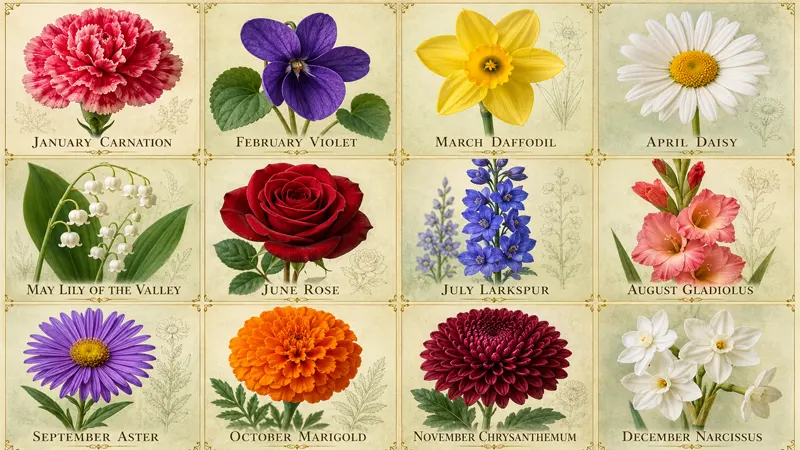
Birth flowers were chosen primarily for two reasons: they bloom (or are commonly available) during their respective months, and they carry symbolic meanings rooted in Victorian floriography — the 19th-century language of flowers. Today, birth flowers serve as meaningful symbols for tattoos, jewelry, gifts, wedding bouquets, gardens, and personal expression.
Unlike birthstones — which were standardized by the American jewelry industry in 1912 — there is no single official authority for birth flowers. This is why some months have two recognized flowers and why minor regional variations exist (the American, British, and Korean traditions differ in a few months). The chart in this guide reflects the most widely accepted Western version.
The Complete Birth Flowers Chart
Here's the full birth flower calendar at a glance — primary flower, secondary flower, and core meaning for each month:
| Month | Primary Flower | Secondary Flower | Core Meaning |
|---|---|---|---|
| January | Carnation | Snowdrop | Love, admiration, hope |
| February | Violet | Primrose / Iris | Faithfulness, devotion, young love |
| March | Daffodil | Jonquil | Rebirth, new beginnings, prosperity |
| April | Daisy | Sweet Pea | Innocence, purity, blissful pleasure |
| May | Lily of the Valley | Hawthorn | Sweetness, return of happiness |
| June | Rose | Honeysuckle | Love, passion, devoted affection |
| July | Larkspur | Water Lily | Levity, strong bonds, purity |
| August | Gladiolus | Poppy | Strength, integrity, imagination |
| September | Aster | Morning Glory | Wisdom, faith, affection |
| October | Marigold | Cosmos | Warmth, creativity, peace |
| November | Chrysanthemum | Peony | Joy, longevity, friendship |
| December | Narcissus | Holly | Hope, good wishes, rebirth |
The History & Origin of Birth Flowers
The tradition of associating flowers with birth months draws from three major cultural roots, layered over more than 2,000 years:
Ancient Rome — The Foundation
The earliest birth flower traditions trace to ancient Rome, where birthday celebrations called natalis honored both the birthday person and their personal guardian spirit (genius). Romans gave flowers as birthday gifts and associated specific blooms with seasonal festivals and the gods who ruled each month. Pliny the Elder's Natural History, completed around 77 CE, discusses many of the flowers that later became associated with month-by-month tradition. The Roman birthday flower custom established the foundational concept that flowers and personal birthdays belonged together.
The Victorian Era — Codification (1800s)
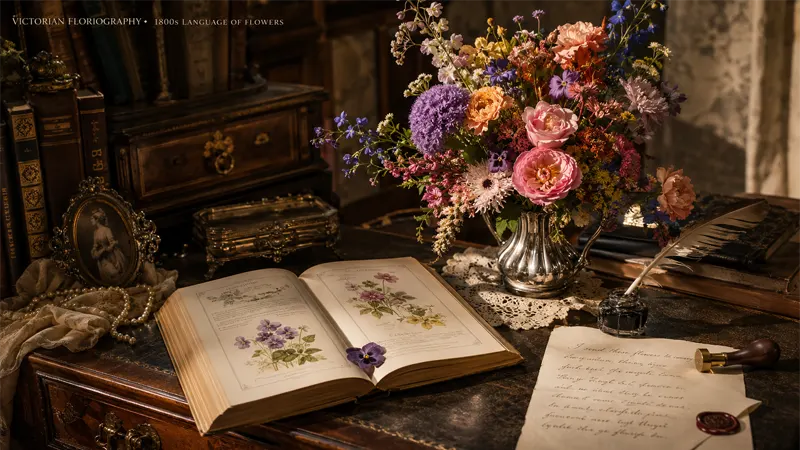
The modern Western birth flower list took shape in 19th-century England through floriography — the language of flowers. The Victorians used carefully chosen bouquets to communicate feelings that polite society wouldn't allow them to speak aloud. Flower writers including Robert Tyas (1836) and Frederic Shoberl (1834) published flower dictionaries that built the formal floriography vocabulary, drawing on older Roman traditions and Christian liturgical calendar flower-saint associations.
The English aristocrat Lady Mary Wortley Montagu (1682–1762) is often credited with introducing the concept of floriography to England after her travels in the Ottoman Empire. By the 1860s, the twelve-flower-per-year system was standardized with primary and secondary assignments that remain the Western default in 2026.
Modern Era — Florists & Marketing (1900s-present)
Early 20th century American florists settled the popular pairings into the list used today, which is why American and British birth flower lists agree on most months. Unlike birthstones — which the American jewelry industry standardized in 1912 — no single body ever officially fixed the birth flower list. This is why your month has both a primary and secondary flower, and why you'll occasionally see regional swaps.
Modern Korean Hanakotoba — A Parallel Tradition
Modern Korean popular culture maintains a parallel tradition that assigns a unique flower to each of the year's 365 days. The system has roots in older East Asian floral calendars and reached its modern day-by-day form through 20th-century Korean publications. Several days align cross-culturally with Western tradition: primrose for February 1 in both Korean and Western traditions; narcissus for March 1 in both.
The 12 Birth Flowers Month-by-Month
Here's a deeper look at each month's birth flowers. For comprehensive guides including symbolism, growing tips, tattoo ideas, and gift suggestions, follow the "Read full guide" link under each month.
❄️ January — Carnation & Snowdrop
Carnation (Primary) • Snowdrop (Secondary)January's primary birth flower is the carnation (Dianthus caryophyllus) — a ruffled bloom in nearly every color, each shade carrying its own meaning. Pink carnations symbolize gratitude, red represents deep love, and white means pure love and good luck. The secondary flower, the snowdrop (Galanthus), is a delicate winter bloomer symbolizing hope and rebirth. Together, they reflect loyalty, perseverance, and emotional strength.
Paired with garnet (January's birthstone), the meaning feels grounded and protective. Carnations have been cultivated for over 2,000 years, used by ancient Greeks and Romans in ceremonies and perfumes.
Read full January guide →💜 February — Violet & Primrose
Violet (Primary) • Primrose / Iris (Secondary)February's primary birth flower is the violet (Viola) — symbolizing faithfulness, spiritual wisdom, and humility. In ancient Greece, violets were linked to fertility and love, often associated with Aphrodite. The secondary flower, the primrose (Primula vulgaris), symbolizes young love and "I can't live without you" in Victorian flower language. Some sources list the iris as an alternative, representing eloquence, faith, and hope.
February babies are often associated with steady, sincere natures — connection and constancy over showiness. Paired with amethyst (February's birthstone), the symbolism feels centered and calm.
Read full February guide →🌼 March — Daffodil & Jonquil
Daffodil (Primary) • Jonquil (Secondary)March's birth flower is the bright yellow daffodil (Narcissus pseudonarcissus) — the herald of spring. Daffodils symbolize rebirth, optimism, and new beginnings, appearing just as winter loosens its grip. In Welsh tradition, spotting the first daffodil of the season is said to bring a year of good luck. The jonquil, a fragrant variety in the same Narcissus family, is the secondary flower with similar meanings plus added symbolism of desire and friendship.
March is sometimes described as having only one birth flower because daffodils dominate the month so completely. People born in March are associated with optimism, creativity, and imagination.
Read full March guide →🌸 April — Daisy & Sweet Pea
Daisy (Primary) • Sweet Pea (Secondary)April's primary birth flower is the daisy (Bellis perennis) — symbolizing innocence, purity, and loyal love. Daisies bound into spring with energy and joy, with their long white petals and yellow centers (though they come in many colors). The secondary flower, the sweet pea (Lathyrus odoratus), represents blissful pleasure, friendship, gratitude, and gentle farewells. The late-Victorian breeding work by Scottish gardener Henry Eckford (beginning 1888) transformed sweet pea into the fragrant garden varieties we know today.
Pair with diamond (April's birthstone) for a classic, luminous combination.
Read full April guide →🌿 May — Lily of the Valley & Hawthorn
Lily of the Valley (Primary) • Hawthorn (Secondary)May's birth flower is the lily of the valley (Convallaria majalis) — small white bell-shaped flowers with a beautiful sweet scent. They symbolize sweetness, humility, and a "return of happiness," and have featured in royal weddings (including Kate Middleton's 2011 bouquet). The French Muguet du 1er Mai tradition dates from 1561, when King Charles IX received muguet as a good-luck gift. The secondary flower, hawthorn (Crataegus), grows on thorny shrubs with white, pink, or red flower clusters, symbolizing hope and protection.
Paired with emerald (May's birthstone), the meaning feels nurturing and protective.
Read full May guide →🌹 June — Rose & Honeysuckle
Rose (Primary) • Honeysuckle (Secondary)June's primary birth flower is the rose (Rosa) — perhaps the most universally recognized and symbolic flower in Western tradition. The rose symbolizes love, passion, and beauty, but its color dramatically shifts the meaning: red for romantic love, pink for gratitude, white for purity, yellow for friendship. The rose spans Persian poetry, Greek mythology, Christian Marian symbolism, and Tudor English political iconography. The secondary flower, the fragrant honeysuckle (Lonicera), symbolizes the bonds of love and new affection.
Paired with pearl (June's birthstone), the symbolism is timelessly romantic.
Read full June guide →☀️ July — Larkspur & Water Lily
Larkspur (Primary) • Water Lily (Secondary)July's primary birth flower is the larkspur (Delphinium) — tall, elegant spires of blue, purple, pink, or white blooms. Larkspur symbolizes levity, strong bonds of love, and an open heart. The secondary flower, the water lily (Nymphaea), represents purity, enlightenment, and rebirth — drawing from both Western and Eastern symbolism. (Some sources list lotus or delphinium variations.) July is one of the more debated months in the birth flower tradition.
Paired with ruby (July's birthstone), the symbolism feels generous and warm-hearted.
Read full July guide →🌻 August — Gladiolus & Poppy
Gladiolus (Primary) • Poppy (Secondary)August's primary birth flower is the gladiolus (Gladiolus species) — towering spikes of showy blooms in dazzling colors. The name comes from the Latin "gladius" (sword), referring to the sword-like leaves; it symbolizes strength, integrity, and infatuation. The secondary flower, the poppy (Papaver), carries meanings of remembrance, imagination, and dreams. August babies are said to combine resilience with creativity — standing firm while still dreaming big.
Paired with peridot (August's birthstone), the symbolism becomes vibrant and bold.
Read full August guide →🍂 September — Aster & Morning Glory
Aster (Primary) • Morning Glory (Secondary)September's primary birth flower is the aster (Aster species) — autumnal star-shaped blooms in many colors. The name comes from the Greek word for "star," and asters symbolize wisdom, faith, and valor. In ancient times, people believed burning aster leaves would drive away evil serpents. The secondary flower, the morning glory (Ipomoea), symbolizes affection and the fleeting nature of life — its blooms last only one day.
Paired with sapphire (September's birthstone), the symbolism becomes contemplative and wise.
Read full September guide →🎃 October — Marigold & Cosmos
Marigold (Primary) • Cosmos (Secondary)October's primary birth flower is the marigold (Tagetes) — vibrant orange and yellow blooms symbolizing warmth, creativity, and the beauty of the sun. Native to North and South America, marigolds were used by the Aztecs in religious ceremonies and traditional medicine. They're central to Mexico's Día de los Muertos celebrations. The secondary flower, the cosmos (Cosmos bipinnatus), represents peace, harmony, and order.
Paired with opal or tourmaline (October's birthstones), the symbolism becomes vibrant and creative.
Read full October guide →🍁 November — Chrysanthemum & Peony
Chrysanthemum (Primary) • Peony (Secondary)November's primary birth flower is the chrysanthemum (Chrysanthemum) — one of the most beloved flowers in East Asian culture. In Japan and China, chrysanthemums represent longevity, joy, and rejuvenation; they're the imperial symbol of Japan. In Victorian flower language, they stood for cheerfulness, well-wishes, and deep respect. The secondary flower in some traditions is the peony, representing prosperity, honor, and good fortune.
Paired with topaz or citrine (November's birthstones), the symbolism feels celebratory and bright.
Read full November guide →🎄 December — Narcissus & Holly
Narcissus (Primary) • Holly (Secondary)December's primary birth flower is the narcissus (Narcissus, often the paperwhite variety) — a winter-blooming relative of the daffodil. Narcissus symbolizes hope, rebirth, and good fortune for the year ahead. In Chinese culture, narcissus is considered a symbol of good luck and is traditionally displayed during the Lunar New Year. The secondary flower, holly (Ilex), with its glossy green leaves and bright red berries, symbolizes protection, defense, and festive joy.
Paired with turquoise, tanzanite, or zircon (December's birthstones), the combination feels protective and festive.
Read full December guide →Birth Flowers + Birthstones Pairing
Birth flowers and birthstones make natural gift pairings. While birthstones were standardized in 1912 and tend to be more rigid, the flowers add a softer, more personal dimension. Here are the traditional pairings:
January
February
March
April
May
June
July
August
September
October
November
December
Why Do Some Months Have Two Birth Flowers?
Most months have a primary and secondary birth flower, while a few (like March and May) typically have one dominant flower. There are several reasons for this:
- No single authority codified the list. Unlike birthstones (standardized 1912), birth flowers evolved through multiple traditions and were never officially fixed by any organization.
- Different cultural traditions assigned different flowers. Victorian floriography, older European folk calendars, Christian liturgical traditions, and early 20th-century florist marketing all contributed different flowers to the same months.
- Regional availability mattered. The "right" flower in one region may not bloom in another. Secondary flowers gave gardeners and florists alternatives.
- Color symbolism overlapped. When two flowers carried similar Victorian meanings, both became associated with the month.
- Modern preference varies. The "primary" and "secondary" designations reflect what's most popular today, not absolute truth.
If your birth month has two flowers, you can choose whichever resonates more with your personality, style, or life story. Many people use both — one for tattoos or jewelry, the other for garden plantings or gifts.
Birth Flower Tattoos — The 2026 Trend
Birth flower tattoos have exploded in popularity over the past few years. Pinterest searches for "birth flower tattoo" have grown substantially as people look for meaningful, personal tattoo designs. The appeal: birth flowers carry symbolism without requiring you to commit to specific words or names that might feel awkward years later.
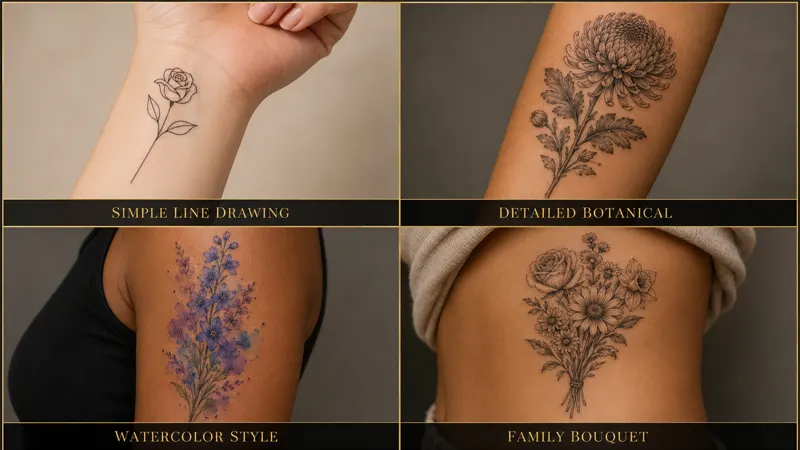
Popular design approaches include:
- Simple line drawings — Minimalist single-line botanical illustrations, often placed on the wrist, behind the ear, or along the spine.
- Detailed botanical illustrations — Vintage-style detailed flower drawings with shading, often in black ink, mimicking Victorian flower dictionary plates.
- Watercolor style — Soft, painterly tattoos with color washes that bleed beyond the flower outlines.
- Family bouquets — Combining multiple birth flowers representing children, parents, or partners into a single arrangement.
- Birth flowers with names or dates — Adding a child's name or birth date alongside their birth flower.
- Birth flower + birthstone color — Incorporating the birthstone color into the flower design.
- Geometric frames — Birth flowers contained within geometric shapes for modern aesthetic.
Birth Flower Gift Ideas
Birth flowers make incredibly thoughtful, personalized gifts. Here are popular ways to gift them:
For Birthdays
- Birth flower bouquet — A bouquet of just the primary birth flower for the recipient's month.
- Birth month necklace — Delicate jewelry featuring the birth flower pendant.
- Custom flower print — Botanical illustration of the recipient's birth flower, framed.
- Birth flower seeds — For gardeners who want to grow their own.
- Pressed flower art — Real pressed flowers preserved in glass frames.
For New Babies
- Family birth flower print — Combining mother's, father's, and baby's birth flowers.
- Birth flower nursery decor — Wall art featuring the baby's birth month bloom.
- Birth flower keepsake jewelry — For mom to wear, representing her child.
For Weddings & Anniversaries
- Bridal bouquet incorporating birth flowers — Bride's and groom's birth flowers combined.
- Wedding favor seed packets — Birth flower seeds for guests to plant.
- Anniversary birth flower portraits — Custom art combining couple's birth flowers.
For Funerals & Memorials
- Memorial bouquet — Loved one's birth flower as a final tribute.
- Garden planting — Planting the deceased's birth flower in their memory.
- Memorial jewelry — Birth flower pendants to keep them close.
Couples & Family Birth Flower Combinations
Combining birth flowers from multiple family members creates deeply personal arrangements. Here are popular approaches:
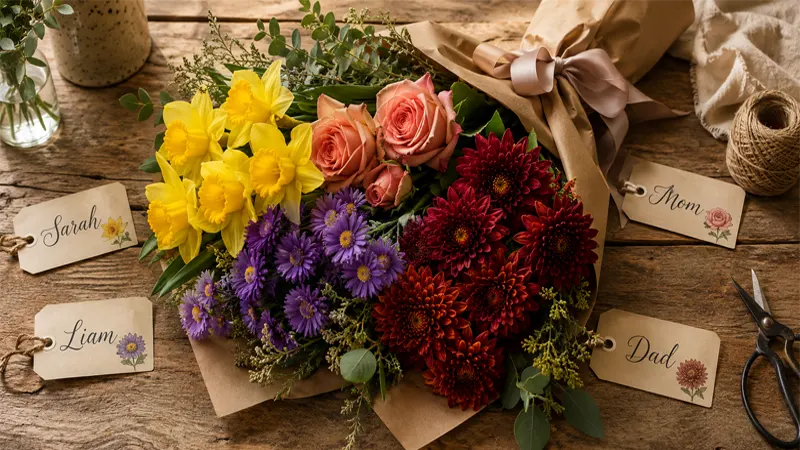
- Couple's combined bouquet — Two birth flowers symbolizing partners (e.g., rose + larkspur for June+July couple).
- Family garden bed — Plant each family member's birth flower together. Asters for September baby, daffodils for March mom, roses for June dad.
- Mother's Day arrangements — Bouquet combining mother's birth flower with each child's birth flower.
- Generational portraits — Botanical art showing grandparent's, parent's, and child's birth flowers in lineage.
- Wedding day combinations — Bride's flowers + groom's flowers + parents' flowers for ceremonial bouquets.
- Anniversary milestone arrangements — Couple's flowers + their kids' flowers for milestone anniversaries.
Cross-Cultural Birth Flower Traditions
Birth flower traditions exist around the world, with some overlap and some unique regional variations:
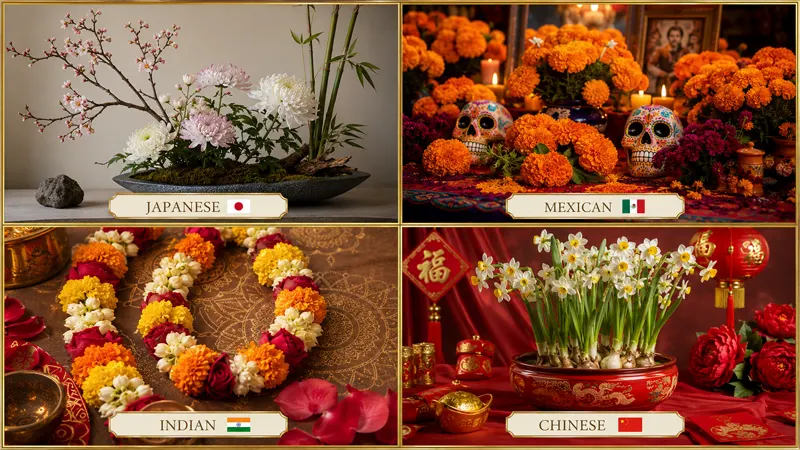
- Western (American & British): The list covered in this guide — Victorian floriography codified.
- Korean (Hanakotoba calendar): A 365-day flower calendar assigning a unique flower to each day of the year, not just each month.
- Japanese: Chrysanthemum holds imperial significance; sakura (cherry blossom) represents the entire spring season. Japan has its own hanakotoba (language of flowers) similar to Victorian floriography.
- Chinese: The narcissus is particularly important during Lunar New Year. Peonies symbolize prosperity. Different lunar months align with different flowers.
- Indian: Different cultural traditions emphasize regional flowers — marigolds (especially for October and Hindu festivals), jasmine, and lotus.
- Mexican: Marigolds (cempasúchil) hold central significance for Día de los Muertos in November, beyond just October's Western birth flower.
If you have heritage in multiple cultures, you can choose to embrace both traditions — Western birth flowers for one set of meanings, regional flowers for another.
How to Choose & Use Your Birth Flower
Once you know your birth flower(s), here are ways to make them part of your life:
- Wear it. Birth flower jewelry, scarves, tattoos, or even subtle floral patterns on clothing.
- Grow it. Plant your birth flower in your garden, balcony, or as houseplants. Some flowers (carnations, daisies) are easy beginners; others (lily of the valley, hawthorn) need specific conditions.
- Display it. Botanical prints, pressed flower art, photography of your birth flower as home decor.
- Gift it. When friends ask what you want for your birthday, mention your birth flower for thoughtful, personal gifts.
- Learn its history. Each flower carries thousands of years of cultural significance. Deepening your understanding makes the connection more meaningful.
- Combine with birthstone. Pair your birth flower with your birthstone for cohesive personal symbolism.
- Use it in life events. Wedding bouquets, baby announcements, anniversary gifts — any milestone benefits from your birth flower's symbolism.
Birth Flowers — Frequently Asked Questions
What is my birth flower?
Your birth flower depends on the month you were born. January is the carnation, February the violet, March the daffodil, April the daisy, May the lily of the valley, June the rose, July the larkspur, August the gladiolus, September the aster, October the marigold, November the chrysanthemum, and December the narcissus. Most months also have a secondary flower — see the chart above for both options.
How did birth flowers begin as a tradition?
The tradition began in ancient Rome over 2,000 years ago, when people gave flowers as birthday gifts and associated specific blooms with seasonal festivals. It was formalized during the Victorian era (1800s) through "floriography" — the language of flowers — when Victorian writers like Robert Tyas (1836) and Frederic Shoberl (1834) published flower dictionaries codifying month-by-month assignments. Early 20th-century American florists settled the popular pairings into the list used today.
Why do some months have two birth flowers?
Unlike birthstones (standardized in 1912), birth flowers were never officially fixed by any single authority. Different traditions — Victorian floriography, older European folk calendars, Christian liturgical traditions, and early 20th-century florist marketing — assigned different flowers to the same months. Regional availability also mattered. Over time, the most popular pairings settled into primary and secondary designations for each month.
Are birth flowers the same in every country?
No. The list in this guide is the most widely used in the United States and United Kingdom. Japan has its own detailed birth flower calendar (hanakotoba). Korea maintains a parallel 365-day daily flower system. Several European countries swap individual months. Chinese tradition emphasizes lunar calendar flowers. If you see a different flower listed for your month elsewhere, it's usually a regional variation rather than an error.
What's the difference between a birth flower and a birthstone?
Both are symbols assigned to your birth month. Birthstones are gemstones (standardized by the American jewelry industry in 1912). Birth flowers are blooms (rooted in Roman tradition and Victorian floriography, never officially standardized). Birthstones are typically more rigid; birth flowers tend to be more flexible with primary and secondary options. They make natural pairings: pearl + rose for June, ruby + larkspur for July, sapphire + aster for September.
Can I have a birth flower tattoo?
Yes — birth flower tattoos are extremely popular in 2026. Pinterest searches for "birth flower tattoo" have grown substantially. Common designs include simple line drawings (minimalist), detailed botanical illustrations (vintage Victorian style), watercolor styles, family bouquets combining multiple birth flowers, and birth flowers paired with names or birthdays. Birth flowers carry symbolism without requiring you to commit to specific words that might feel awkward later.
What's the most popular birth flower?
The rose (June's birth flower) is the most universally recognized and culturally significant flower in Western tradition, spanning Persian poetry, Greek mythology, Christian symbolism, and Tudor English iconography. The lily of the valley (May) is famous for royal weddings. The marigold (October) holds significant cultural importance in both Mexican Día de los Muertos and Indian Hindu traditions. The chrysanthemum (November) is imperial in Japan.
Can I grow my birth flower at home?
Yes — most birth flowers can be grown in home gardens with appropriate climate matching. Easy beginners: daisies (April), marigolds (October), sweet peas (April secondary). Moderate: carnations (January), daffodils (March), gladiolus (August), asters (September), chrysanthemums (November). More demanding: lily of the valley (May, needs shade), hawthorn (May secondary, needs space), larkspur (July, cool climates). Match the flower to your climate zone for best results.
What birth flowers are best for weddings?
Roses (June) are the most popular wedding flowers regardless of bride's birth month. Other wedding favorites: lily of the valley (May — featured in royal weddings), peony (November secondary), sweet peas (April secondary), and daisies (April). Brides often incorporate their own birth flower into bouquets even if they don't marry in their birth month. Some couples combine both partners' birth flowers as a meaningful touch.
How do I use birth flowers as gifts?
Many ways: bouquets of just the birth flower, birth flower jewelry (necklaces, rings, bracelets), pressed flower art frames, botanical illustration prints, birth flower seeds for gardeners, custom birth flower portraits combining multiple family members, embroidered scarves or handkerchiefs, candles or perfumes with birth flower fragrances, and birth flower greeting cards. The recipient's connection to the symbolism makes any of these deeply personal.
Do birth flowers have personality meanings?
Yes, traditionally each birth flower's symbolism extends to people born in that month. January (carnation) babies are seen as loyal and ambitious; February (violet) as faithful and wise; March (daffodil) as optimistic and creative; April (daisy) as innocent and joyful; May (lily of valley) as nurturing; June (rose) as romantic and passionate; July (larkspur) as warm-hearted; August (gladiolus) as strong; September (aster) as wise; October (marigold) as creative; November (chrysanthemum) as joyful; December (narcissus) as hopeful. These are traditional associations rather than scientific assessments.
Where can I learn more about my specific birth flower?
This guide provides links to detailed articles for each month's birth flower (see the "Read full guide" buttons throughout). Each month-specific guide covers the flower's full symbolism, growing requirements, color meanings, tattoo design ideas, gift suggestions, and historical/mythological background. Click any month above for the comprehensive deep dive into that birth flower.
Birth flower traditions vary by source and region. This guide reflects the most widely accepted Western birth flower assignments rooted in Victorian floriography. Some sources may list alternative flowers for individual months — these are regional variations rather than errors. The deeper symbolism described represents traditional meanings; modern interpretation is flexible and personal.
