


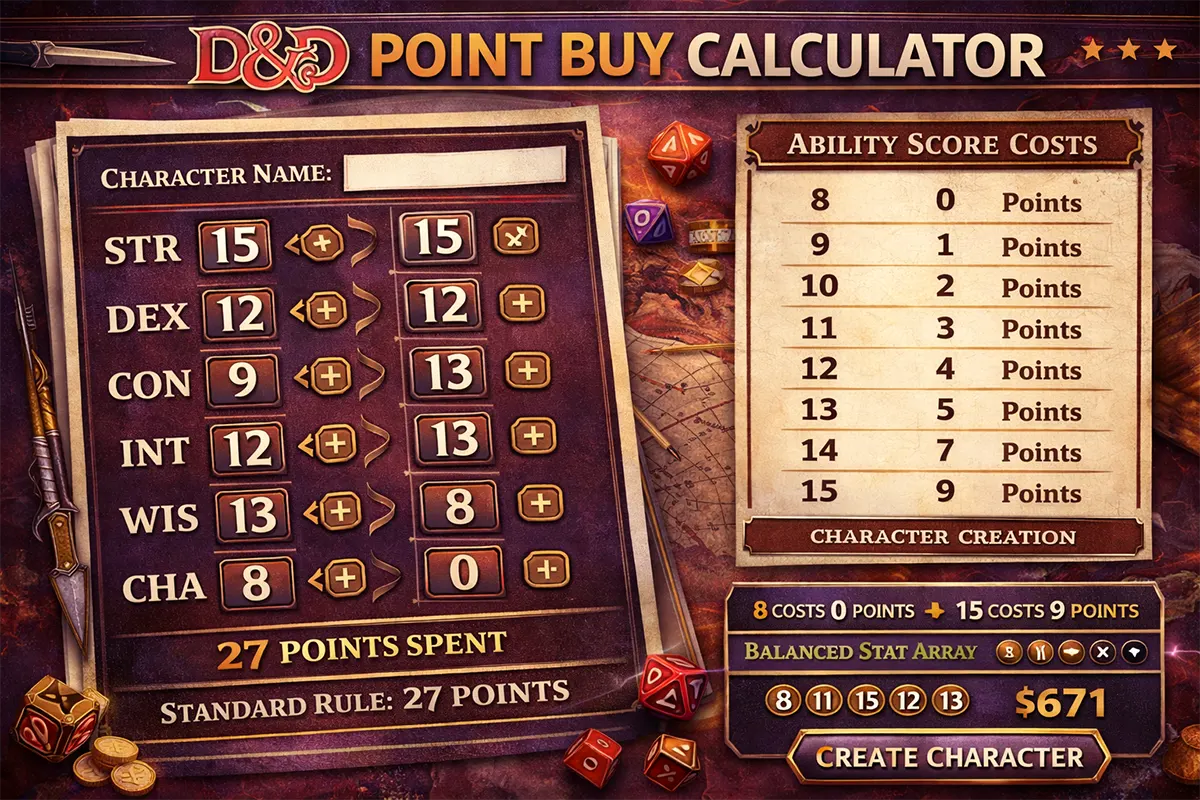
Create balanced, optimized ability scores for your next Dungeons & Dragons character. Whether you’re a first-time player rolling up a fighter in a Dubai gaming café or a veteran Dungeon Master preparing a one-shot, this point buy calculator removes the guesswork and lets you focus on what matters — telling a great story.
Table of Contents
ToggleWhat Is the Point Buy Calculator?
The point buy system is an official method for generating ability scores in D&D 5th Edition. Instead of rolling dice — which can produce wildly uneven characters — every player receives 27 points to spend across six ability scores: Strength, Dexterity, Constitution, Intelligence, Wisdom, and Charisma.
Our point buy calculator automates the entire process so you can experiment freely:
- Instant math — see remaining points and ability modifiers update in real time.
- Race & subrace bonuses — apply official racial ability score increases with one click.
- Rule enforcement — the tool prevents illegal scores (below 8 or above 15 before racial bonuses).
- Shareable results — copy your final stat block to paste into a character sheet or VTT.
The formulas follow the Player’s Handbook cost table exactly, so your stat line will be accepted at any table — from a casual session among friends in Abu Dhabi to an Adventurers League event at a convention.
⚔️ Point Buy Calculator
D&D 5e & 2024 — Assign ability scores with precision
How the Point Buy System Works
The Cost Table
Every ability score starts at 8 (which costs 0 points). Raising a score costs an increasing number of points as the value climbs:
| Ability Score | Point Cost (Cumulative) |
|---|---|
| 8 | 0 |
| 9 | 1 |
| 10 | 2 |
| 11 | 3 |
| 12 | 4 |
| 13 | 5 |
| 14 | 7 |
| 15 | 9 |
Step-by-Step Process
Start with all six scores at 8 and a budget of 27 points. Choose which scores to raise. Each increment from 8 → 13 costs 1 point per step. Moving from 13 → 14 costs 2 points, and 14 → 15 costs another 2 points. No base score can exceed 15 or drop below 8.
After spending all (or some) of your 27 points, apply any racial ability score increases. A Half-Elf, for example, gains +2 Charisma and +1 to two other abilities of the player’s choice — these bonuses can push a score above 15.
Important Caveats
Point buy produces characters that are strong but never extreme. The maximum starting modifier (before racial bonuses) is +2. This keeps the party balanced and prevents one player from overshadowing others. If your group prefers higher-powered games, some DMs allow a 30- or 32-point budget — our calculator supports custom budgets too.
Point Buy Examples for Popular Builds
Example 1: The Classic Human Fighter
Scenario: Amir is creating a Human Fighter for a weekend game. He wants high Strength and Constitution with decent Wisdom for saving throws.
| Ability | Base Score | Cost | Racial Bonus (+1 Human) | Final Score | Modifier |
|---|---|---|---|---|---|
| Strength | 15 | 9 | +1 | 16 | +3 |
| Dexterity | 10 | 2 | +1 | 11 | +0 |
| Constitution | 15 | 9 | +1 | 16 | +3 |
| Intelligence | 8 | 0 | +1 | 9 | −1 |
| Wisdom | 13 | 5 | +1 | 14 | +2 |
| Charisma | 10 | 2 | +1 | 11 | +0 |
Total points spent: 27/27. Amir’s fighter hits hard (STR 16) and can take punishment (CON 16), with a solid Wisdom save to resist spells.
Example 2: The Half-Elf Warlock
Scenario: Fatima wants a Charisma-focused Warlock with enough Constitution to survive the front lines when using Hexblade features.
| Ability | Base Score | Cost | Racial Bonus | Final Score | Modifier |
|---|---|---|---|---|---|
| Strength | 8 | 0 | — | 8 | −1 |
| Dexterity | 14 | 7 | — | 14 | +2 |
| Constitution | 14 | 7 | +1 | 15 | +2 |
| Intelligence | 8 | 0 | — | 8 | −1 |
| Wisdom | 10 | 2 | — | 10 | +0 |
| Charisma | 15 | 9 | +2 | 17 | +3 |
Total points spent: 25/27 (2 unspent). Fatima could raise Wisdom to 12 for +1 more point spend, but she prefers to keep things lean. CHA 17 will become 18 at level 4 with a half-feat like Fey Touched.
Example 3: The MAD Paladin (Multiple Ability Dependent)
Scenario: Omar is tackling the classic Paladin challenge — needing Strength, Charisma, and Constitution all at respectable levels.
| Ability | Base Score | Cost | Racial Bonus (Half-Elf) | Final Score | Modifier |
|---|---|---|---|---|---|
| Strength | 15 | 9 | +1 | 16 | +3 |
| Dexterity | 8 | 0 | — | 8 | −1 |
| Constitution | 13 | 5 | +1 | 14 | +2 |
| Intelligence | 8 | 0 | — | 8 | −1 |
| Wisdom | 10 | 2 | — | 10 | +0 |
| Charisma | 15 | 9 | +2 | 17 | +3 |
Total points spent: 25/27. By picking Half-Elf, Omar squeezes three strong scores out of a tight budget. He dumps Dexterity and Intelligence — heavy armor covers the first, and Paladins rarely need the second. The remaining 2 points could push Wisdom to 12 for better saves.
Tips, Rules & Common Mistakes
Official Rules Recap
The point buy system is described on page 13 of the Player’s Handbook (5th Edition) under “Variant: Customizing Ability Scores.” It’s the default method for Adventurers League play, so if you plan to join organized events — like those hosted at gaming shops across Dubai and Sharjah — you’ll need to use it or the standard array.
Common Mistakes to Avoid
- Forgetting the escalating cost. Moving from 13 to 14 costs 2 points, not 1. Many new players overshoot their budget because of this jump.
- Applying racial bonuses before buying. Racial increases are added after you spend your 27 points. They don’t count against the 15-cap.
- Ignoring odd scores. A score of 13 and 14 both give a +2 modifier. The only reason to buy 14 over 13 is if a racial bonus will push it to 15 (+2) or if a feat requires an even score.
- Dumping too many stats. Leaving three scores at 8 saves points but creates a character who fails most non-combat challenges. Balance is key.
Pro Tips
Target odd base scores (13 or 15) for abilities that receive a +1 racial bonus — this way you land on an even final number and gain the next modifier bracket. Also, consider your class’s saving throw proficiencies when deciding where to place mid-range scores. A fighter proficient in Strength and Constitution saves can afford a lower Wisdom, while a Cleric might prioritize it.
Frequently Asked Questions
What is a point buy calculator used for?
A point buy calculator helps you assign ability scores to a D&D 5e character using the official 27-point budget. It tracks costs, remaining points, and modifiers so you don’t have to do the math manually.
Is point buy better than rolling for stats?
Neither is objectively better — it depends on your table’s preferences. Point buy guarantees balanced characters where no player is dramatically stronger or weaker. Rolling introduces randomness that some groups enjoy for the excitement and variety it brings.
Can I go above 15 with point buy?
Not with points alone. The maximum base score is 15. However, racial ability score increases can push a score to 16 or 17. For example, a Mountain Dwarf gains +2 Strength and +2 Constitution, potentially starting with two scores at 17.
Does this calculator work for D&D 2024 (5.5e)?
The 2024 revised Player’s Handbook keeps the same point buy cost table and 27-point budget. Our calculator is fully compatible. The main difference in 2024 rules is how racial bonuses are handled — you may assign +2/+1 or +1/+1/+1 to any abilities regardless of species.
What is the standard array, and how does it compare?
The standard array is 15, 14, 13, 12, 10, 8 — a preset allocation that also costs exactly 27 points. Point buy gives you more flexibility to customize, like pushing two scores to 15 if you’re willing to accept lower values elsewhere.
Can my DM change the point budget?
Absolutely. Many Dungeon Masters use a 30- or 32-point budget for higher-powered campaigns. Our calculator lets you adjust the total budget to match your table’s house rules.
How do I use this calculator on my phone?
The calculator is fully responsive. Open it in any mobile browser, tap the + and − buttons to adjust each ability score, and the remaining points and modifiers update instantly. You can screenshot or copy the result for your character sheet.
Is this calculator free to use?
Yes. There are no sign-ups, paywalls, or hidden fees. Use it as many times as you like for every character you create.
Start Building Your Character Now
Scroll up, set your race, and start spending points. In under a minute you’ll have a fully optimized ability score spread ready for your next campaign. If you want to verify the rules yourself, check the official D&D Systems Reference Document (SRD) published by Wizards of the Coast — it includes the complete point buy table at no cost.
Have questions about your build? Gaming communities on Reddit’s r/3d6 and the D&D Beyond forums are great places to get feedback from experienced players and DMs.
Related Calculators You Might Find Useful
- Uni Grade Calculator — calculate your university GPA and track academic progress.
- Fractions Calculator — simplify, add, subtract, multiply, and divide fractions instantly.
- Chess Calculator — estimate your chess rating and track performance across games.
- Sig Fig Calculator — round numbers to the correct significant figures for science and math work.
- ACFT Calculator — score your Army Combat Fitness Test events accurately.