


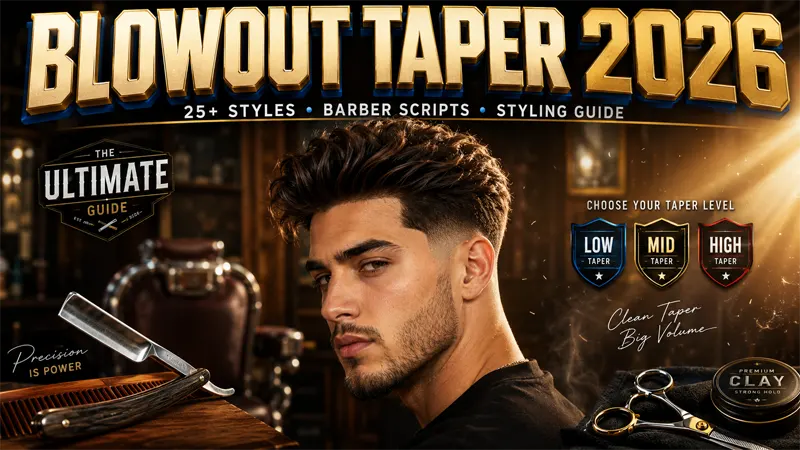

Quick answer: A blowout taper is a men's haircut that combines a clean tapered fade on the sides and neckline with a lifted, voluminous top styled upward and back with a blow-dryer. It works on straight, wavy, curly, and coily hair, suits most face shapes, and stays sharp for 2–4 weeks before needing a touch-up. The three main variations are low (fade starts near the ears), mid (fade starts around the temples), and high (fade starts above the temples). The mid blowout taper is the safest first-timer choice — it's bold enough to look fresh but balanced enough to suit almost everyone.
What Is a Blowout Taper Haircut?
The blowout taper is the most-requested men's haircut of 2026, and there's a real reason it's everywhere right now. It combines two techniques into one cut: a taper fade on the sides and neckline (where the hair gradually shortens toward the skin), and a blowout on top (where the hair is blow-dried upward and slightly back for maximum volume and movement).

The result is a haircut that looks intentional without looking overdone. The sides stay clean and sharp for weeks. The top has body and shape that you can style in five minutes. And unlike a skin fade or a buzz cut, the blowout taper grows out gracefully — even at the three-week mark, you still look like you got it cut yesterday.
This style works because it adapts to whatever hair you have. Straight hair gets lift and texture. Wavy hair gets controlled bounce. Curly and coily hair get definition without losing the natural pattern. If you've ever asked a barber for a haircut that "looks good every day," this is what they would suggest.
The Three Main Blowout Taper Variations
Before picking a specific style, you need to choose where the fade starts on your head. This single decision changes how dramatic the cut looks and who it suits. Here are the three options:
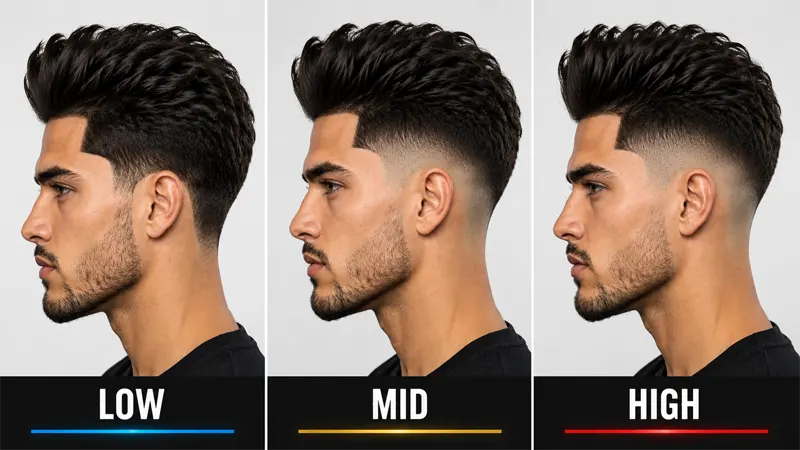
🔵 Low Blowout Taper
The fade starts just above the ears and around the neckline. Subtle and office-friendly. Doesn't show much skin even when freshly cut.
🟡 Mid Blowout Taper
The fade starts around the temples — the sweet spot. Clearly looks fresh and styled without being aggressive. Works on almost every face shape.
🔴 High Blowout Taper
The fade starts above the temples for maximum contrast. Bold, attention-grabbing, and shows the most scalp. Needs more frequent touch-ups (2 weeks).
Exact Barber Scripts (Copy & Paste)
Most blowout taper failures happen at the barber chair because guys don't communicate clearly. "Just give me a blowout taper" gets you whatever your barber thinks that means — which might be totally different from what you want. Use one of these scripts instead.
For a Low Blowout Taper
"I want a low blowout taper. Keep the fade subtle — start it just above my ears and clean up around the neckline. Leave plenty of length on top, about 3–4 inches, so I can blow-dry it upward for volume."
For a Mid Blowout Taper
"Mid blowout taper, please. Start the fade around my temples and keep the transition smooth — no harsh lines. Leave the top long enough to style upward and slightly back, around 3 inches. Add a clean lineup if my hairline can handle it."
For a High Blowout Taper
"High blowout taper. Take the fade above my temples but keep it tapered — not skin. I want clear contrast between the sides and the top. Keep at least 3 inches of length up top for the blowout. Match it with a sharp lineup."
Blowout Taper by Hair Type
The same cut behaves completely differently depending on your hair texture. Here's what to expect and what to ask for based on your hair type.
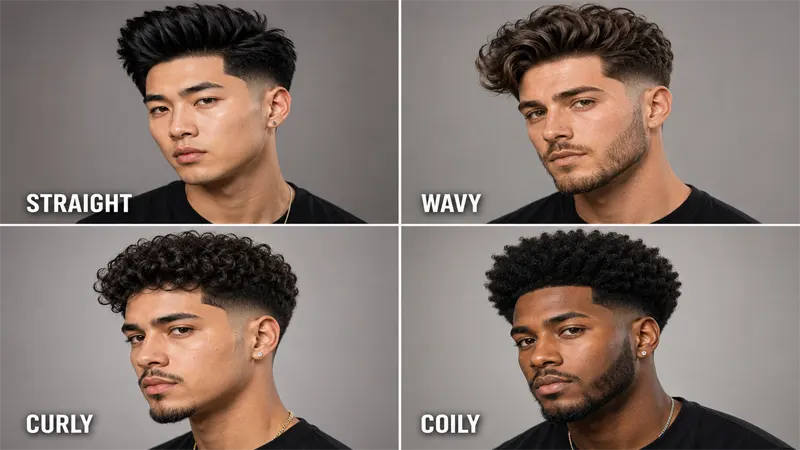
Straight Hair
Straight hair is the trickiest because it lacks natural body — without proper styling, your blowout taper falls flat by midday. Ask for slightly longer length on top (3.5–4 inches) and add light layers to give the top movement. The blow-drying technique matters more than the cut itself.
Product to use: Volumizing mousse before drying + matte clay after. Avoid pomades and gels — they weigh straight hair down. Some men with very straight hair even get a light Korean perm to make the blowout taper hold all day.
Wavy Hair
Wavy hair is the easiest to work with. The natural movement plays perfectly with the blowout shape. You don't need much length — 2.5–3 inches is enough. Air-drying with a small amount of sea salt spray often works as well as a full blow-dry.
Product to use: Sea salt spray + light texture paste. Use a diffuser if you blow-dry to enhance the natural pattern.
Curly Hair
Curly blowout tapers are stunning — the contrast between defined curls on top and clean tapered sides creates massive visual impact. Ask your barber to "shape, don't shorten" the curls on top. Keep at least 3.5 inches of length so the curls have weight to form properly.
Product to use: Curl cream applied to damp hair + light hold gel for definition. Diffuse-dry to preserve the curl pattern.
Coily / Afro-Textured Hair
For coily hair, the blowout becomes a true afro-shaped crown. The taper creates clean definition where the hair meets the skin. Ask for the taper to follow your natural hairline closely. You may want to pair this with traditional styling techniques used in African hair braiding for off-cut days when you want a different look.
Product to use: Leave-in conditioner + curl sponge for shape + light oil for shine. Use a pick to lift the roots before shaping.
Trending Blowout Taper Sub-Styles for 2026
Once you've chosen low/mid/high, you can layer on a sub-style for personality. These are the variations dominating 2026:
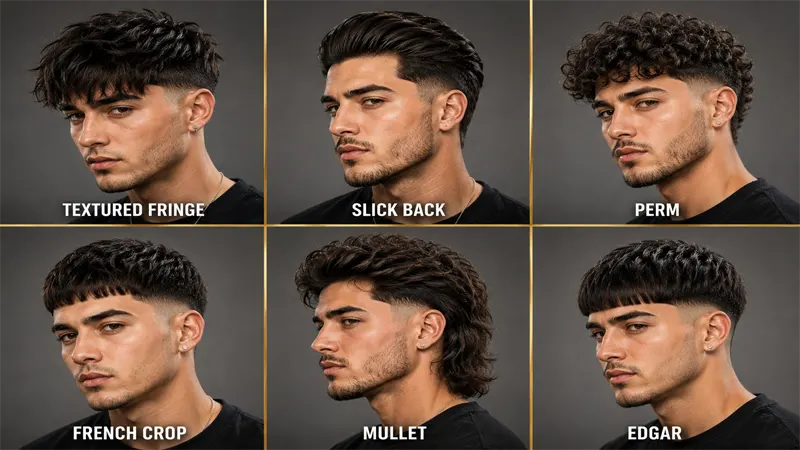
1. Blowout Taper with Textured Fringe
The top falls forward as a textured fringe. Most popular variation in 2026 — looks fresh from every angle.
2. Blowout Taper Mullet
Combines the blowout volume on top with longer length at the back. See our modern mullet fade guide for the full breakdown.
3. Blowout Taper Slick Back
The volume on top sweeps straight backward instead of upward. Office-friendly, polished, business-appropriate.
4. Blowout Taper Perm
Get a soft perm on top for curls that hold the blowout shape all day. Massive trend among younger men in 2026.
5. Blowout Taper French Crop
Shorter top with a forward-styled fringe. Great for receding hairlines and lower-maintenance routines.
6. Blowout Taper Edgar
Bowl-cut influence with blunt bangs and faded sides. Strongly associated with Latino "takuache" style in 2026.
7. Blowout Taper Curly Afro
Full rounded afro on top meeting a sharp taper. Maximum volume, maximum statement.
8. Blowout Taper with Highlights
Add color to make the volume pop. See our dark brown hair with highlights guide for color options that work.
9. Blowout Taper Wolf Cut
Layered top with the wolf-cut shaggy texture meeting clean taper sides. Edgier 2026 evolution.
10. Blowout Taper Messy Fringe
Deliberately tousled top with a fringe pushed forward at varying angles. Effortless, lived-in vibe.
How to Style a Blowout Taper at Home (7 Minutes)
The cut is only half the equation — without styling, a blowout taper is just a long top with tapered sides. Here's the routine that takes under 7 minutes once you've practiced a few times:
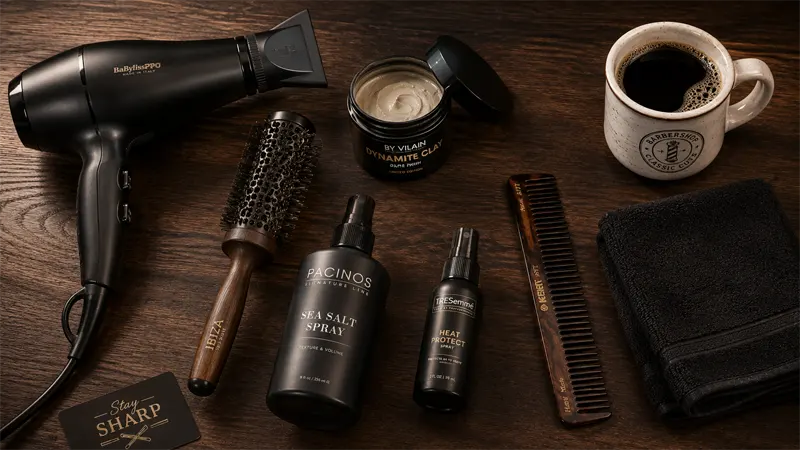
- Start with damp hair. Not soaking wet (takes too long to dry and falls flat), not dry (won't shape). Towel-dry until your hair stops dripping but still feels cool to the touch.
- Apply your base product. Volumizing mousse for straight hair, sea salt spray for wavy, curl cream for curly/coily. Work it through the top with your fingers — don't touch the tapered sides.
- Blow-dry upward, not downward. Point the nozzle from underneath your hair, push the hair upward and slightly back with your fingers or a round brush. This is what creates the "blown out" volume.
- Set the shape with cool air. Switch the dryer to cool for the last 30 seconds. Cool air locks in volume that warm air created.
- Apply your finishing product. Matte clay or texture paste for hold without shine. Rub a small amount (pea-sized) between your palms and press it into the top — don't comb it through, that flattens everything.
- Shape with your fingers, not a comb. Push hair upward and slightly back. If you want a fringe, pull a small section forward and down.
- Set with a light hairspray (optional). Only if you live in a humid climate or you'll be sweating. Hold the can 12 inches away and spray lightly.
What a Blowout Taper Looks Like Week-by-Week
Knowing how the cut grows out helps you plan touch-ups. Here's the realistic timeline most men experience:
10 Common Blowout Taper Mistakes (And How to Avoid Them)
These are the mistakes I see most often when guys try to pull off this cut. Each one is fixable.
❌ Asking for "a blowout taper" with no specifics
Fix: Specify low/mid/high, mention your hair type, bring photos. Use the scripts above.
❌ Choosing high taper when you have a round face
Fix: Round faces look wider with high tapers. Stick to low or mid for vertical balance.
❌ Cutting the top too short for a real blowout
Fix: You need a minimum of 3 inches on top. Anything shorter can't be blown up properly.
❌ Blow-drying hair that's already dry
Fix: Style only on damp hair. If hair is dry, spritz it lightly and start over.
❌ Using shiny pomades or gels
Fix: The blowout taper is a matte, textured look. Use matte clay or texture paste, never high-shine products.
❌ Skipping the cool-air step
Fix: 30 seconds of cool air locks in the shape. Skip this and your volume collapses by midday.
❌ Using a comb to shape the top
Fix: Combs flatten texture. Always shape with your fingers for that lived-in look.
❌ Going to a new barber without reference photos
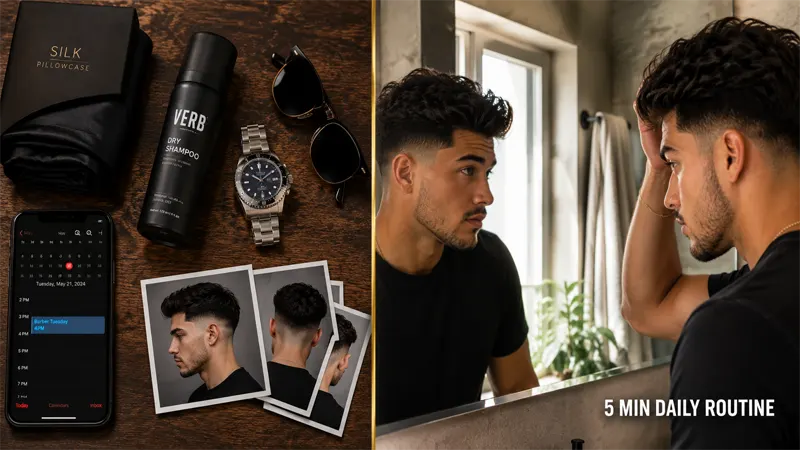
Fix: Always bring 2–3 photos showing front, side, and back. Words alone leave too much interpretation.
❌ Letting it grow past 5 weeks
Fix: The blowout taper looks worst between weeks 5–7 because the taper grows out unevenly. Book touch-ups every 3–4 weeks.
❌ Forgetting the lineup
Fix: A clean line up haircut doubles the impact of any blowout taper. Always ask your barber to include one.
Blowout Taper vs Other Popular Men's Haircuts
Not sure if the blowout taper is right for you? Here's how it compares to similar 2026 men's haircuts:
| Haircut | Sides | Top | Maintenance | Best For |
|---|---|---|---|---|
| Blowout Taper | Tapered fade | Long, blown upward | 3–4 weeks | Most men, versatile |
| Regular Taper Fade | Tapered fade | Medium, styled flat | 3 weeks | Conservative looks |
| Skin Fade | Shaved to skin | Varies | 1–2 weeks | Bold contrast lovers |
| Textured Crop | Faded | Short, textured forward | 3–4 weeks | Low-maintenance guys |
| Mid Taper Fade | Tapered at temples | Any length | 3 weeks | Office-friendly versatility |
| Modern Mullet Fade | Faded | Long back, shorter front | 4 weeks | Trend-forward statement |
| Viking Haircut | Shaved/braided | Long top, often braided | 6+ weeks | Bold alternative look |
Blowout Taper by Face Shape
Not every variation works for every face. Match your face shape to the right blowout taper:
- Oval face: Lucky — any variation works. Mid blowout taper is a safe default; high if you want bold.
- Round face: Add vertical height with extra top volume. Low or mid taper only. High taper makes a round face look wider.
- Square face: Soften angles with wavy or curly texture on top. Mid blowout taper works best. Skip the high — too much contrast.
- Long face: Avoid too much height on top. Go low blowout taper with the volume styled more outward than up.
- Heart-shaped face: Add width at the jaw level. A textured fringe blowout taper balances the wider forehead.
- Diamond face: Mid blowout taper with a slight fringe to soften the pointed chin and cheekbones.
How Much Does a Blowout Taper Cost?
Costs vary heavily by location and barbershop level, but here's the realistic 2026 range in major US cities:
| Barbershop Tier | Cost Range | What You Get |
|---|---|---|
| Chain (Great Clips, Supercuts) | $20–35 | Basic execution. Quality varies by stylist. Bring photos. |
| Local neighborhood barber | $25–45 | Better skill. Usually familiar with the trend. Best value. |
| Specialty men's barbershop | $45–80 | Highest skill level. Lineup and beard work included. Worth it for first cut. |
| High-end salon | $70–150+ | Premium experience. Hair products included. Worth it only for special occasions. |
Tip: $5–10 cash tip is standard for barbers. For your first blowout taper, go to a specialty men's barbershop — the extra $20 buys execution quality that's hard to fix at a chain.
Pro Tips That Make a Real Difference
- Modern Mullet Fade Guide 2026 — the boldest evolution of the blowout taper
- Line Up Haircut Guide — the sharp edge that completes any taper
- Korean Perm for Men — pair with your blowout taper for all-day hold
- Viking Haircut Guide — a bold alternative if you want to grow it out
- Dark Brown Hair with Highlights — color options that pop with volume
- How to Manage a Cowlick — fix the #1 issue that wrecks blowout tapers
Blowout Taper Haircut — Frequently Asked Questions
What is the difference between a blowout taper and a regular taper?
A regular taper just refers to the gradually shortening hair on the sides and neckline. A blowout taper adds the styling element on top — the hair is blown upward and back with a dryer for volume and movement. Same haircut on the sides, completely different styling on top. The blowout taper is essentially a taper fade plus a specific styling technique.
How long does my hair need to be on top for a blowout taper?
Minimum 3 inches. Below that, there's not enough length to blow upward and hold volume. Ideal length is 3–4 inches for most hair types, and 4–5 inches if you want a longer textured fringe or messy top. If your hair is currently shorter than 3 inches, grow it out for 4–6 weeks before getting the cut.
How often do I need to get a blowout taper trimmed?
Every 3–4 weeks for a full cut. The high blowout taper needs touch-ups closer to every 2 weeks because the sharp contrast softens fastest. You can also book a $10–15 lineup-only visit at Week 2 to extend the freshness of your main cut.
Does a blowout taper work on thin or thinning hair?
Yes — and it's actually one of the best cuts for thinning hair. The blowout creates the illusion of more volume, while the taper draws the eye away from any thin patches on the sides. Ask your barber for a low or mid taper (not high — that exposes too much scalp) and use a thickening mousse before blow-drying.
Can I get a blowout taper if I have a cowlick?
Yes, but mention it to your barber upfront. Cowlicks affect how the top will lay after blow-drying. A good barber will cut around your cowlick and may suggest styling the top to use the cowlick rather than fight it. For deeper guidance, check our cowlick hair management guide.
What products do I need to style a blowout taper?
Three products total: a pre-styling product matched to your hair type (volumizing mousse for straight, sea salt spray for wavy, curl cream for curly), a blow-dryer with a nozzle attachment, and a finishing product (matte clay or texture paste). Total cost: about $30–50 for products that last 4–6 months.
Is the blowout taper hard to maintain?
Easier than most modern men's cuts once you've practiced the styling technique a few times. Daily routine is 5–7 minutes after your first week. The main maintenance commitment is the 3–4 week visit to your barber — without that, the cut loses its shape fast.
Does a blowout taper look good on older men?
Absolutely — though the style choice matters. Older men should skip the high taper and the Edgar/Takuache variations (these read youthful). The slick-back blowout taper, the low blowout taper, and the textured fringe blowout taper all work beautifully on men in their 40s, 50s, and beyond. The cut adds visual youthfulness without looking like you're chasing trends.
Can I get a blowout taper without a beard?
Yes — the cut works clean-shaven too. With no beard, ask your barber to include a sharper lineup since there's no facial hair to frame your jaw. Beards do enhance the look by adding contrast to the tapered sides, but they're optional.
Will my blowout taper look the same in humid weather?
Humidity is the enemy of any blowout. To extend hold in humid climates: finish with a light hairspray, use a sea salt spray pre-style for grip, and consider a soft perm if you live somewhere consistently humid. The blowout will lose some height by afternoon — that's normal. The taper sides hold up perfectly regardless of weather.
This guide is based on current 2026 men's grooming trends and barbering practices. Specific results depend on your barber's skill, your hair type, and styling consistency. Always communicate clearly with your barber and bring reference photos for best results.
